

When you place a Buddha statue in your home, you may wonder whether the direction it faces actually matters. The question of why Buddha statues face directions is one that touches on ancient Buddhist tradition, sacred architecture, and living cultural practices like Vastu Shastra and Feng Shui. The answer is more layered than a single compass point. Direction carries spiritual weight in Buddhism, and understanding that weight helps you place your statue with genuine intention rather than guesswork. This guide untangles the history, the symbolism, and the practical wisdom so you can feel confident in every choice you make.
Key takeaways
| Point | Details |
|---|---|
| East-facing has deep roots | East-facing statues connect directly to Shakyamuni Buddha’s enlightenment at Bodh Gaya, especially for Bhumisparsha Mudra poses. |
| Mudra determines direction | The correct orientation depends on the statue’s pose and symbolic function, not a single universal rule. |
| Cultural traditions add nuance | Vastu Shastra and Feng Shui offer placement advice that complements but differs from core Buddhist convention. |
| Entrance-facing is widely respected | Positioning your statue to face the main entrance is broadly endorsed across Buddhist and home-placement traditions. |
| Elevation signals respect | Placing a statue at or above eye level, away from low-energy spaces, honours the figure and supports positive atmosphere. |
Why Buddha statues face directions: the spiritual origins
The practice of orienting Buddha statues is not decorative habit. It is rooted in one of the most significant moments in Buddhist history. Shakyamuni Buddha, the historical Buddha, is said to have attained enlightenment at Bodh Gaya while seated beneath the Bodhi tree and facing east, towards the rising sun. That eastward gaze is understood as a turning towards awakening, and it became the directional foundation for Buddha statue orientation across many traditions.
This is most clearly expressed through the Bhumisparsha Mudra, a gesture where the Buddha’s right hand reaches down to touch the earth, calling the ground as witness to his enlightenment. East-facing is preferred specifically for this mudra because the direction is inseparable from the moment it represents. Placing a Bhumisparsha statue facing east is not a design preference. It is an act of spiritual alignment.
Beyond the mudra, orientation plays a central role in sacred Buddhist architecture. The ancient Bamiyan Buddhas in Afghanistan offer a striking example. Their placement was designed with built-in pathways that guided worshippers through ritual circumambulation, a practice of walking around a sacred object in a clockwise direction as an act of devotion. In this context, the statue’s orientation was never static. It was designed to draw the devotee into movement, gaze, and focused attention.
“In sacred Buddhist architecture, statue orientation coordinates with ritual circumambulation paths, guiding worshippers’ movement and devotional focus. Orientation is part of broader spatial practice, not arbitrary direction.”
At home, this translates into a simpler principle. Statues face outward, towards the room’s main entrance, so that anyone who enters is met with the statue’s presence and blessing. It also mirrors the temple logic of drawing a person’s attention inward and upward at the moment of arrival.
Pro Tip: If you own a Bhumisparsha Mudra statue, place it so it faces east whenever your room layout allows. Even a rough eastward orientation honours the symbolic meaning far more than compass-perfect placement without awareness.
How statue type and mudra shape orientation
The significance of Buddha statue orientation changes depending on the pose and purpose of the figure itself. There is no single rule that applies to every statue, which is why the phrase “Buddha statues face east” can be both true and incomplete at the same time.
Here is how orientation connects to specific statue types and their spiritual functions:
Meditating Buddha (Dhyana Mudra, hands resting in the lap): This figure embodies stillness and inner focus. It is traditionally placed in a quiet corner, oriented to face northeast or east, where it can anchor a meditation or reading space. Placing it in the northeast of a room is a widely observed Vastu recommendation, and it also sits comfortably within Buddhist practice since the direction carries an association with clarity and spiritual rising.
Bhumisparsha Buddha (Earth-touching gesture): As detailed above, east-facing orientation is specific to this mudra. The directional symbolism is inseparable from the pose itself.

Shop Now: Large Classic Brass Buddha Head
Laughing Buddha (Budai, the round, cheerful figure): Strictly speaking, Budai is not a representation of Shakyamuni Buddha. He is a beloved Chinese folkloric figure often associated with abundance and good fortune. For this figure, facing the main entrance is the broadly recommended placement, as it is believed to welcome positive energy into the home.
Protection Buddha (standing with hand raised): This gesture, known as Abhaya Mudra, represents fearlessness and the warding off of harm. Protection statues face main doors or are positioned to face north, where they are understood to stand guard against negative energy entering the space.
Reclining or sleeping Buddha: This figure represents the Buddha’s passing into Parinirvana and is placed with the head facing north or east, typically in a bedroom corner where its energy is restful rather than activating.
Each pose carries its own symbolic weight, and direction amplifies that meaning. A statue placed without awareness of its mudra is like a sentence with the wrong punctuation. The words are there, but something essential is missing.
Vastu and Feng Shui: cultural layers on placement
Much of the popular advice you encounter about Buddha statue directions meaning comes not from Buddhist scripture but from Vastu Shastra and Feng Shui. Both are ancient spatial traditions that have woven themselves into everyday home practice across South Asia and East Asia, and both carry genuine wisdom worth understanding.
| Tradition | Recommended direction | Core reasoning |
|---|---|---|
| Buddhist canon | East (especially for Bhumisparsha Mudra) | Aligned with Buddha’s enlightenment at Bodh Gaya |
| Vastu Shastra | Northeast or facing main door | Northeast placement is considered spiritually charged; entrance-facing invites blessings |
| Feng Shui | East, north, or facing main entrance | Energy flow is directed outward to meet and filter incoming chi |
Vastu Shastra, the ancient Indian system of spatial design, regards the northeast corner of a home as the most spiritually receptive zone. Placing a statue here is said to invite positive energy and reinforce the home’s spiritual aura. Vastu also favours positioning statues to face the main door, since this creates a welcoming threshold energy that greets anyone crossing the entrance.
Feng Shui, the Chinese practice of harmonising space, similarly values the relationship between a statue and the flow of energy through a room. The core idea is that a statue facing the main entrance acts as a guardian and channel for calm, settled energy rather than allowing it to scatter.
What is worth noting is that these traditions often complement Buddhist directional logic without contradicting it. East-facing, entrance-facing, and elevated placement appear across all three systems, which is why they blend so naturally in popular home decor guidance. The differences arise mainly in the finer details, such as whether northeast or due east takes priority, or whether protection statues face north or the front door specifically.
Understanding these distinctions helps you make choices that feel personally meaningful rather than following a conflated list of rules from different traditions.
Placing your statue at home with care
With the spiritual and cultural context in place, the practical decisions become much clearer. Here is a grounded approach to positioning your statue with both respect and intention.
1. Face it outward, towards the main entrance or living space. This is the most widely honoured principle across Buddhist tradition, Vastu, and Feng Shui. A statue that greets you at the threshold or observes the room from a settled position feels anchored rather than overlooked.
2. Match orientation to mudra where possible. East-facing suits Bhumisparsha and meditating statues. Entrance-facing suits protection and laughing Buddha figures. A quality statue will often come with guidance on its pose and intended placement.
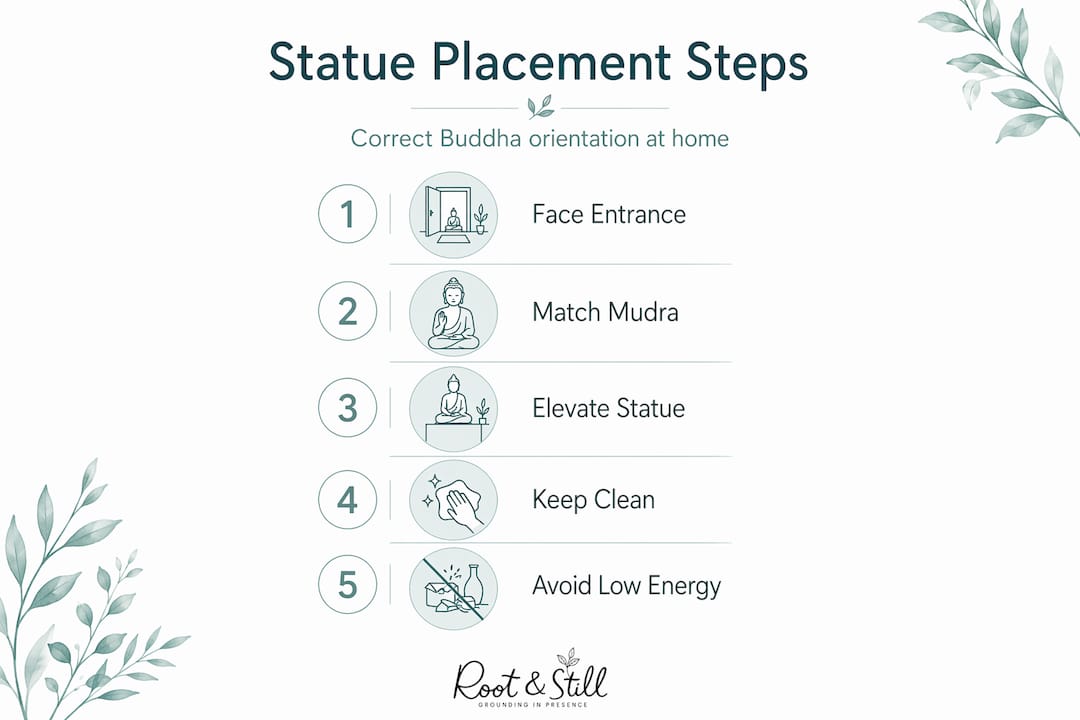
3. Elevate the statue above floor level. Placing a statue directly on the floor is considered disrespectful in most Buddhist traditions. Elevation at eye level or above maintains the figure’s dignity and preserves its sense of quiet authority in the room. A shelf, mantelpiece, or dedicated plinth all work beautifully.
4. Keep the space clean and uncluttered. The area around a Buddha statue benefits from being tidy. Clutter interrupts the stillness the statue is meant to carry. A few deliberate objects such as a candle, a small plant, or a smooth stone can complement the figure without crowding it.
5. Avoid low-energy spaces. Bathrooms and cluttered areas are consistently identified as unsuitable placements across traditions. These spaces interrupt the sense of reverence that makes a statue feel genuinely present rather than merely decorative.
6. Let light do quiet work. Soft, warm lighting directed towards a statue draws the eye gently and reinforces the sense of calm. This is especially true in a meditation corner or a bedroom alcove where you want the statue to feel settled and still.
Pro Tip: If you are unsure of the exact compass direction in your room, let the entrance take priority. A statue facing the door brings you back to the most universal and spiritually consistent principle across all three traditions.
My thoughts on direction, meaning, and modern homes
By Dhriti
I’ve spent a lot of time thinking about why the question of direction seems to matter so deeply to people who bring Buddha statues into their homes. What I’ve noticed is that the question is rarely just about compass points. It is about wanting to do this right. That desire for respect is itself meaningful.
What I find compelling is that the east-facing principle is so specific. It does not apply to every statue. It applies to one particular gesture that captures one particular moment: the Buddha touching the earth at the instant of awakening. When you know that, placing a Bhumisparsha statue east-facing stops feeling like following a rule and starts feeling like participating in something ancient and exact.
I’ve also seen people become overwhelmed by the conflicting advice online, where Vastu says one thing, Feng Shui says another, and Buddhist tradition says a third. My honest view is that these systems overlap far more than they diverge on the fundamentals. Elevation, cleanliness, facing outward towards life and movement rather than corners and walls. These principles are shared because they come from the same root intuition: that sacred objects deserve space, light, and a position that allows them to be genuinely present.
The deeper truth I keep returning to is this. A statue placed with awareness, even imperfectly positioned, carries more spiritual weight than one placed perfectly but carelessly. Intention matters. Direction amplifies intention, but it does not replace it.
— Dhriti
Find your statue’s perfect place with Rootandstill
At Rootandstill, every statue in the collection is chosen with both spiritual symbolism and home placement in mind. Whether you are drawn to a standing welcome Buddha positioned to greet your entrance, or a praying meditation statue for a quieter corner, each piece comes with the context you need to place it thoughtfully. You can also explore the full guide on choosing the right statue size for every room, so proportion and orientation work together. Browse the collection and let the right statue find its place in your home.
FAQ
Why do Buddha statues face east?
East-facing statues connect to the moment Shakyamuni Buddha attained enlightenment at Bodh Gaya while facing east. This direction is specifically associated with the Bhumisparsha Mudra and represents awakening and spiritual clarity.
Are Buddha statues directional by tradition or just custom?
Both. In Buddhist tradition, orientation carries genuine symbolic meaning tied to mudras and sacred architecture. Cultural practices like Vastu and Feng Shui have added further placement conventions that complement this original spiritual reasoning.
Which direction should a Buddha statue face in a home?
The most universally respected position is facing the main entrance, so the statue greets anyone who enters. East-facing is additionally recommended for meditation and Bhumisparsha statues when the room layout allows.
Should a laughing Buddha face a specific direction?
Yes. The laughing Buddha, known as Budai, is traditionally placed facing the main door to welcome good fortune and positive energy into the home. It is treated differently from Shakyamuni statues in terms of directional convention.
What placement should you avoid for a Buddha statue?
Placing a statue in a bathroom, directly on the floor, or in a cluttered, low-energy area is considered disrespectful across most traditions. Elevated placement at or above eye level in a clean, considered space is the respectful standard.


