

You walk into a room, spot a Buddha statue on a shelf or in a garden corner, and something in you quietly settles. It happens almost before you register it consciously. Most people assume this calming effect is purely religious or symbolic, a kind of learned association with spirituality. But the reality is far more interesting. There are specific psychological, physiological, and design factors that explain why Buddha statues feel calming, and understanding them gives you a much more deliberate way to use these pieces in your home.
Key takeaways
| Point | Details |
|---|---|
| Calm faces signal safety | The Buddha’s serene expression triggers an automatic positive response in the brain, reducing anxiety without effort. |
| Posture shapes your mood | Expansive, grounded seated postures communicate stability and have a measurable effect on emotional regulation. |
| Focal points anchor the mind | A statue placed thoughtfully acts as a drishti point, steadying attention and reducing mental chatter. |
| Placement matters greatly | Size, colour, texture, and positioning all work together to either amplify or undermine a statue’s calming presence. |
| Personal resonance is everything | The calming vibe of a Buddha depends partly on your own relationship with the piece and the space around it. |
Why Buddha statues feel calming: what your brain reads first
Before you consciously process the meaning of a Buddha statue, your brain has already read its face. Research shows that calm facial expressions are processed automatically as positive social signals, without requiring complex mental effort. This happens in a fraction of a second. Your nervous system registers the expression and responds accordingly, softening your alertness and inviting a quieter state.
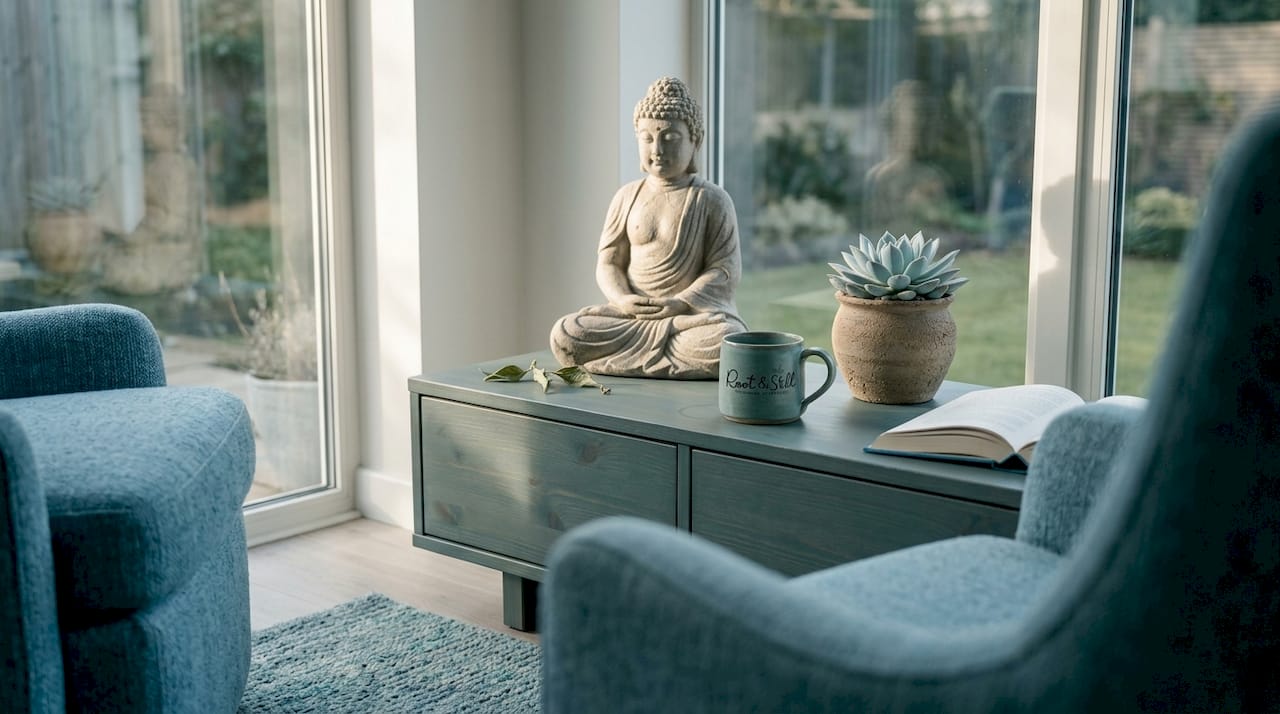
Compare this with what happens when you see an angry or dramatic face. Studies confirm that angry expressions trigger attentional withdrawal, a kind of internal pulling back that puts the body into a low-grade defensive state. It is the opposite of calm. The Buddha’s half-lidded eyes, softened brow, and gently upturned mouth avoid all of those cues entirely. There is nothing in that face to retreat from.
This matters because it means the calming effect is not dependent on belief. You do not need to be a Buddhist, or even particularly spiritual, to experience the shift. The response is wired into human social perception. A peaceful face reads as safe, and safety is where calm lives.
Pro Tip: If you want a Buddha statue to do its quieting work most effectively, choose one with a clearly serene facial expression rather than an abstract or stylised face. The more clearly readable the calm, the stronger the response.
What also contributes is the ease of recognition itself. When the brain processes something without effort, it produces a mild positive feeling that psychologists sometimes call cognitive fluency. A well-crafted, familiar Buddha face is easy to read, and that effortlessness carries its own quiet pleasure.
The power of posture and the focused gaze
The seated Buddha posture is one of the most stable and expansive postures a human body can hold. Grounded, upright, with hands resting open in the lap. This is not accidental. The physical form communicates something your own body understands instinctively.
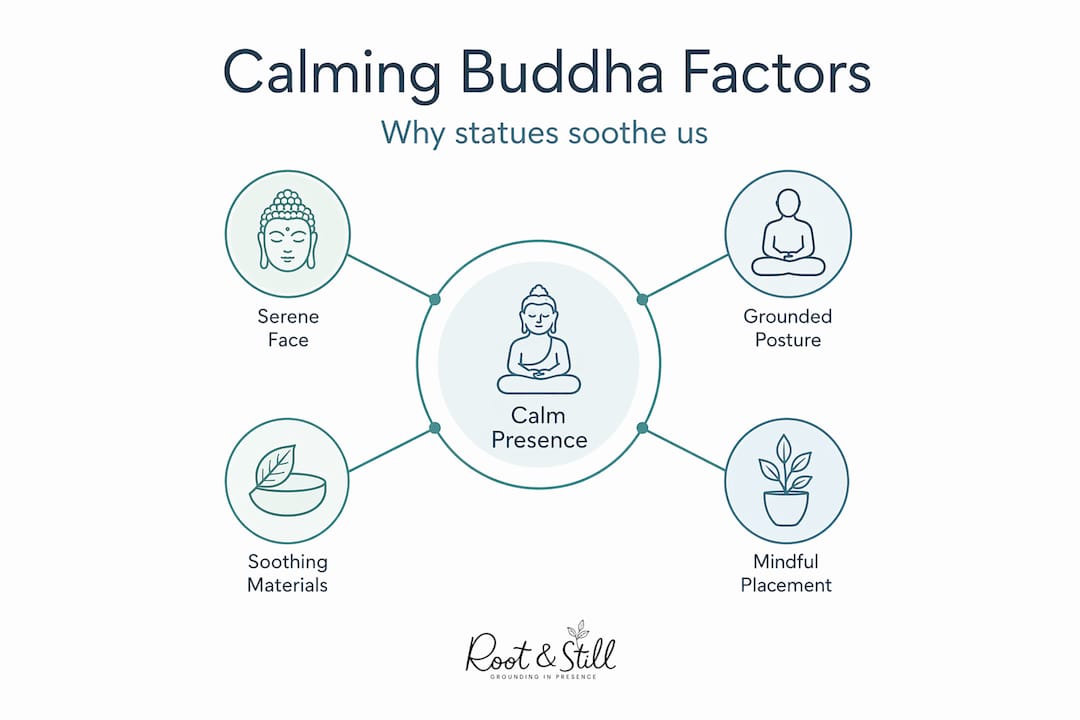
Research on expansive posture and self-regulation shows that holding or observing open, grounded postures increases feelings of self-efficacy and reduces anxiety. This is part of what embodied cognition theory tells us: the body and mind are not separate systems. What you see in physical form, your own body begins to mirror or respond to emotionally.
Here is how the posture of a Buddha statue works as a calming signal in three layered ways.
- The grounded base of the seated figure suggests immovability and steadiness, qualities your nervous system reads as security.
- The open hands and relaxed shoulders signal the absence of threat or tension, encouraging your own body to let go of held stress.
- The upright spine communicates alertness without aggression, a state of balanced awareness rather than collapse or strain.
“Drishti trains single-pointed focus and presence, improving meditation effectiveness and emotional steadiness.” — School of Yoga
This connects directly to the concept of drishti, a Sanskrit term from yoga practice that refers to a focused, single-pointed gaze. In practice, drishti is the technique of fixing your eyes softly on one point to calm mental fluctuation and bring presence into the body. A Buddha statue, placed at eye level and given clear space, functions naturally as a drishti object. Your gaze settles. Your thoughts slow. The statue holds your attention without demanding anything of you.
How Buddha statues support mindfulness at home
Mindfulness, at its simplest, is the practice of returning attention to the present moment rather than letting the mind wander into plans, worries, or memories. The challenge with mindfulness at home is that there is almost always something pulling your attention elsewhere. Screens, tasks, noise. A physical object that draws calm, steady focus can genuinely help.
Research into attentional control and emotional regulation shows that directing attention to calming stimuli reduces mind wandering and supports better emotional balance. A Buddha statue, particularly one placed in a quiet corner of a room, acts precisely as this kind of stimulus. It gives your eyes somewhere restful to land.
The benefits of Buddha statues in a mindful home go beyond decoration in several practical ways.
- A statue in your meditation corner gives you a consistent focal point, which matters because consistency helps the brain move into a quieter state more readily over time.
- Glancing at a serene figure while making morning tea or sitting with a book creates micro-moments of calm throughout the day, not just during formal practice.
- The presence of a statue can serve as a gentle reminder to breathe more slowly and hold yourself with a little more ease, especially in a room where you often feel rushed.
- For those new to Buddha statue meditation, the statue becomes a visible cue that this is a space for slowing down, reinforcing the intention over time.
The significance of Buddha statues in mindful spaces is partly symbolic, yes, but it is also deeply practical. You are creating an environmental cue. Humans are responsive to their surroundings in ways they rarely notice. A room with a grounded, beautiful focal point feels different to live in than one without.
Placement and design: making the most of the calming effect
Knowing why Buddha statues feel calming is only half the conversation. The other half is knowing how to place and choose one so that the calming effect actually lands in your space.
Size is the starting point. A statue that is too small for its setting gets lost visually and loses its presence as a focal point. One that overwhelms the space creates visual tension instead of ease. The right statue size for each room is the one that anchors the eye without competing with everything around it.
Colour and material carry their own weight. Stone and terracotta finishes feel grounded and earthy, sitting quietly in a space without demanding attention. White or pale finishes open up and soften a room. Buddhist colour symbolism runs deep: gold suggests warmth and wisdom, white evokes purity, and green speaks to healing. These are not rules so much as resonances worth being aware of when you choose.
| Statue style | Typical material | Mood it evokes |
|---|---|---|
| Seated meditating Buddha | Stone, resin, terracotta | Deep stillness, focused calm |
| Standing welcome Buddha | Resin, bronze finish | Warmth, openness, invitation |
| Reclining Buddha | Stone, pale finishes | Rest, acceptance, ease |
| Praying Buddha | Resin, gold or turquoise | Reverence, spiritual steadiness |
| Garden Buddha | Weathered stone, moss-friendly finishes | Natural, grounded, timeless |
Placement shapes everything. A statue placed at or near eye level when seated works best as a mindfulness focal point because it sits within your natural resting gaze. Give it space to breathe around it. Avoid clustering it with unrelated objects, which creates visual clutter and pulls the eye away before it can settle.
Pro Tip: Place your Buddha statue facing into the room rather than towards a wall. This positions the calm expression within your line of sight during daily activity, reinforcing the subtle calming effect throughout the day without any conscious effort on your part.
The role of statues in interior design is often underestimated. A thoughtfully placed piece does not just fill a corner. It changes how a room feels to be in.
Misconceptions and why some people feel differently
Not everyone experiences the calming vibe of a Buddha statue in the same way, and it is worth being honest about that. Personal history, cultural background, and emotional associations all shape how any object is received.
Some individuals carry complicated feelings about religious imagery, which can create unease where calm was intended. Others may respond differently to certain statue styles, particularly those with more dramatic or elaborate expressions that depart from the serene simplicity most strongly associated with the calming effect.
A few things are worth considering if a statue does not feel right.
- The expression matters most. If a particular statue feels unsettling rather than restful, look for one with a clearly softened face and closed or half-closed eyes. Dramatic or stylised expressions can trigger the same attentional withdrawal as angry faces.
- Context shapes meaning. A statue placed carelessly on a cluttered shelf carries none of the presence it would have if given space and intention.
- Personal connection is real. The significance of Buddha statues in your home grows when you choose a piece that genuinely resonates with you, not one that simply matches the furniture.
If you are new to using mindfulness objects in your space, start small and notice how you respond over a few days. The calming effect tends to deepen with familiarity.
My honest perspective on what actually works
I have watched people approach Buddha statues in two very different ways. Some choose a piece with real care, considering its expression, its scale in the room, where the light falls on it in the morning. Others pick one quickly because it fills a gap on a shelf. The difference in what those two statues actually do for a space is significant.
What I have found, again and again, is that the calming effect is not automatic. It is created. The statue is the beginning, not the whole answer. The space around it, the intention behind placing it, and the small daily practice of actually noticing it, all of these matter. A beautifully crafted seated figure on a clear surface with a candle nearby and a little room to breathe will do more for your sense of peace than a dozen pieces arranged without thought.
I also think people underestimate how much the facial expression of a piece matters to their own daily experience. You will glance at that face dozens of times a week. If it feels restful to look at, that accumulates into something real over time. If it does not, no amount of styling will compensate.
The calming vibe of a Buddha is not magic. It is design, psychology, and intention working together. Once you understand that, you can make it work for you rather than hoping it happens on its own.
— Root
Bring calm into your home with Rootandstill
At Rootandstill, every piece is chosen with this understanding in mind. The standing Buddha statue brings grounded presence to hallways and garden spaces, while the turquoise praying Buddha adds a quiet spiritual warmth to living rooms and meditation corners. Pair either with the terracotta incense plate for a layered sensory atmosphere that feels genuinely restful rather than arranged. You can explore the full range of mindful home decor at Rootandstill and find pieces that feel right for your space, your style, and the kind of stillness you want to live with.
FAQ
Why do Buddha statues feel calming even to non-Buddhists?
The calming effect comes largely from the serene facial expression and stable posture of the figure, both of which trigger positive social and psychological responses that are wired into human perception, regardless of religious belief.
Where is the best place to put a Buddha statue for calm?
Place the statue at or near eye level in a clear, uncluttered spot where it sits within your natural resting gaze. A meditation corner, reading nook, or garden alcove works particularly well.
What posture of Buddha statue is most calming?
The seated meditating posture is most commonly associated with deep calm, as the grounded, expansive form communicates stability and ease. Research on expansive posture and anxiety supports the idea that observing such postures can reduce stress.
Can a Buddha statue help with mindfulness practice?
Yes. A statue placed as a focal point functions as a drishti object, a physical anchor for attention that reduces mind wandering and supports steadier emotional awareness during meditation or daily moments of stillness.
Do some Buddha statues feel less calming than others?
Statues with dramatic, stylised, or ambiguous expressions can feel less restful because they do not send the same clear calm social cues. For a strong calming effect, choose a piece with a clearly serene, softened expression and simple, grounded form.


