

Most people who own a Buddha statue describe it simply as something calming to look at. That instinct is not wrong, but a buddha statue carries far more weight than its presence alone suggests. Understanding what a buddha statue actually represents — where it came from, what its postures mean, and how it should be placed — transforms it from an ornament into something genuinely meaningful. This article covers the history, symbolism, and types of buddha statues explained in plain terms, so you can engage with them thoughtfully and honestly.
Key takeaways
| Point | Details |
|---|---|
| More than decoration | Buddha statues embody spiritual values including compassion, resilience, and balance, not just aesthetic beauty. |
| Origins span centuries | The earliest Buddha statues date from the 1st and 2nd centuries CE, with monumental examples carved as early as the 6th century. |
| Posture carries meaning | Each seated, standing, or reclining form communicates a distinct spiritual intention or moment in the Buddha’s life. |
| Placement shows respect | Statues should be elevated at least 30 inches above the floor, in clean and peaceful areas of the home. |
| Authenticity matters | Meaningful pieces reflect genuine craftsmanship and cultural awareness, regardless of whether they are antique or contemporary. |
What is a buddha statue, and where did it begin?
A buddha statue is a sculptural representation of Siddhartha Gautama, the historical figure who became the Buddha, meaning “the awakened one.” These statues are not depictions of a god in the conventional sense. They are images of a human being who achieved enlightenment and whose example practitioners seek to follow. That distinction matters, because it shapes how the statues are made, used, and understood across different cultures.
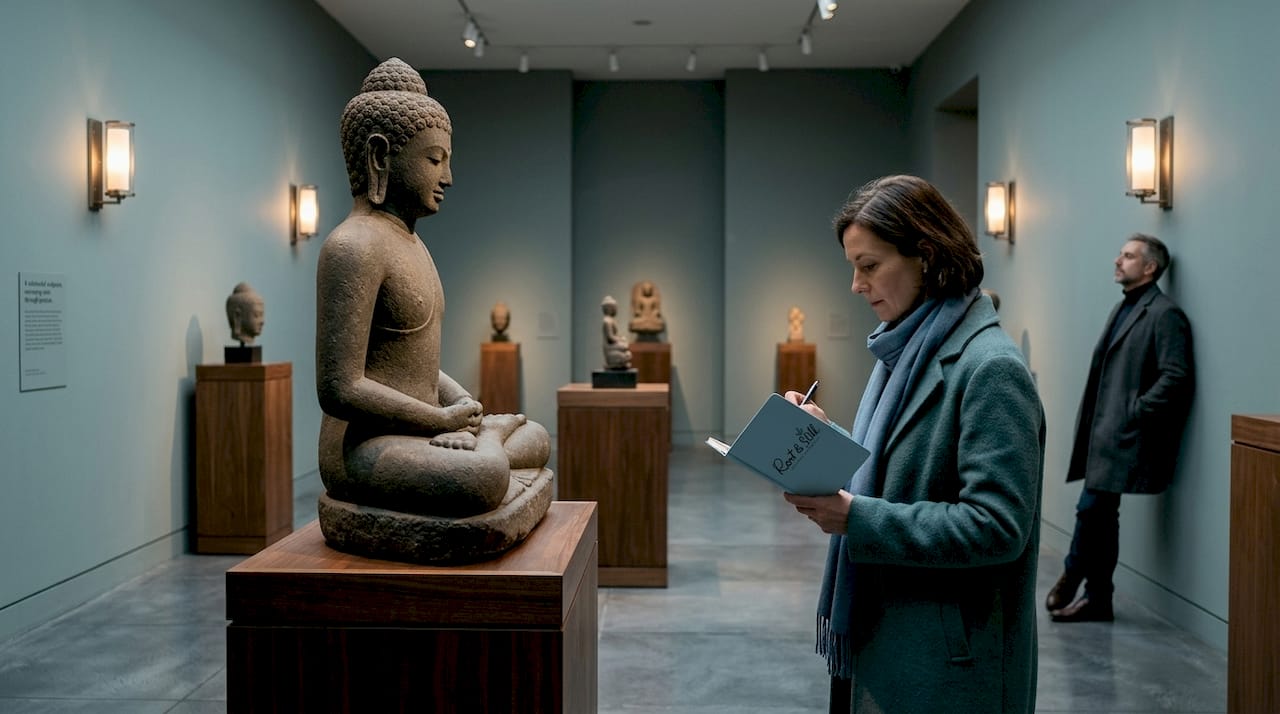
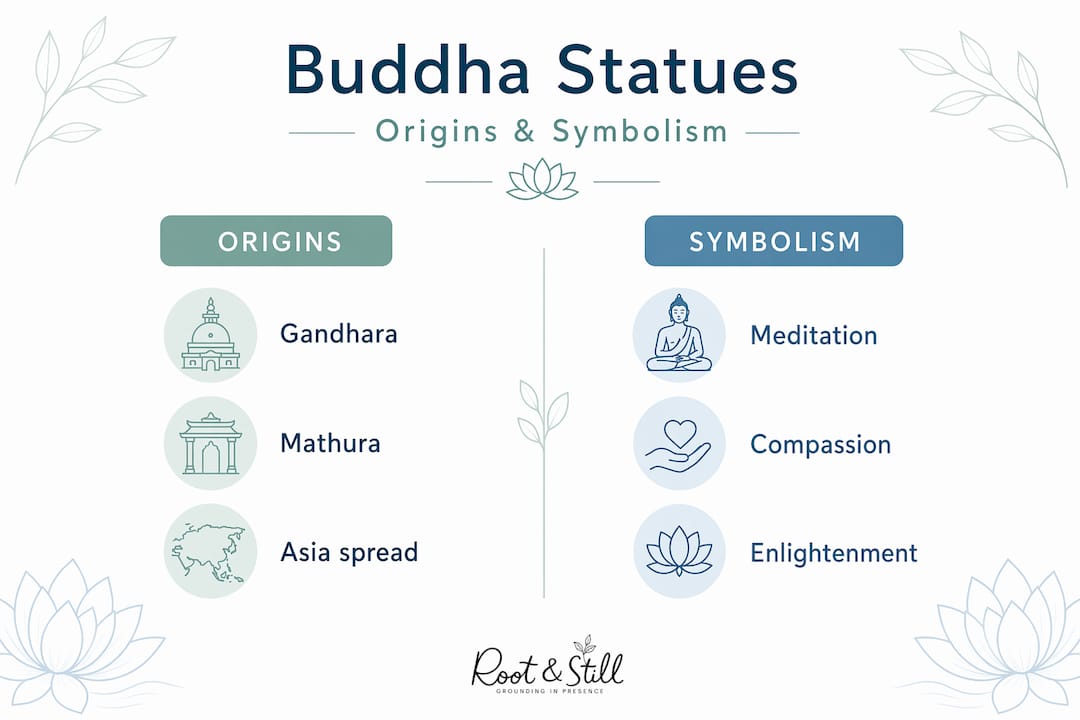
The story of how buddha statues came to exist is itself revealing. Early Buddhism, in the centuries following the Buddha’s death around 400 BCE, avoided depicting him in human form. His presence was symbolised instead through objects: a footprint, an empty throne, or a Bodhi tree. The shift toward human representation began around the 1st to 2nd century CE, with schools of art in the Gandhara region (present-day Pakistan and Afghanistan) and Mathura in northern India producing some of the earliest figural sculptures.
These early statues drew on Greek sculptural conventions introduced through Hellenistic influence following Alexander the Great’s campaigns. The result was a figure with recognisable physical features: elongated earlobes symbolising wisdom and the letting go of material attachments, a protuberance on the crown of the head representing spiritual knowledge, and a serene facial expression conveying inner stillness.
As Buddhism spread across Asia, cave architecture and monumental statues became integral to monastic life and pilgrimage. Communities built physical reminders of the Buddha’s teachings into the landscapes they inhabited, and these became meeting points for both ritual and community.
| Statue | Location | Period | Notable feature |
|---|---|---|---|
| Bamiyan Buddhas | Afghanistan | 6th–7th century CE | Carved into sandstone cliffs; 38m and 55m tall |
| Great Buddha of Leshan | China | 8th century CE | 71m tall, carved from cliff face |
| Tian Tan Buddha | Hong Kong | 1993 CE | Bronze; symbolises harmony between people and nature |
| Ushiku Daibutsu | Japan | 1993 CE | 120m tall; one of the tallest statues in the world |
The Buddhas of Bamiyan are among the most studied examples in history. The smaller statue, approximately 38 metres tall, was built around 570 CE. The larger, reaching 55 metres, followed around 618 CE. Both were carved in high relief into cliff niches, with heads and feet sculpted in the round so that worshippers could walk around them as part of ritual practice. Destroyed in 2001, they served as spiritual centres for over 1,500 years.
Pro Tip: When exploring the history of buddha statues, pay attention to the material used. Sandstone, bronze, and gilded wood each carry cultural associations tied to the region and era of production. Material is not incidental; it reflects the resources, beliefs, and aesthetics of the civilisation that created the piece.
Symbolism and types of buddha statues explained
Understanding the types of buddha statues meanings requires looking at two things: the posture of the figure, and the position of its hands. Together, these communicate the spiritual intention behind each representation. A seated Buddha conveys meditation or teaching. A standing Buddha suggests protection or welcome. A reclining Buddha represents the parinirvana, the peaceful passing of the Buddha into final liberation.
Here is a closer look at the most widely recognised forms:
- Meditating Buddha (seated, hands in lap): This is the most common form in Western homes. The hands rest in the dhyana mudra, with palms facing upward and one hand resting on the other. It represents deep concentration and inner stillness.
- Earth-touching Buddha (seated, right hand pointing to the ground): Known as the bhumisparsha mudra, this gesture commemorates the moment the Buddha called the earth to witness his enlightenment. It is one of the most symbolically significant postures.
- Teaching Buddha (seated or standing, hand raised with palm outward): The dharmachakra mudra shows the Buddha setting the wheel of teaching in motion. This posture is associated with wisdom and communication.
- Protection Buddha (standing, one or both hands raised, palm facing outward): This gesture, the abhaya mudra, conveys fearlessness and the offer of protection. A standing figure in this position is a common choice for entryways and gardens.
- Laughing Buddha (rounded, seated, often smiling broadly): This figure is actually not Siddhartha Gautama at all. It depicts Budai, a Chinese folkloric figure associated with contentment and good fortune. The two are often confused, but they represent quite different traditions.
- Reclining Buddha: Depicts the Buddha lying on his right side, serene in the moment of parinirvana. Found widely in Southeast Asian temples, this form embodies peace and the release from the cycle of rebirth.
Cultural variations add further layers. Theravada Buddhist traditions, practised widely in Thailand and Sri Lanka, tend to favour elongated, gilded figures with flame-shaped topknots. Tibetan Buddhist statues often feature elaborate painted or jewelled details and multiple arms representing divine attributes. Japanese Zen traditions favour simpler, more austere forms that reflect the aesthetic of restraint.
Buddha’s deeper symbolism reaches beyond any single cultural tradition, which is part of what makes these figures so enduringly present in homes across the world. When you choose a statue for your space, its posture and gesture are not arbitrary. They are a quiet conversation with a centuries-old tradition.
Placing a buddha statue respectfully at home
How you position a Buddha statue says something about your intention. A statue placed thoughtlessly, on the floor beside a rubbish bin or perched in a bathroom, communicates neither awareness nor care. Intentional placement in elevated, clean, and quiet spaces is the approach that honours both the symbolism and the cultural tradition behind the piece.
Here are the principles that guide respectful placement:
- Elevate the statue so it sits at least 30 inches above the floor. Height represents esteem, and the idea that enlightenment is something to aspire toward rather than overlook.
- Choose a clean, uncluttered setting. A Buddha statue needs room to breathe. Surrounded by paperwork, tangled cables, or general household clutter, it loses its sense of presence and feels diminished rather than anchored.
- Face the figure toward the room. Positioning the statue so it looks into the living space, rather than at a wall, allows it to hold the room’s energy. Entryways work particularly well, as the figure greets the space and sets a quiet tone from the moment you arrive.
- Avoid the bathroom entirely. This applies across cultural traditions. The bathroom is not a neutral space; it is associated with the functional and private, not the contemplative.
- Pair with complementary elements. Natural textures such as stone, rattan, or linen nearby allow the statue to settle into its setting rather than sit in isolation. Plants work especially well, lending the piece a living, grounded quality.
Stability and elevation are also practical concerns, not just symbolic ones. Taller statues, especially those placed in households with children or pets, need a secure base. A statue that tips easily becomes a hazard rather than a point of calm.
Pro Tip: A north or east-facing position is considered auspicious in several Buddhist traditions. If your layout allows for it, this small adjustment can align your display with a broader cultural understanding without requiring any significant rearrangement.
How to identify a meaningful buddha statue
Not every Buddha statue is created with care, and part of appreciating these objects is knowing what to look for. The question is not always whether a piece is antique or contemporary. It is whether the figure has been made with attention to its symbolic language and craftsmanship.
| Feature | Meaningful piece | Generic import |
|---|---|---|
| Posture accuracy | Posture and mudra align with a recognised form | Hands and body positions are vague or inconsistent |
| Material quality | Stone, resin, or bronze with visible texture and weight | Lightweight plastic with uniform surface finish |
| Facial expression | Serene, proportional, and attentive | Generic or commercially simplified |
| Cultural detail | Robes, topknot, and features reflect a specific tradition | Blended or indeterminate cultural references |
| Finish and care | Hand-finished details; aged or tactile surface | Machine-smooth, uniform colour with no variation |
When you choose a buddha statue for a specific setting, size matters as much as symbolism. A small, delicate head sculpture works quietly on a shelf or side table. A metre-tall standing figure commands a garden or hallway. The scale should feel proportionate to the space, not squeezed in or lost against a large backdrop.
For gardens specifically, weather-resistant materials such as reconstituted stone or treated resin are the practical choice. The figure should feel settled and rooted in its surroundings rather than perched uncomfortably on a surface it was not made for. Placing a garden statue beside plantings, particularly lush foliage or still water, creates a sense of the natural harmony the Buddha’s teachings often speak to.
My perspective on what buddha statues mean today
I’ve thought a great deal about why so many people feel drawn to Buddha statues without knowing exactly why. What I’ve observed is that most people are responding to something genuine. There is a quality of stillness in a well-made Buddha figure that genuinely does affect the atmosphere of a room. That is not mysticism. It is the result of a form that has been refined over centuries to communicate calm.
What I find less comfortable is the tendency to strip the figure of its meaning entirely and treat it as purely decorative. A Buddha statue placed without any awareness of what it represents is a missed opportunity. You do not need to be a Buddhist to own one with intention. You simply need to be curious enough to understand what it communicates, and respectful enough to let that understanding shape how you display it.
In my experience, the people who feel most at peace with their choice are those who took time to learn what they were bringing into their home. The role of statues in interior design goes well beyond visual interest. A figure that carries symbolic weight, placed thoughtfully, becomes part of the emotional texture of a home. That is something worth paying attention to.
— Root
Bring stillness home with Rootandstill
At Rootandstill, every Buddha statue in the collection has been chosen with both symbolism and quality in mind. Whether you are drawn to a standing 1m Buddha for a garden or hallway, or a turquoise praying statue for a meditation or living space, each piece reflects a considered approach to craft and cultural respect. The range also includes smaller sculptural pieces suited to shelves and side tables, allowing you to begin simply and build a space that feels genuinely settled. Browse the full collection at Rootandstill and find the piece that feels right for your home.
FAQ
What is a buddha statue used for?
A buddha statue serves as a visual reminder of mindfulness, compassion, and inner peace. It can be used as a focus point for meditation, a respectful decorative element, or a symbol of the values its owner wishes to cultivate in daily life.
Is it disrespectful to display a buddha statue at home?
Displaying a buddha statue at home is not inherently disrespectful, provided it is placed with care. Respectful display involves elevating the figure, keeping it in a clean space, and avoiding locations like bathrooms or areas associated with clutter and low energy.
What do the different hand gestures on buddha statues mean?
Each hand gesture, known as a mudra, carries a specific meaning. The earth-touching gesture represents the moment of enlightenment, the raised palm signals protection and fearlessness, and hands resting in the lap represent deep meditation.
What is the origin of buddha statues?
The earliest buddha statues emerged around the 1st to 2nd century CE in the Gandhara and Mathura regions of South Asia, drawing on both local and Hellenistic artistic traditions. Before that period, the Buddha was represented through symbols rather than human form.
How should I choose a buddha statue for my garden?
Choose a garden buddha statue in a weather-resistant material such as reconstituted stone or treated resin, and select a posture with a meaning that resonates with you. A standing figure with a raised palm is a popular choice for outdoor spaces, conveying protection and welcome.


