

Anxiety is one of the most pervasive struggles of modern life, yet many approaches focus on managing symptoms rather than understanding their roots. The role of Buddha in anxiety relief goes deeper than relaxation techniques. Buddhist teachings offer a complete framework for changing how you relate to worry, fear, and mental unrest. Rooted in insight and compassion rather than quick fixes, this path has supported people for over 2,500 years and is now being validated by contemporary research. This guide explores what that framework actually contains and how you can begin to use it.
Key takeaways
| Point | Details |
|---|---|
| Buddhist teachings reframe anxiety | Buddha’s approach changes your relationship to anxious thoughts rather than simply suppressing them. |
| Impermanence reduces fear | Understanding that anxiety is transient loosens its grip on identity and mood. |
| Mindfulness disrupts worry loops | Present-moment awareness, even practised briefly, interrupts the mental cycles that sustain anxiety. |
| Insight and compassion work together | Combining panna (wisdom) with the four immeasurables produces deeper, longer-lasting emotional resilience. |
| Daily practice matters most | Small, consistent steps including mindful breathing and compassionate noting build genuine calm over time. |
The role of Buddha in anxiety relief: foundational ideas
Before exploring specific practices, it helps to understand the three core Buddhist concepts that form the foundation of anxiety relief. These are not abstract philosophy. They directly address the mental patterns that keep anxiety alive.
Impermanence (anicca) is the teaching that all experiences, including anxiety, arise and pass away. When you feel gripped by worry, it can seem permanent and total. Buddhist psychology invites you to observe that the feeling is already shifting, even as you notice it. This single shift in perspective can soften the urgency that anxiety feeds on.
Non-self (anatta) is perhaps the most radical teaching. It suggests that anxious thoughts are not a fixed part of who you are. Buddhist psychology clarifies that identifying with anxiety reinforces suffering, while practising non-self loosens that grip. You can observe a worried thought without becoming it. That space between you and the thought is where relief begins to grow.
Suffering (dukkha) in Buddhist teaching does not mean life is only pain. It points to the subtle dissatisfaction that arises when we grasp at pleasant experiences or push away difficult ones. Anxiety is often a product of this grasping and pushing. The Buddhist understanding of dukkha invites you to meet discomfort directly rather than fighting it, which paradoxically reduces its power.
Together, these three principles address something that many conventional approaches overlook:
- Anxiety is not an enemy to defeat but a mental pattern to understand.
- Your identity is not defined by your worried mind.
- Meeting difficulty with awareness, rather than avoidance, is where lasting change begins.
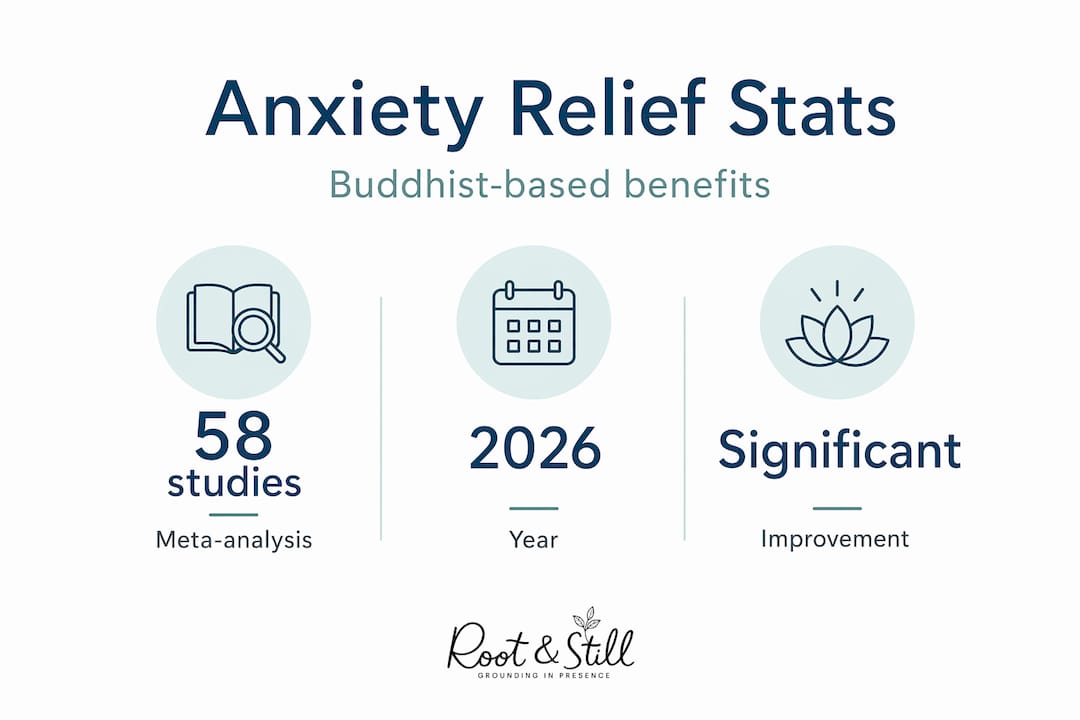
A 2026 meta-analysis of 58 studies found that Buddhist-style interventions show significant benefits for individuals with anxiety symptoms, particularly when teachings emphasised insight and compassion alongside practical techniques.
Mindfulness and meditation for anxiety
Mindfulness, the English term most closely associated with Buddhist mental training, is not the same as relaxation. It is the deliberate practice of paying attention to the present moment without judgement. When anxiety pulls your mind into imagined futures or regretted pasts, mindfulness returns you to what is actually happening right now.
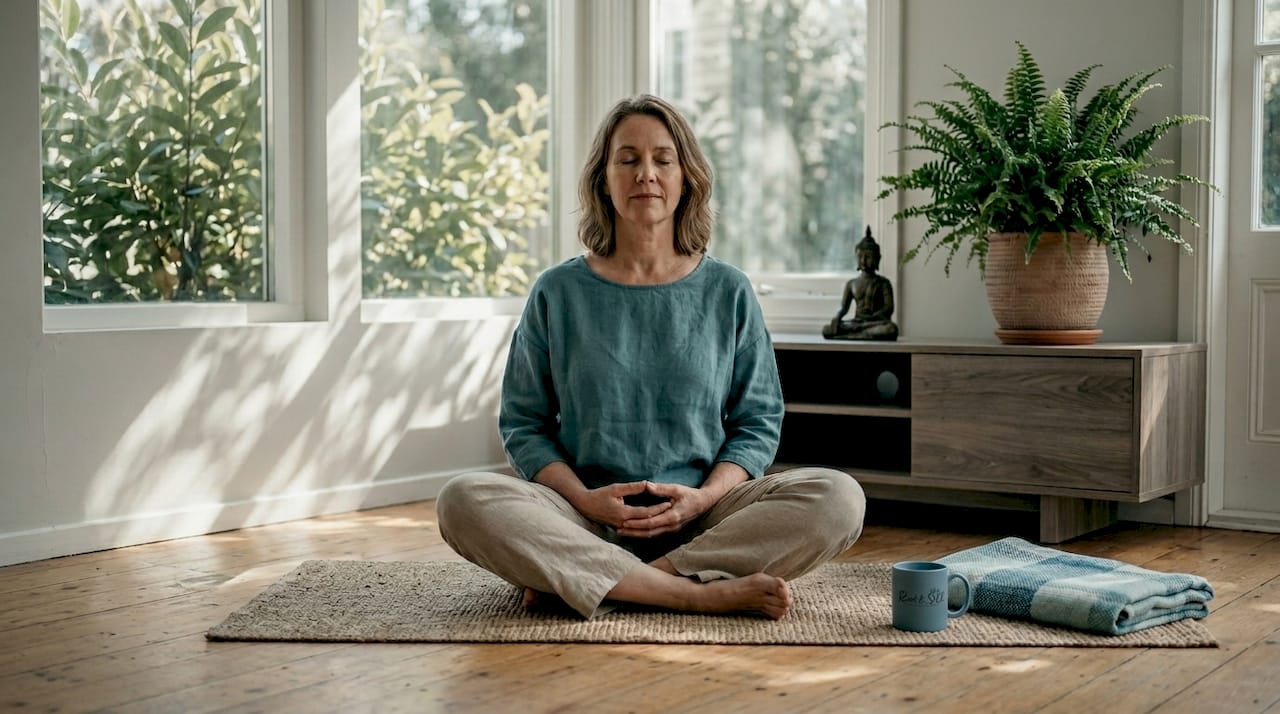
One particularly grounded technique drawn from Buddhist practice is mindful noting. Rather than suppressing anxious thoughts, you simply name them. You might quietly observe “worrying” or “planning” as thoughts arise, then return your attention to your breath. Practising mindful noting of anxiety as a mental hindrance, rather than suppressing it, helps withdraw the reinforcement that keeps worry running.
Clinical research supports this approach strongly. An 8-week mindfulness-based intervention effectively reduced clinician-rated anxiety in adults with generalised anxiety disorder in a randomised controlled trial. A systematic review of over 24,000 participants reported a pooled effect size of Hedges’ g = 0.56, indicating moderate to strong reductions in anxiety through mindfulness-based practices.
Here is a simple sequence you can begin with today:
- Find a comfortable seated position and close your eyes.
- Bring your attention to the natural rhythm of your breath. Notice the sensation of air entering and leaving.
- When a worried thought arises, gently name it. “Thinking.” “Planning.” “Worrying.” Then return to the breath.
- If the same thought returns several times, observe it with curiosity rather than frustration.
- Continue for five to ten minutes. Even one minute of this practice can begin to settle the mind.
Pro Tip: The Mayo Clinic recommends even one minute of focused breathing to disrupt a worry loop and improve emotional regulation. You do not need a long sitting practice to feel the benefit.
Wisdom and compassion: the deeper tools
Beyond mindfulness lies a layer of Buddhist practice that research suggests is particularly potent for anxiety relief. This involves panna, the Pali term for wisdom or insight, and the four immeasurables.
Panna is not intellectual knowledge. It is direct, lived understanding of impermanence and non-self. When you genuinely see that your anxious thoughts are transient events and not a fixed identity, the grip of anxiety loses its foundation. The distinction between short-term calm states and wisdom-based changes is significant. Mindfulness can bring immediate relief. Panna changes the mental habits that generate anxiety in the first place.
The four immeasurables are:
- Loving-kindness (metta): Offering warmth and goodwill to yourself and others, including the part of you that feels anxious.
- Compassion (karuna): Recognising your own suffering without judgement, then extending that recognition to others who feel the same.
- Sympathetic joy (mudita): Finding genuine pleasure in others’ wellbeing, which loosens the self-referential loop of anxiety.
- Equanimity (upekkha): Resting in a balanced, open awareness that is neither grasping nor averse.
The therapeutic value of these qualities is well documented. Combining panna and the four immeasurables in Buddhist interventions may yield more effective anxiety relief by cultivating motivation and a healthy relationship to suffering.
| Practice | Core quality | Effect on anxiety |
|---|---|---|
| Mindful noting | Present-moment awareness | Disrupts worry loops |
| Panna (insight) | Wisdom about impermanence | Reduces identity with anxious thoughts |
| Metta (loving-kindness) | Warmth toward self | Softens self-critical inner voice |
| Equanimity | Balanced awareness | Reduces reactivity to anxious feelings |
This combination of insight and compassion is not incidental. It appears to be what makes Buddhist-inspired approaches to anxiety relief distinctly effective compared with secular relaxation techniques alone.
How Buddhist framing differs from conventional approaches
Most conventional anxiety strategies aim to reduce or remove anxious symptoms. Buddhist teachings take a different stance. They aim to change your relationship to anxiety rather than eliminate it immediately. This is a meaningful distinction.
Anxiety is often sustained by a loop of grasping and avoidance. You feel fear, try to push it away, feel more fear about the fear, and the cycle intensifies. Buddhist mental health frameworks promote acceptance and insight-based transformation over quick fixes, interrupting this loop at its root.
The concept most relevant here is decentring: the ability to observe your thoughts from a slight distance rather than being entirely absorbed in them. Buddhist practice cultivates this naturally. When you sit with a worried thought and simply name it “thinking,” you are no longer the thought. You are the awareness noticing the thought. That shift is subtle but profound.
- Conventional approach: Reduce the frequency or intensity of anxious thoughts.
- Buddhist approach: Change how you relate to anxious thoughts so they lose their power over you.
- Practical difference: Buddhist practice does not require anxiety to disappear for you to feel settled. Relief comes from the quality of attention you bring, not the absence of difficulty.
Pro Tip: The next time anxiety spikes, resist the urge to argue with the thought or distract yourself. Instead, place one hand on your chest, take a slow breath, and say internally: “This is a feeling. It will pass.” You are practising Buddhist acceptance in its most accessible form.
Bringing these teachings into daily life
Buddhist teachings on anxiety are not confined to a meditation cushion. They translate into small, repeatable actions that gradually shift how your mind meets difficulty.
- Begin each morning with three minutes of quiet breathing. Before checking your phone, sit with your natural breath and notice what is present without trying to change it.
- During the day, practise the what Buddha symbolises in your home space. A statue or mindful object in view can serve as a gentle prompt to return to the present.
- When anxious thoughts arise, use mindful noting. Name what you observe, then return to the task at hand.
- Once daily, spend two minutes practising loving-kindness toward yourself. Silently offer the phrase: “May I be at ease. May I feel settled. May I be free from suffering.”
- At the end of the day, reflect briefly on one moment where you noticed anxiety without being consumed by it. Recognising progress, however small, sustains the practice.
Consistency matters far more than duration. Even brief mindfulness practices of one minute can effectively disrupt the worry loop and support emotion regulation over time.
My honest take on this path
I’ve spent years reading about Buddhist approaches to mental health, and the thing that strikes me most is how often people expect these teachings to work like a switch. They expect to meditate once and feel calm. What I’ve found is that the real shift is much slower and much more interesting than that.
What Buddhist practice actually does is make you a better observer of your own mind. And once you can observe anxiety rather than becoming it, everything begins to feel more spacious. I’ve seen people describe this as the first time they felt genuinely in control, not because the anxiety disappeared, but because it no longer had the last word.
The part of this path that I think is underestimated is the compassion piece. Insight alone can sometimes turn into a cold, analytical watching. It is the warmth of loving-kindness toward yourself that makes the practice feel inhabitable rather than clinical. The two together create something that is both grounding and genuinely kind.
My honest advice is this: start smaller than you think you need to. One breath. One moment of noting. One quiet minute before the day begins. The practice does not need to be grand to be real.
— Dhriti
Create a space that holds your practice
Your physical environment plays a quiet but real role in supporting a mindful state of mind. At Rootandstill, every piece is chosen to bring a sense of stillness and grounded presence into the spaces where you live. A standing Buddha statue placed thoughtfully in a living room or garden can serve as a daily visual anchor, a reminder to breathe and return to the present. The turquoise praying Buddha carries both spiritual symbolism and a calming aesthetic that softens any room. Explore the full Rootandstill collection to find pieces that feel right for your space and your practice.
FAQ
What is the role of Buddha in anxiety relief?
Buddha’s teachings address anxiety by changing how you relate to worried thoughts rather than simply suppressing them. Practices like mindfulness, non-self awareness, and loving-kindness reduce both the frequency and the intensity of anxious reactions over time.
How do Buddha teachings differ from conventional anxiety therapy?
Buddhist approaches reduce reactivity to anxiety rather than aiming for immediate symptom removal. This decentring quality, developed through mindfulness and insight practice, is similar to defusion techniques used in acceptance and commitment therapy.
Does mindfulness meditation actually reduce anxiety?
Yes. A systematic review of over 24,000 participants found moderate to strong reductions in anxiety through mindfulness-based interventions, and a randomised controlled trial showed significant clinical improvements in generalised anxiety disorder.
What is panna and why does it matter for anxiety?
Panna is the Buddhist concept of wisdom or insight, specifically the lived understanding that thoughts and feelings are impermanent and not a fixed identity. This understanding is associated with larger improvements in anxiety outcomes compared with mindfulness alone.
How can I start using Buddhist practices for calm at home?
Begin with three minutes of mindful breathing each morning, practise noting anxious thoughts by name rather than engaging with them, and bring loving-kindness phrases into your daily routine. Consistent small steps produce more lasting calm than occasional intensive sessions.


