

Meditation statues are defined as physical objects used as external visual focal points, known in yoga tradition as drishti, to anchor attention and reduce mental drift during practice. The concept of drishti as a concentration tool) appears throughout Patanjali’s eight limbs of yoga, where steady gaze is described as a gateway to dharana, or sustained concentration. Modern mindfulness research supports this ancient principle, showing that external anchors make attentional drift easier to detect and correct than internal breath tracking alone. Whether you practise in a dedicated yoga room or a quiet corner of your home, understanding why meditation statues aid focus can genuinely transform the quality of your sessions.
Why meditation statues aid focus through external gaze
The mechanism is straightforward. When you rest your gaze on a statue, you are practising a form of drishti, a focused single-point gaze) that reduces the fluctuation of the mind. Patanjali’s yoga texts describe drishti not as staring intensely, but as a tranquil, steady settling of the eyes onto one point. That quality of ease is what makes it sustainable across a long sit.

Trataka is the closely related practice of gazing at a fixed visible object, traditionally a candle flame, to train concentration. The principle transfers directly to a statue. Because the focal point is external and visible, you notice the moment your gaze begins to wander far more quickly than you would notice your mind drifting away from the breath. External visual attention is easier to detect drifting from than internal breath awareness, which is subtler and slower to signal a lapse. That faster feedback loop is the core reason statues work so well as meditation aids for concentration.
Comparing the two approaches makes the advantage clear:
- Breath focus: The object of attention is internal and invisible. You may drift for thirty seconds before realising your mind has wandered.
- Statue gaze: The object is external and fixed. The moment your eyes slide away, you have an immediate, physical signal to return.
- Trataka on a statue: Combines the benefits of both, using a meaningful, calming object rather than a neutral flame, which adds symbolic weight to the practice.
The drishti gaze in yoga is described as steady and tranquil, never tense or forced. Squinting or staring hard creates eye and brain fatigue, which defeats the purpose. The goal is a soft, settled gaze that holds the statue in your field of vision without gripping it.
Pro Tip: Focus on the statue’s eyes or the space between its brows. This specific point gives your gaze something precise to return to, making the re-anchoring habit faster and more reliable.
What does research say about statues and concentration?
Scientific evidence for the benefits of meditation statues sits within a broader body of mindfulness research, and the findings are consistent. A 21-day self-guided digital mindfulness RCT involving 90 participants showed significant improvements in self-control and health-related attributes from pre to post intervention. Self-control is the cognitive skill that allows you to notice distraction and return to your chosen focus point. A statue that makes that return faster and more habitual directly supports this capacity.
Physiological benefits are equally well documented. A 10-day online mindfulness programme increased heart rate variability during sessions and improved sleep efficiency in healthy adults. Heart rate variability is a marker of autonomic regulation, meaning the nervous system becomes better at shifting between alert and restful states. A calm, grounded meditation environment, anchored by a statue, supports exactly this kind of regulation.
Research in mindfulness journals supports that a visual anchor reduces mind-wandering and supports sustained attention during meditation.
The research also points to an important nuance. External anchors suit people with visually restless or “monkey mind” tendencies better than internal breath focus, because the visual channel is dominant for most people. If you have ever found breath meditation frustrating because your mind simply refuses to settle, a statue may be the more appropriate tool for your attention style.
Pro Tip: Treat your statue as a metronome for attention. Every time you notice your gaze has drifted, return it immediately and without judgement. That single habit, repeated consistently, is what builds concentration over time.
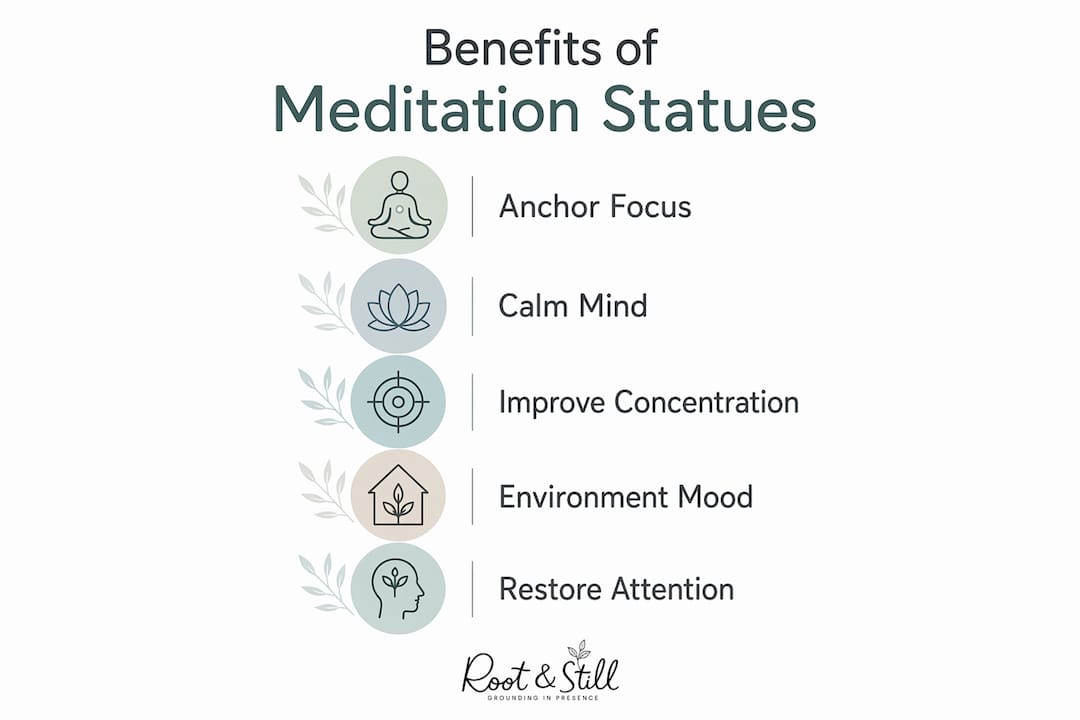
How do statues shape the meditation environment?
A meditation statue does more than provide a gaze point. It shapes the entire atmosphere of the space around it. Buddha statues embody calmness and balance through their posture, proportions, and symbolic hand gestures, known as mudras. The dhyana mudra, for example, shows hands resting open in the lap, a posture that communicates receptive stillness. Seeing that form before you sit quietly primes your own body and mind toward the same quality.
The statue also acts as a mood stabiliser between sessions. Placed in a corner of your living room or on a dedicated shelf, it becomes a visual reminder of your intention to practise. Over time, simply seeing it triggers a small but real shift in your mental state, much like how a well-chosen piece of art can soften the mood of an entire room. For guidance on how statement wall artwork and visual focal points shape the feel of a space, the same principles apply to statue placement.
Placement matters more than most practitioners realise. Facing a statue in a specific direction can influence the psychological tone of a meditation space. East-facing statues are traditionally associated with new beginnings and clarity, while north-facing positions are linked to wisdom and calm. These are not rigid rules, but they offer a thoughtful framework for arranging your space with intention.
Different statue types also carry different qualities:
| Statue Type | Material | Atmosphere Created |
|---|---|---|
| Hand Carved Wooden Buddha | Natural wood grain | Warm, grounded, organic |
| Brass Buddha Figure | Polished metal | Formal, luminous, traditional |
| Antique Buddha Collectable | Aged resin or stone | Timeless, settled, contemplative |
| Resin Buddha Statue | Smooth, lightweight | Accessible, versatile, clean |
Pro Tip: Keep the area around your statue uncluttered. Give it room to breathe on the shelf or surface. A crowded setting dilutes the focal quality of the object and makes it harder for the eye to settle.
How to incorporate a statue into your daily practice
Integrating a statue into your meditation routine works best when you treat it as a deliberate tool rather than passive décor. The following approach builds the habit steadily.
-
Position the statue at eye level. When seated in your usual meditation posture, the statue’s face should be roughly level with your gaze. Looking sharply up or down creates physical tension that disrupts the settled quality you are trying to cultivate.
-
Begin each session with thirty seconds of soft gazing. Before closing your eyes or shifting to breath awareness, rest your gaze on the statue’s face. Let your eyes soften. This brief opening ritual signals to your nervous system that focused, quiet attention is beginning.
-
Use the statue as your return point. Whenever you notice your mind has wandered, open your eyes gently, find the statue’s gaze, and re-anchor. This is the core of the rapid re-anchor habit that builds concentration over weeks of practice.
-
Choose a statue whose size suits your space. A small mini Buddha works well on a desk or bedside table for brief daily sits. A medium or large seated Buddha suits a dedicated yoga room or corner where you practise for longer periods.
-
Avoid forcing the gaze. The drishti principle is one of tranquil steadiness, not intensity. If your eyes feel strained, soften your focus or briefly close them before returning.
The same approach translates naturally to a workspace. A small statue on your desk can serve as a reset point during a demanding day, a brief moment of soft gaze that interrupts the cycle of distraction and restores a degree of calm. For ideas on how mindful statue placement works across different rooms in the home, the principles remain consistent.
Pro Tip: If you find your eyes closing naturally during statue gazing, that is a sign your nervous system is settling. Allow it. The statue has done its work as an anchor and you can continue the session with eyes closed.
Key takeaways
Meditation statues aid focus because they provide a stable, external visual anchor that makes attentional drift faster to detect and easier to correct than internal breath focus alone.
| Point | Details |
|---|---|
| Drishti is the mechanism | Resting your gaze on a statue practises the yoga principle of single-point focus, reducing mental fluctuation. |
| External anchors outperform breath for some | People with visually restless minds find statue gazing more effective than internal breath tracking for building concentration. |
| Research supports the practice | Mindfulness interventions show improved self-control, heart rate variability, and sleep quality, all linked to sustained attentional focus. |
| Placement and symbolism matter | Statue orientation, material, and surrounding space all influence the psychological atmosphere and depth of your practice. |
| Consistency builds the habit | Returning your gaze to the statue immediately upon noticing drift is the single most effective technique for strengthening attention over time. |
What i have learnt from years of gazing at a still face
I will be honest: when I first placed a seated Buddha on my practice shelf, I thought of it mainly as décor. It took several weeks of consistent sitting before I noticed what was actually happening. The statue was not something I was contemplating. It was something I was using, the way a musician uses a metronome. Not to admire, but to return to.
What surprised me most was how quickly the habit formed. Within a fortnight, my eyes knew where to go the moment my mind began to scatter. That automatic return is the real gift of a physical focal point. Breath awareness requires you to notice an absence, the absence of attention on the breath. A statue requires you to notice a presence, and presence is always easier to find.
I have also seen people misuse the practice by treating the statue as an object of religious devotion during meditation, which shifts the quality of attention entirely. The statue works best as a concentration tool, not a contemplation object. Keep the gaze soft, the posture easy, and the intention simple: notice drift, return, repeat.
My honest recommendation is to experiment with the specific feature you gaze at. The eyes of a statue carry a particular stillness. The hands, especially in the dhyana mudra, carry a quality of openness. Different focal points within the same statue can shift the tone of a session in subtle but real ways. Try both and notice what feels most settled for you.
— Dhriti
Find your focal point with Rootandstill
Rootandstill offers a considered range of meditation statues designed to serve exactly this purpose, from compact pieces that sit quietly on a desk to larger, more commanding forms for a dedicated practice space. The Antique Buddha Classic Statue brings a settled, timeless presence to any meditation corner, while the Mini Meditating Sitting Buddha offers a more intimate focal point for shorter daily sits. For those drawn to the symbolic harmony of feng shui, the Buddha Feng Shui Set brings both visual focus and spatial intention to a room. Each piece is chosen for its quality of stillness, because the statue you gaze at shapes the quality of the attention you bring.
FAQ
What is drishti and how does it relate to meditation statues?
Drishti is a focused gaze technique from yoga tradition, used to anchor attention and reduce mental wandering. A meditation statue serves as a drishti point, giving your eyes a stable, meaningful object to return to during practice.
Are meditation statues more effective than breath focus for concentration?
For people with visually restless minds, external visual anchors like statues are more effective than breath tracking because attentional drift is faster to detect when the focus point is visible and fixed.
Does the placement of a meditation statue affect its benefits?
Placement does influence the psychological tone of a space. East-facing statues are traditionally linked to clarity and new beginnings, while keeping the area around the statue uncluttered helps maintain its quality as a clear focal point.
How long should i gaze at a meditation statue during a session?
Begin with thirty seconds of soft gazing at the start of each session to settle your attention, then use the statue as a return point whenever your mind wanders throughout the sit.
Can a small desk statue work as well as a larger meditation statue?
A small statue works well for brief daily sits or desk-based reset moments. The key factor is eye-level positioning and an uncluttered surrounding, not the size of the piece itself.


