

Buddha statue office desk styling is the intentional arrangement of a Buddha figurine and complementary decor to create a calming, focused workspace that balances spiritual symbolism with modern aesthetics. The practice draws on both traditional Buddhist principles and contemporary desk-scaping trends to transform an ordinary work surface into something that feels genuinely settled and purposeful. Whether you are drawn to the meditative stillness of a Dhyana Mudra figure or the warm prosperity associations of a Laughing Buddha, the way you select, position, and surround your statue shapes the entire atmosphere of your desk. This guide walks you through every decision, from choosing the right size and pose to building a mindful arrangement that supports your working day.
How to choose the right Buddha statue for your desk
The statue itself is the foundation of everything. Get this choice right, and the rest of the arrangement falls into place naturally.
Desk-sized statues sit best at 3 to 5 inches (7 to 13 cm) tall, with 2 to 3 inches of clearance above the head. This is not arbitrary. At close viewing distances, a statue that is too large crowds the desk and draws the wrong kind of attention, while one that is too small loses its presence entirely. The 3 to 5 inch range gives the figure enough visual weight to anchor the space without dominating it.
Choosing a pose that suits your intentions
The mudra, or hand gesture, of a Buddha statue carries specific meaning, and for an office desk, two poses work particularly well. The Dhyana Mudra, where both hands rest open in the lap, represents meditation and inner stillness. It is a natural choice if your goal is to soften the mood and create a restful focal point during demanding work. The Dharmachakra Mudra, where the hands are raised with fingers forming a circle, represents teaching and wisdom. This suits professionals who want their desk to reflect clarity of thought and purposeful communication.
Selecting the right material
Material affects both the visual tone and the longevity of your piece. Bronze carries a quiet authority and ages gracefully in office light. Resin is lighter and more affordable, making it practical for smaller desks where weight matters. Wood brings warmth and a natural texture that pairs well with linen desk mats, stone paperweights, and rattan accessories. For those who want a softer ambient effect, metal frame LED Buddha statues cast a gentle glow that works particularly well in home offices with limited natural light.
Pro Tip: If your desk sits near a window, choose a matte or stone-finish statue rather than a highly polished one. Reflective surfaces catch direct sunlight and can become distracting rather than calming.
| Feature | Recommended choice | Why it works |
|---|---|---|
| Size | 3 to 5 inches (7 to 13 cm) | Proportional to a standard desk surface |
| Clearance above head | 2 to 3 inches minimum | Shows respect and prevents visual crowding |
| Pose for calm | Dhyana Mudra | Evokes meditation and stillness |
| Pose for focus | Dharmachakra Mudra | Represents wisdom and clear thinking |
| Material for warmth | Wood or resin | Pairs well with natural desk accessories |
Where should you place a Buddha statue on your desk?
Placement is where many people make their first misstep, and it is the detail that most affects whether the statue feels grounded or simply decorative.
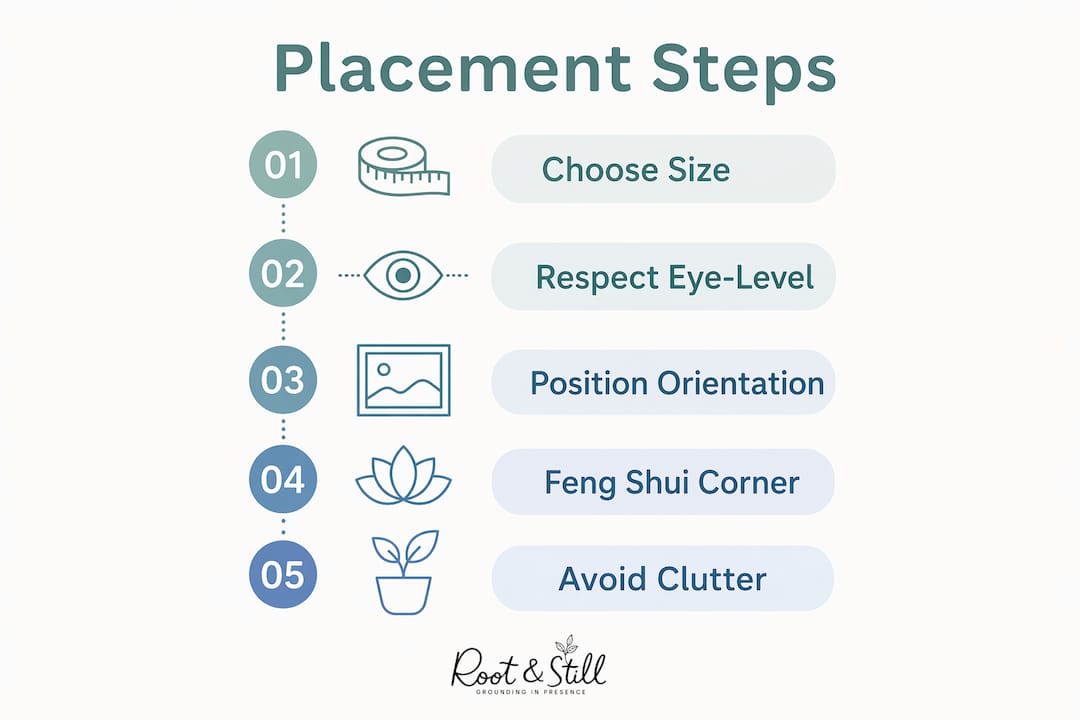
The core principle is straightforward. Respectful placement keeps the statue at or above eye level when you are seated, on a clean and raised surface, facing either the room entrance or the person at the desk. This is not purely ceremonial. A statue positioned at eye level enters your peripheral awareness naturally throughout the day, offering a quiet visual anchor without demanding your attention.
Orientation matters more than most people realise. A Buddha figure facing a wall receives no sightline and loses its calming influence on the room. Facing the main entrance is the traditional preference, as it creates a sense of welcome and presence. If your desk faces a wall, orient the statue toward you directly so that it sits within your natural line of sight.
Feng shui adds a further layer of guidance. The far right corner of your desk, as you sit facing it, is considered the prosperity corner. Placing a Laughing Buddha here, facing toward you, is said to support career luck and abundance. Whether or not you follow feng shui principles closely, this corner placement tends to work well visually because it keeps the statue within your field of vision without sitting directly in your working zone.
There are also clear boundaries around where a statue should never sit. Avoid placing it near shoes, on the floor, beside bathroom doors, or next to kitchen appliances. In a home office, this means keeping it away from the corner where bags and shoes are dropped. A small wooden pedestal, a natural stone tray, or a folded piece of linen cloth all serve to elevate and separate the statue from the everyday clutter of a working surface.
Pro Tip: If your desk is low or your chair sits high, place the statue on a small wooden block or a decorative tray to bring it up to eye level. Even a 3 cm lift makes a noticeable difference to how settled the arrangement feels.
How to integrate a Buddha statue into your desk-scaping
Desk-scaping is the practice of layering meaningful and functional objects to create a workspace that is both inspiring and organised. Design expert Meghan Jay describes it as styling a desk the way you would style an entire room, with intention and a clear sense of purpose. The Buddha statue becomes the anchor of this arrangement, the piece everything else relates to.
The key is restraint. Overcrowding the desk with non-purpose decorative objects actively harms focus and productivity. Choose one or two calming objects to accompany the statue rather than building a collection. A small potted succulent, a single candle holder, or a smooth river stone each add texture and life without competing for attention.
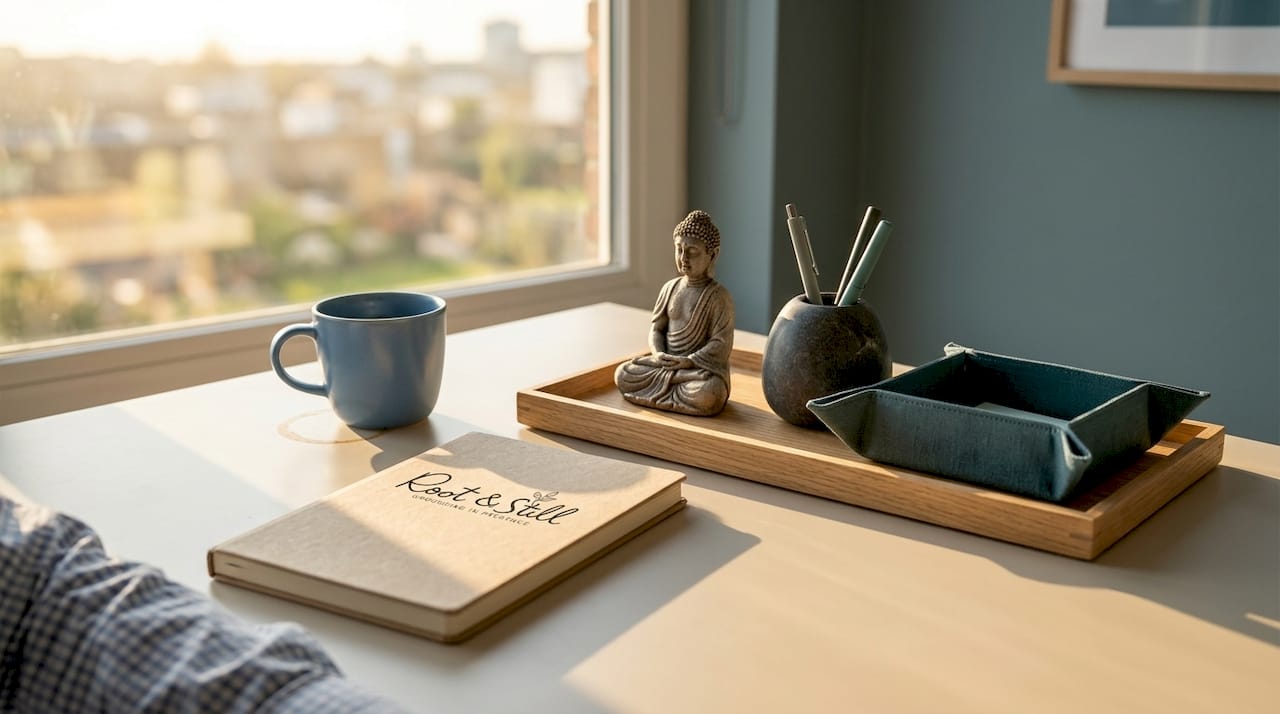
Natural materials create cohesion. When your statue sits on a wooden tray alongside a stone pen holder and a linen desk mat, the desk reads as a considered whole rather than a collection of separate items. Soft, warm lighting from a small desk lamp placed to one side of the arrangement completes the effect, casting gentle shadows that give the statue depth and presence.
One of the most thoughtful additions to a mindful desk arrangement is a miniature Zen garden kit. The Buddha Zen Garden Desk Kit pairs a meditating Buddha figure with a 21.5 by 17.5 cm MDF tray, sand, stones, and a rake. The contained tray keeps the sand tidy and the deep sides prevent mess, making it genuinely practical for a working desk rather than purely ornamental. It sits beside your statue as a companion piece rather than a replacement for it.
Here is a simple sequence for building your desk arrangement:
- Place the Buddha statue first, at the correct height and orientation, as the visual anchor of the desk.
- Add a single natural material tray or pedestal beneath it to elevate and frame the figure.
- Position one functional item to the left or right, such as a pen holder in stone or wood, keeping it lower than the statue.
- Introduce one living element, a small plant or a single stem in a bud vase, to soften the arrangement.
- Add a Zen garden kit if space allows, keeping it within reach for brief mindful pauses during the day.
- Step back and remove anything that does not contribute to either calm or function.
Setting up your Buddha desk arrangement: common mistakes to avoid
Getting the arrangement right the first time saves you from the frustration of a desk that looks assembled rather than considered. Start with a clear surface and gather your items before placing anything.
The most common mistake is placing the statue too low. A figure sitting flat on a desk surface, below your eye line, loses its presence and can feel disrespectful in a traditional sense. Use a pedestal, a folded cloth, or a small tray to raise it. The second most common error is facing the statue toward a wall. Even a slight angle toward the room or toward you makes a significant difference to how the arrangement reads.
Clutter is the quietest enemy of a mindful desk. Once the statue is in place, resist the urge to add more. A desk that holds a Buddha figure, a Zen garden, two plants, a candle, a crystal collection, and a stack of notebooks is no longer calm. It is busy. Choose the pieces that genuinely add to the atmosphere and let the rest live elsewhere.
Maintenance is part of the practice. Dust the statue gently with a soft cloth once a week. Keep the Zen garden sand smooth and free of debris. Sand-raking for two minutes between tasks has been shown to aid focus recovery and reduce tension, making it one of the most practical mindful rituals you can build into a working day.
Pro Tip: If your desk is genuinely small, a single 3 inch statue on a slim wooden tray is more effective than a crowded arrangement on a larger surface. Proportion and breathing room matter more than quantity.
For those working with limited space, the right statue size is the single most important decision. A compact figure on a well-chosen surface will always feel more intentional than a larger piece squeezed into an unsuitable spot.
Key takeaways
Mindful Buddha statue desk styling works because the right size, respectful placement, and restrained desk-scaping combine to create a workspace that feels genuinely calm rather than merely decorated.
| Point | Details |
|---|---|
| Size and clearance | Choose a statue 3 to 5 inches tall with 2 to 3 inches of clearance above the head. |
| Respectful placement | Keep the statue at or above eye level on a raised, clean surface facing you or the room entrance. |
| Feng shui positioning | Place a Laughing Buddha in the far right desk corner, facing toward you, to support focus and prosperity. |
| Desk-scaping restraint | Limit accompanying objects to one or two purposeful pieces; overcrowding actively reduces calm. |
| Mindful maintenance | Dust the statue weekly and rake the Zen garden sand between tasks to sustain the calming effect. |
Why the smallest details on your desk carry the most weight
I have rearranged my own desk more times than I care to admit, and the lesson I keep returning to is this: the statue does not do the work on its own. It is the relationship between the figure and the space around it that creates the feeling you are after.
What surprises most people is how quickly a poorly placed statue becomes invisible. When it sits too low, or faces the wrong direction, or gets buried behind a laptop stand and a stack of notebooks, the eye simply stops registering it. You lose the quiet anchor it was meant to provide. The moment you raise it, clear the space around it, and give it room to breathe, the whole desk shifts. It feels more settled, and so do you.
I am also aware that some professionals hesitate to bring spiritual decor into a work setting, worrying it will look out of place or invite questions. My honest experience is the opposite. A single, well-chosen Buddha figure in a natural material reads as considered and calm, not conspicuous. It signals that you have thought about your environment, which is something most people quietly respect.
The symbolic impact of a Buddha statue in a professional space is real, but it is subtle. It works through repetition and presence, the way a good piece of furniture does. You notice it most on the days when it is absent.
— Dhriti
Bring calm to your desk with Rootandstill
Rootandstill curates Buddha statues and mindful desk accessories designed to bring genuine stillness into everyday spaces. Each piece is chosen for its craftsmanship, natural texture, and proportions that work in real rooms and on real desks. If you are ready to build a desk arrangement that feels as good as it looks, the Rootandstill collection is a considered place to start. For those drawn to the idea of an interactive mindful ritual, explore the standing Buddha statues and complementary decor pieces that pair beautifully with a Zen garden kit. You can also find guidance on statues in interior design to help you make a choice that feels right for your space.
FAQ
What size Buddha statue is best for an office desk?
A statue between 3 and 5 inches (7 to 13 cm) tall is the recommended size for a desktop, with at least 2 to 3 inches of clearance above the head. This proportion keeps the figure visible and respectful without overwhelming the working surface.
Which Buddha pose is most suitable for an office setting?
The Dhyana Mudra (meditation pose) and the Dharmachakra Mudra (wisdom pose) are both well suited to office desks. The Dhyana Mudra encourages calm and stillness, while the Dharmachakra Mudra reflects clarity and purposeful thinking.
Where should a Laughing Buddha be placed on a desk for good luck?
Feng shui guidance places the Laughing Buddha in the far right corner of the desk, facing toward you. This position is associated with the prosperity corner and is said to support career luck and abundance.
Can a Buddha statue really help with focus at work?
A well-placed statue acts as a visual anchor that gently draws the eye away from screen fatigue and mental noise. Pairing it with a Zen garden kit and practising brief sand-raking between tasks has been shown to aid focus recovery and reduce tension during busy working days.
What should I avoid when styling a Buddha statue on my desk?
Avoid placing the statue below eye level, facing a wall, or near shoes, bathroom doors, or kitchen appliances. Overcrowding the desk with too many decorative objects also undermines the calm you are trying to create.


