

Most people recognise the cheerful, round-bellied figure at a glance. Yet very few know who he actually is. What is laughing Buddha, exactly? The answer surprises most people: he is not the same person as Siddhartha Gautama, the historical Buddha whose image appears in temples worldwide. The Laughing Buddha, known formally as Budai, is a distinct figure entirely, with his own history, symbolism, and cultural tradition. Understanding the difference changes how you see this beloved figure and, if you choose to bring one home, how you engage with it.
Key takeaways
| Point | Details |
|---|---|
| Budai, not Siddhartha | The Laughing Buddha is Budai, a 10th-century Chinese monk, not the historical founder of Buddhism. |
| Rich symbolic meaning | His belly, smile, and cloth sack each represent specific virtues: abundance, joy, and detachment. |
| Cultural spread across Asia | Budai’s image travelled from China to Japan, Vietnam, Korea, and eventually the Western world. |
| Placement matters at home | Feng Shui guidance places him at eye level facing the entrance to welcome positive energy. |
| A mindfulness tool, not a deity | Engaging with the Laughing Buddha is about cultivating contentment and gratitude, not worship. |
The history of the Laughing Buddha (Budai)
The figure you know as the Laughing Buddha is a 10th-century Chinese Zen monk named Budai, which translates loosely as “cloth sack.” He wandered from village to village in China carrying that sack on his back, giving out sweets and small gifts to children, and was known for his joyful, generous spirit. He was not a philosopher writing treatises or a teacher with a formal following. He was an eccentric, warmhearted wanderer whose presence brought people comfort.

Shop Now: Wooden Happy Buddha - Whitewash 50cm
Buddha statue in traditional temple setting">
What makes Budai remarkable in Chinese folklore is the belief that he was an incarnation of Maitreya, the Future Buddha. In Buddhist tradition, Maitreya is the Buddha yet to come, a figure associated with universal compassion and the next great awakening. By identifying Budai with Maitreya, Chinese culture gave his jovial image profound spiritual weight. He was not merely a cheerful monk. He was seen as an embodiment of future enlightenment, arriving in humble, laughing form.
It helps to place the two figures side by side to appreciate how different they are:
- Siddhartha Gautama was a prince who renounced wealth, practised severe asceticism, and attained enlightenment under the Bodhi tree around the 5th century BCE. His traditional iconography shows a serene, slender figure in meditation.
- Budai was a wandering monk of the 10th century CE, depicted as stout, laughing, and generous, often surrounded by children or animals, carrying a sack filled with gifts.
- The name “Fat Buddha” used in Western countries almost always refers to Budai, not Siddhartha. This is one of the most common misconceptions in popular culture.
- Budai represents the Zen tradition’s embrace of everyday life as the path to enlightenment, rather than withdrawal from the world.
Understanding this distinction is not pedantic. It shifts your relationship with the figure from vague superstition to genuine cultural appreciation.
Laughing Buddha symbolism: what each feature means
Every element of the Laughing Buddha’s appearance carries deliberate meaning. His physical features are not accidental or simply artistic choices. They are a visual language developed over centuries to communicate specific virtues and states of being.
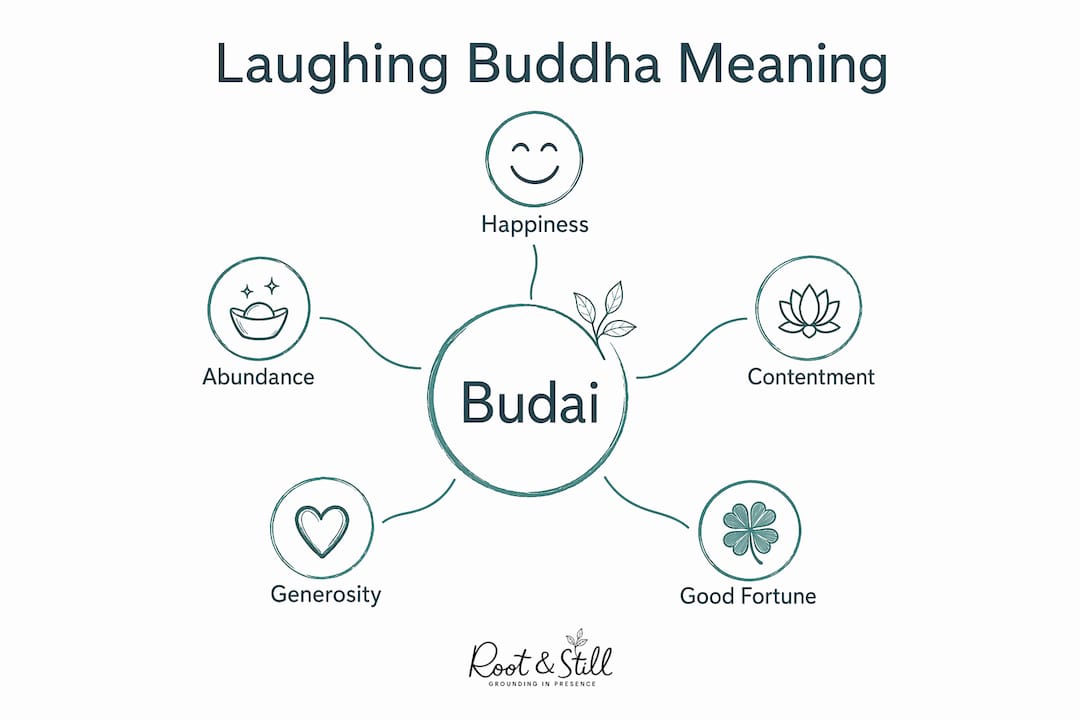
His large, exposed belly is probably the most recognisable feature. In Chinese and East Asian symbolism, a rounded belly signals abundance and contentment. It suggests someone who is well fed, at ease, and unburdened by anxiety. The Laughing Buddha symbolises five core virtues: happiness, abundance, contentment, generosity, and good fortune. The belly is the physical expression of all five at once.
His wide, open smile speaks directly to joy and generosity of spirit. It is not a polite smile. It is the kind of laughter that fills a room. This expression signals that Budai found delight in the ordinary world, a quality the Zen tradition values deeply.
The cloth sack he carries is layered with meaning. On one level, it holds gifts for children and those he met along the road. On another, it represents detachment from material possessions. He carried his belongings in a simple cloth bag, owning very little, yet giving freely. The sack is abundance without attachment.
His bald head reflects monastic life and the letting go of vanity. His posture, often seated or standing with arms raised, projects ease and openness rather than tension.
Pro Tip: Rubbing the belly of a Laughing Buddha figure is a meditative practice intended to focus your intention on contentment and gratitude. Treat it as a mindful pause rather than a wish-making ritual, and the gesture feels more grounded and more meaningful.
The symbols work together to deliver a single, coherent message: a good life is not one free of difficulty, but one met with joy, generosity, and an easy relationship with what you have.
Cultural significance across Asia and the wider world
The Laughing Buddha’s image did not stay within China’s borders. It followed the paths of trade, migration, and the spread of Zen Buddhism, taking on new layers of meaning in each place it reached.
In Japan, Budai became Hotei, one of the Seven Lucky Gods, a group of deities associated with good fortune and happiness. As Hotei, he is patron of fortune, children, and good health. His image appears in homes, restaurants, and temples throughout Japan, deeply embedded in folk tradition rather than formal Buddhist doctrine.
The table below shows how his significance and name shift across different cultures:
| Culture | Name | Primary association |
|---|---|---|
| China | Budai | Folk hero, Maitreya incarnation, generosity |
| Japan | Hotei | One of the Seven Lucky Gods, fortune and health |
| Vietnam | Bố Đại | Symbol of contentment and abundance |
| Western cultures | Fat Buddha / Happy Buddha | Good luck charm, home decor icon |
The Western reception is worth examining honestly. When his image spread to Europe and the Americas, it was largely stripped of its spiritual context and became a decorative good luck charm. Western perception frequently collapses Budai and Siddhartha into a single “Buddha” figure, erasing the distinct identity and tradition each represents. This matters if you want to engage with the symbol meaningfully rather than superficially.
In Feng Shui and Vastu Shastra, Budai functions as what some practitioners call an “abundance consciousness” tool. He is not worshipped in these contexts. He is placed intentionally to shift the energy of a space toward gratitude, openness, and generosity.
Using the Laughing Buddha in your home
Bringing a Laughing Buddha into your home is not about seeking magical outcomes. It is about choosing an object with presence and intention. When you understand what Budai represents, placing one in your home becomes a quiet act of choosing joy as a daily reference point.
Feng Shui offers clear guidance on placement, and it is worth following whether or not you subscribe to the tradition formally. The core principle is simple:
- Position the statue at eye level facing the main entrance. This placement is believed to welcome positive energy into the home and greet arrivals with warmth.
- Avoid placing him in bathrooms, on the floor, or in spaces associated with stress or clutter. The figure deserves a considered setting, not an afterthought shelf.
- Locate him in living rooms, hallways, or dedicated meditation corners where he can serve as a calm, visible reminder of contentment.
- Statues carrying a cloth bag are among the most traditional forms. Different postures and accessories carry slightly different emphases, so choose the one that resonates with what you want to invite.
In terms of materials and styling, the Laughing Buddha translates well across a range of interior aesthetics. Stone or resin finishes feel grounded and solid alongside natural textures like linen and rattan. Glazed ceramic versions in muted tones work well in lighter, more minimal spaces. A Laughing Buddha lamp takes the symbol into something both decorative and atmospheric, casting warm light that softens any corner.
Pro Tip: Pair a Buddha statue with a small dish for incense or a simple candle holder nearby. The combination creates a natural focal point in any room and makes the space feel more settled without demanding too much attention.
The wellness dimension is real, even if you prefer to keep things secular. Having a physical object that you associate with contentment and generosity acts as a gentle cue. Every time you notice it, you are reminded, briefly and quietly, of the virtues it represents.
My perspective on Budai’s enduring relevance
I have spent a good deal of time thinking about why the Laughing Buddha continues to speak to people across such different cultures and centuries. My honest view is that his appeal has very little to do with luck and almost everything to do with permission.
What Budai offers, at his core, is permission to be content with an ordinary life. In a culture that constantly frames contentment as complacency, his laughing image is quietly radical. He was not withdrawn, not suffering, not striving. He was present, generous, and joyful in the middle of the everyday world. As the Zen tradition reflects, his jovial nature embodies enlightenment within the practical realities of life rather than apart from them.
I think the mistake most people make is approaching him either as a lucky charm or dismissing him entirely as kitsch. Both responses miss something. When you take time to understand the cultural context, something shifts. You stop seeing a decorative ornament and start seeing a carefully constructed symbol of a whole philosophy: that a good life is available now, in the small moments, through generosity and ease.
For me, having a Laughing Buddha figure in a space is less about what it attracts and more about what it asks of you each time you notice it. That is a kind of mindfulness that does not require a meditation cushion.
— Dhriti
Bring that calm into your home with Rootandstill
If reading about the Laughing Buddha has made you want to bring that spirit of contentment into your own space, Rootandstill offers a thoughtfully curated range of pieces that do exactly that. Each statue and accessory is chosen for its presence as much as its appearance, designed to settle into a home and feel at ease there rather than demanding attention.
The standing Buddha statue is a particularly considered choice for hallways or living room corners, bringing warmth and a quiet sense of welcome to the most-used areas of your home. For those drawn to Feng Shui practice, the Buddha Feng Shui set in grey offers a composed, elegant starting point for intentional placement. Rootandstill also carries complementary incense accessories and candle holders that work alongside any statue to complete the atmosphere. Browse the full collection to find the piece that feels right for your space.
FAQ
Who is the Laughing Buddha, really?
The Laughing Buddha is Budai, a 10th-century Chinese Zen monk widely regarded in Chinese folklore as an incarnation of Maitreya, the Future Buddha. He is a distinct figure from Siddhartha Gautama, the historical founder of Buddhism.
What does the Laughing Buddha symbolise?
He represents five core virtues: happiness, abundance, contentment, generosity, and good fortune. Each of his physical features, including his belly, smile, and sack, carries a specific layer of this meaning.
Where is the best place to put a Laughing Buddha at home?
Feng Shui guidance recommends positioning him at eye level facing the main entrance to welcome positive energy. Avoid bathrooms or cluttered areas, and choose a spot where the figure feels considered and respected.
Is the Laughing Buddha a religious figure?
He originates within Chinese Buddhist and Zen tradition, but he functions more as a cultural and folk symbol than a deity. Engaging with his image is best understood as a mindfulness and gratitude practice rather than a form of religious worship.
Why is the Laughing Buddha so popular worldwide?
His appeal crosses cultures because his core message, that contentment and joy are available in ordinary life, is deeply human. His image spread globally through trade, Zen Buddhism’s international reach, and an instinctive warmth that translates without explanation.
Recommended
- What is a buddha statue? Meanings and origins explained – Root & Still
- What Buddha symbolises for mindfulness and home harmony – Root & Still
- Why gifting Buddha statues creates mindful, tranquil homes – Root & Still
- Laughing Buddha Lamp Sky Blue - Elegant Round Stand – Root & Still
- Buddha Gifts, A Complete UK Buying Guide


