

The reclining Buddha is defined as a representation of the historical Buddha entering parinirvana, his final liberation from the cycle of birth, death, and rebirth known as samsara. This is not a sleeping figure or a pose of rest. The posture carries precise doctrinal weight, and understanding it changes how you see every reclining Buddha statue you encounter, whether in a Thai temple, a Khmer pagoda, or a thoughtfully arranged corner of your own home.
What does the reclining Buddha represent in Buddhist teaching?
The reclining Buddha represents the Buddha’s passage into parinirvana, the state of complete liberation that follows physical death. Unlike ordinary death, parinirvana marks the end of all karmic cycles. The figure is not departing in sorrow but arriving at the deepest form of peace imaginable. This distinction is the foundation of the reclining Buddha’s meaning, and it shapes every artistic and devotional choice made in its depiction.
The term parinirvana comes from the Pali and Sanskrit traditions of Buddhism and refers specifically to the final nirvana attained at the moment of a fully enlightened being’s death. Different Buddhist traditions add interpretive layers, but the reclining Buddha fundamentally signifies the Buddha’s final passing and liberation. Recognising this gives the image its gravity. It is not decorative stillness. It is the visual language of ultimate release.
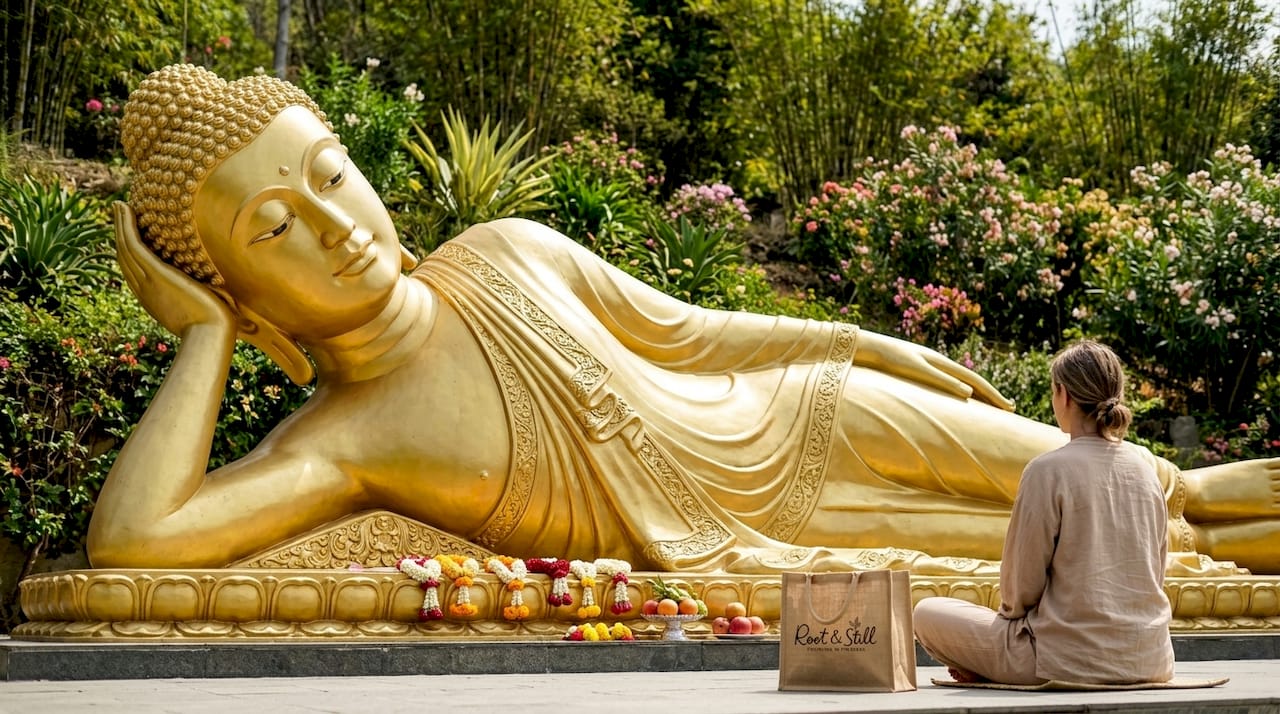
For those drawn to Buddha symbolism in mindfulness and home harmony, the reclining form carries a particular resonance. It invites you to sit with the idea that letting go is not loss. It is arrival.
What does the posture and expression of the reclining Buddha signify?
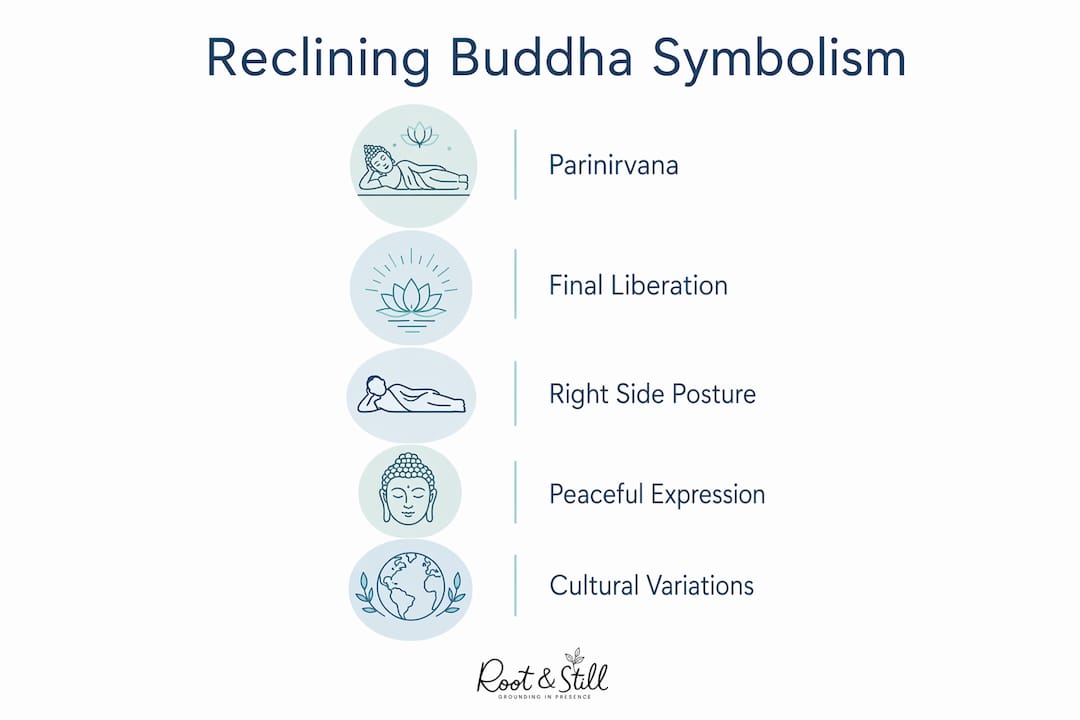
The posture of the reclining Buddha follows a strict iconographic convention. The right-side reclining posture with the head supported by the bent arm is a universal scene marker for the Buddha’s transition to parinirvana, independent of any surrounding narrative context. This means that even without inscriptions or surrounding figures, the posture alone communicates the moment of final passing. It functions as religious meaning, not mere compositional preference.
Several specific visual elements work together to convey this meaning:
- Right-side reclining posture. The Buddha lies on his right side, which in Indian and Buddhist tradition is associated with auspiciousness and spiritual dignity. Lying on the left side would carry entirely different connotations.
- Head resting on the right arm or a cushion. This detail appears consistently across cultures and centuries, reinforcing the canonical nature of the pose. The serene facial expression represents the Buddha’s last earthly moments, free from suffering.
- Eyes gently closed or half-open. The expression is one of profound calm, not sleep. There is a quality of settled awareness in the face that distinguishes parinirvana imagery from ordinary rest.
- Extended legs, relaxed body. The body carries no tension. Every line of the figure communicates release, not effort.
The materials used to render these figures also carry meaning. Gilded surfaces, smooth stone, and polished bronze are not simply aesthetic choices. They amplify the sense of sacred presence, catching light in ways that feel alive and reverential. Scale matters too. A large reclining Buddha fills a space with a kind of gravitational calm that a small figure cannot replicate in the same way.
Pro Tip: When choosing a reclining Buddha for your home, pay attention to the facial expression. A figure with a genuinely serene, settled quality will hold that atmosphere in a room far more effectively than one that simply looks horizontal.
How is the symbolism of the reclining Buddha interpreted across Buddhist cultures?
The core meaning of the reclining Buddha remains consistent across Buddhist traditions, but regional cultures have woven their own storytelling layers around it. Understanding these variations makes the image richer rather than more complicated.
-
Thai tradition. In Thailand, the reclining posture carries the standard parinirvana meaning but is also connected to a story of inner confidence and spiritual authority. Thai interpretation associates the posture with inner peace and a narrative about the conversion of a challenging spirit called Asura Rahu. In this story, the Buddha’s unshakeable calm in the face of a threatening presence becomes the very thing that transforms the encounter. The posture, then, is not only about death. It is also about the kind of peace that cannot be disturbed.
-
Khmer Theravada tradition. In Cambodia and among Khmer communities in Vietnam, large-scale reclining Buddhas are used specifically to depict the Buddha entering Nirvana. The 100-metre reclining Buddha at Serey Meang Kol Sa Kor Pagoda in An Giang province exemplifies this tradition. The sheer scale of these figures is deliberate. It communicates that the event being depicted is not a private moment but a cosmic one.
-
Sri Lankan and Southeast Asian Theravada traditions. Across these traditions, the reclining Buddha is consistently placed within temple complexes as a focal point for meditation and devotion. The figure anchors the space spiritually, giving practitioners a visual point of contemplation for teachings on impermanence and liberation.
-
Mahayana traditions. In East Asian Buddhism, reclining Buddha imagery appears less frequently than in Theravada contexts, but when it does appear, it carries the same parinirvana significance. The emphasis tends to fall on the Buddha’s compassionate final teachings to his disciples rather than on the moment of passing itself.
What this tells you is that interpreting a specific reclining Buddha requires attention to its cultural and architectural context. The posture is the constant. The story surrounding it shifts depending on where you are.
What makes famous reclining Buddha statues so spiritually powerful?
The most celebrated reclining Buddha statues in the world do not simply depict a moment. They create an environment. The Wat Pho Reclining Buddha in Bangkok is 46 metres long and 15 metres high, gilded entirely in gold leaf, and housed within a building that was designed specifically around its scale. This is not a statue placed in a room. The room was built to hold the statue, and the experience of standing beside it is one of spatial enclosure and quiet awe.
| Feature | Spiritual and artistic significance |
|---|---|
| 46-metre length, Wat Pho | Scale transforms the viewer’s experience into something immersive and devotional |
| Full gilding in gold leaf | Gilded surface plays with light to reinforce sacred presence and reverence |
| Architectural enclosure | The building surrounding the statue amplifies the sense of entering a sacred space |
| Mother-of-pearl inlay on feet | Decorative detail depicting the 108 auspicious signs of the Buddha, adding doctrinal depth |
| Repeated ornamental patterns | Temple ornamentation creates visual rhythm that slows the viewer and encourages contemplation |
The gilded surface of Wat Pho’s Reclining Buddha is a symbolic language in itself. Gold in Buddhist art represents the light of wisdom and the incorruptible nature of enlightenment. When light moves across a gilded surface, the figure seems to breathe. This is not accidental. It is the result of centuries of artistic tradition understanding that material and meaning are inseparable.
Pro Tip: If you are incorporating a reclining Buddha into a home setting, consider how light falls on the figure at different times of day. A piece placed where natural light shifts across it will feel more alive and present than one kept in static, even lighting.
How can the reclining Buddha’s meaning enrich your home and mindfulness practice?
Understanding what the reclining Buddha represents changes how you relate to it as an object in your space. It is not simply a decorative piece. It is a reminder of one of Buddhism’s most profound teachings: that release from suffering is possible, and that it looks like peace, not struggle.
- Letting go as a daily practice. The reclining Buddha’s symbolism of freedom from samsara speaks directly to the practice of non-attachment. Placing this figure where you see it regularly can serve as a gentle, daily prompt to release what no longer serves you.
- Creating a restful atmosphere. The serene expression and horizontal form of the reclining Buddha naturally soften the mood of a room. It gives a space permission to be still. Paired with natural materials such as stone, linen, or rattan, it anchors a room without dominating it.
- Respectful placement. The reclining Buddha depicts a sacred moment. Placing it at floor level or in a position where it might be stepped over is considered disrespectful in Buddhist tradition. A low shelf, a dedicated surface, or a garden setting where the figure has room to breathe all work well.
- Pairing with complementary elements. Incense, candles, and simple natural objects placed nearby deepen the contemplative quality of the space. The aim is not to recreate a temple but to create a corner of your home that feels genuinely settled and intentional.
For more guidance on mindful statue placement in interior design, the principles of balance, breathing room, and material harmony all apply directly to the reclining form.
Key takeaways
The reclining Buddha represents the Buddha’s entry into parinirvana, a state of complete liberation, conveyed through a canonical right-side posture, serene expression, and rich cultural traditions that deepen its spiritual resonance.
| Point | Details |
|---|---|
| Core symbolism | The reclining Buddha depicts parinirvana, the Buddha’s final liberation from the cycle of rebirth. |
| Posture as meaning | The right-side reclining posture with head supported is a universal iconographic marker, not a stylistic choice. |
| Cultural variations | Thai and Khmer traditions add narrative layers while preserving the central parinirvana significance. |
| Material and scale | Gilding, size, and architectural enclosure amplify the devotional impact of monumental reclining Buddhas. |
| Home practice | Understanding the symbolism transforms a reclining Buddha from decoration into a meaningful daily reminder of peace. |
Why the reclining Buddha has stayed with me
By Dhriti
I have spent a long time thinking about why the reclining Buddha feels different from other Buddhist iconographic forms. The seated meditating Buddha is about the journey inward. The standing Buddha is about presence and protection. But the reclining figure asks something harder of the viewer. It asks you to sit with an ending and find it beautiful.
What strikes me most is that the peaceful expression and right-side posture are not incidental. They are the entire point. The artists who created these figures across centuries understood that how you depict a moment shapes how people feel about what that moment means. They chose serenity deliberately. They chose gold deliberately. They chose scale deliberately. Every decision was in service of communicating that this passing was not a tragedy but a completion.
I also think there is something quietly radical about the reclining Buddha’s place in home decor. When you bring this figure into your living space, you are not simply adding a beautiful object. You are placing a reminder of impermanence and liberation where you eat breakfast, read in the evening, or sit quietly at the end of a long day. That is not a small thing. The meaning of the reclining Buddha is experienced through its material presence as much as through doctrine, and a well-chosen piece carries that presence into your daily life in a way that is both grounding and gently transformative.
— Dhriti
Bring a sense of stillness into your home
If the symbolism of the reclining Buddha has resonated with you, Rootandstill offers a curated selection of Buddha statues and devotional accessories designed to bring that same quality of calm into your everyday environment. Each piece is chosen for its craftsmanship, material presence, and ability to anchor a space with quiet intention. The standing Buddha statue at 1 metre tall brings a grounded, welcoming presence to living rooms, hallways, and garden settings. For a complete contemplative corner, the terracotta incense plate pairs beautifully with any Buddha figure, adding warmth, texture, and the gentle ritual of incense to your space. These are not ornaments. They are objects that hold meaning.
FAQ
What does the reclining Buddha represent?
The reclining Buddha represents the historical Buddha entering parinirvana, his final liberation from the cycle of birth and rebirth. The right-side posture and serene expression are canonical iconographic markers of this moment, not a depiction of sleep or rest.
Is the reclining Buddha sleeping or dying?
The reclining Buddha is neither sleeping nor dying in the ordinary sense. It depicts the Buddha’s passage into parinirvana, a state of complete liberation, which is considered the most peaceful and spiritually significant moment in his life.
Why does the reclining Buddha lie on his right side?
The right-side posture is a deliberate iconographic convention in Buddhist art, associated with auspiciousness and spiritual dignity. Right-side reclining with the head supported by the bent arm is the universal scene marker for the Buddha’s transition to parinirvana across all Buddhist traditions.
Does the reclining Buddha mean the same thing in all Buddhist cultures?
The core meaning of parinirvana is consistent across traditions, but regional cultures add their own narrative layers. Thai tradition connects the posture to inner peace and a story of spiritual confidence, while Khmer Theravada tradition uses large-scale reclining Buddhas specifically to depict the Buddha entering Nirvana.
Where should you place a reclining Buddha at home?
A reclining Buddha should be placed on a raised surface such as a shelf, table, or dedicated altar space, never at floor level where it might be stepped over. A position where natural light falls across the figure, paired with natural materials and incense, creates the most settled and respectful atmosphere.


