

A home altar is often the first thing people notice when visiting a practitioner’s space, and also the most frequently misunderstood. The role of altars in Buddhist homes goes far beyond aesthetics. Rather than serving as a decorative display, a Buddhist home altar functions as a practical support for attention, a sensory cue that signals to the mind that this is a space for stillness, reflection, and practice. This guide explores the symbolism behind common altar objects, how to set one up with intention, how to care for it daily, and how to let it grow honestly with your practice over time.
Key takeaways
| Point | Details |
|---|---|
| Altars support attention | A home altar works as a mental cue for practice, not as a decorative centrepiece. |
| Symbolism has purpose | Every item, from offering bowls to candles, carries specific meaning rooted in Buddhist teaching. |
| Start minimal | A single Buddha image, a clean surface, and one water offering is a complete and respectful starting point. |
| Daily care deepens practice | Filling bowls, lighting candles, and cleaning the altar are acts of mindfulness in themselves. |
| Let it evolve naturally | Add objects only as your understanding and commitment deepen, not as decoration accumulates. |
The role of altars in Buddhist homes
A Buddhist altar is not a shrine to an external deity. This distinction shapes everything. The Buddha image at the centre of a home altar represents your own capacity for awakened mind qualities: clarity, compassion, and awareness. When you look at the image, you are not praying to a figure above you. You are recognising a quality within you.

This is why altar objects function as teachers, prompting mindful attention rather than passive reverence. Each item on the altar has a role.
| Object | Symbolic meaning |
|---|---|
| Buddha image | Represents enlightened mind; the central focus of practice |
| Seven offering bowls | Water, flowers, incense, light, perfume, and food; each embodies a specific offering |
| Candles or butter lamps | Light as a symbol of awareness dispelling ignorance |
| Incense | Represents ethical conduct and the spread of virtue |
| Dharma text | One of the Three Jewels; a reminder that study is part of practice |
| Thangka (above) | Creates a vertical symbolic axis connecting practitioner to awakened qualities |
The seven offering bowls represent traditional offerings including water for drinking, water for washing, flowers, incense, light, perfume, and food. Each corresponds to an aspect of generosity and respect. The thangka, placed vertically above the statue, supports meditation visualisation by creating a spatial connection between the practitioner and the qualities symbolised above.
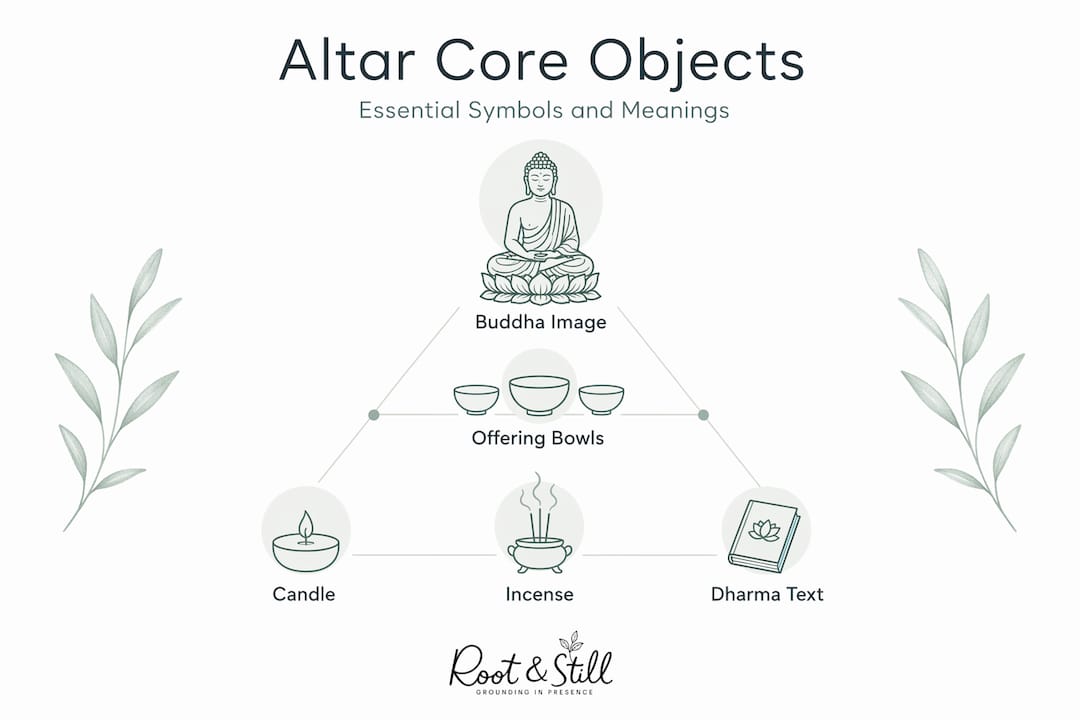
One object many people overlook is a Dharma text. Including a teaching on the altar completes the representation of the Three Jewels (Buddha, Dharma, Sangha) and reminds you that reading and reflection are not separate from sitting practice. The text belongs on the altar to be read, not just displayed.
What does not belong? Crystals, unrelated ornaments, and objects chosen purely for visual appeal can quietly shift the altar away from its function. Keep the surface uncluttered. Give each object room to breathe. The significance of altars rests on their clarity, not their complexity.
Setting up a Buddhist altar at home
The good news is that a sincere, functional altar can be remarkably simple. A minimal altar needs only a Buddha image, a clean and stable surface, and a single offering bowl filled with fresh water. That is enough to begin.
When choosing a location, look for a spot that feels calm and accessible. A shelf at eye level or a dedicated small table works well. Avoid placing the altar on the floor, where it would be walked past without acknowledgement, and avoid positioning it inside a wardrobe or tucked away where you will rarely see it. The altar supports your practice only when it is genuinely part of your day.
The central Buddha image should be positioned at a slightly elevated point so that you naturally look up towards it when seated or kneeling. Elevating the image reflects respect and also creates a visual focal point that steadies the gaze during meditation. If you are choosing a statue for the first time, thinking carefully about scale matters. A very large statue on a small shelf can feel imposing rather than restful. A guide to Buddha statue sizing can help you find a proportion that suits your space.
For lighting, candles are common and carry genuine symbolic weight. That said, candles should never burn unattended; this is both a safety concern and a matter of respectful practice.
Pro Tip: Design your altar so that the daily maintenance takes less than five minutes. Sustainable setups support daily consistency far better than elaborate arrangements that feel like a burden to maintain.
For those living in shared homes or with limited privacy, a smaller altar on a personal shelf or beside a reading chair works just as well as a dedicated room. The intention behind the space matters more than its size. Avoid the common beginner mistake of creating an ornate altar all at once. An over-elaborate setup that goes unmaintained quickly becomes visual noise rather than a support for stillness.
Daily altar practices and their meaning
The real spiritual role of altars emerges through daily use, not through how they look. The rituals that surround a home altar are not ceremonial obligations. They are practical training in attention, generosity, and non-attachment.
A structured morning or evening routine at the altar might look like this:
- Fill the offering bowls with fresh water, moving from left to right. This act of offering, repeated daily, trains the quality of generosity even before the formal practice begins.
- Light a candle or incense as a deliberate signal that practice is beginning. Offerings like light and incense serve as practice-state switches, marking the transition into meditation or study.
- Sit, chant, or recite mantra with the altar as your visual anchor. Even five minutes of focused attention in this space deepens the association between the altar and a settled, attentive mind.
- Empty the offering bowls at the end of the session or before bed, moving from right to left. Emptying them is as important as filling them. It reflects the Buddhist teaching on non-attachment: you offer fully, then release.
- Extinguish candles with care, never blowing them out dismissively. In many traditions, blowing out a flame with the breath is considered disrespectful; use a candle snuffer or gently fan the flame.
- Clean and tidy the altar surface as a closing act. This practice, known in Zen traditions as samu or mindful work, treats the physical care of the space as meditation itself.
Pro Tip: If you miss a day, simply begin again without self-criticism. The consistency of practice matters more than perfection. A simple, regularly used altar is worth far more than an elaborate one visited only occasionally.
Over time, you may notice that the altar begins to reflect your own growth. Objects you found meaningful at the start may shift in significance. New teachings may find their way onto the surface. This is entirely natural, and it is one of the quieter joys of maintaining a home altar.
Personalising your altar over time
One of the more freeing realisations about Buddhist altar practices is that there is no single correct configuration. Different Buddhist traditions, from Tibetan to Zen to Theravāda, approach altar arrangement differently, and your own setup can honour whichever lineage resonates with you while remaining authentic to your circumstances.
Start with what you can genuinely maintain. Then, as your practice deepens, add objects that carry real meaning rather than reaching for a prescribed look. A mala used in daily recitation, a small bowl from a teacher’s retreat, or a simple stone that grounds your attention are all appropriate additions when they are connected to lived practice rather than acquired for display.
A few principles worth keeping in mind:
- Avoid mixing symbols from different traditions without understanding their distinct contexts. A Tibetan deity figure and a Zen ensō painting can coexist respectfully, but placing them together without understanding is like collecting foreign words without knowing their meaning.
- Prioritise quality over quantity. One well-chosen, personally meaningful object settles the space more effectively than many.
- If you share your home with family members who do not practise, a smaller, self-contained altar that fits naturally into the room creates less friction. The importance of home altars does not diminish with scale.
- Altars evolve organically with the practitioner’s spiritual journey. Resist the urge to fill the space before your understanding catches up with the objects.
- Authenticity of practice matters more than authenticity of materials. A good quality print of a thangka serves the same function as a handcrafted original for most home practitioners.
The most honest test of your altar’s effectiveness is simple: does sitting near it make you feel more settled and attentive? If yes, it is doing its work.
My honest take on altar practice at home
I’ve spent a good deal of time observing how people actually relate to their altars, not how they intend to. And what I’ve noticed is that the most meaningful altars are rarely the most beautiful ones. The ones that carry genuine presence are the ones that show signs of daily life: a bowl that has been filled and emptied a thousand times, a candle holder darkened with use, a small statue that has been moved and replaced.
What I’ve found is that beginners often feel a kind of performance anxiety around setting up an altar. They want it to be right before they begin using it. But the altar does not come to life through arrangement. It comes to life through practice. I’ve seen incredibly sparse altars in modest flats carry more stillness than elaborate setups in dedicated rooms, simply because one practitioner showed up every morning and the other did not.
The harder truth I’ve learned is that the altar is never the practice itself. It is a support. And like any support, its value depends entirely on what you do with it. The practitioner who lights a single candle each morning with full attention is doing something more meaningful than someone who has seven offering bowls but fills them only when guests are coming.
Start where you are. Use what you have. Let the altar grow when you grow, not before.
— Root
Bring your altar to life with Rootandstill
If you are ready to create or refresh a home altar space, Rootandstill offers a considered selection of Buddha statues, incense accessories, and decorative pieces designed to bring stillness into everyday interiors. The standing Buddha statue makes a grounded and graceful centrepiece for larger altar spaces or garden arrangements, while the turquoise praying Buddha statue brings quiet presence to a dedicated corner or meditation room. For incense offerings, the natural terracotta incense plate handles the practical side of altar care with a texture that feels at home alongside stone and wood. Each piece is chosen to support genuine use rather than decoration alone.
FAQ
What is the main role of altars in Buddhist homes?
A Buddhist home altar serves as a practical support for attention and mindfulness, creating a sensory cue for meditation and daily practice. It is not a place of worship directed at an external deity, but a reminder of awakened qualities that exist within the practitioner.
How do you set up a Buddhist altar for the first time?
Begin with a clean, stable surface at a slightly elevated height, a single Buddha image, and one offering bowl filled with fresh water. Additional objects can be added gradually as your understanding and practice deepen.
What items belong on a Buddhist home altar?
Core items include a Buddha statue or image, offering bowls, a light source such as a candle, incense, and a Dharma text. Each object carries symbolic meaning, and the surface should remain uncluttered to preserve its function as a visual anchor.
How often should you maintain a Buddhist altar?
Daily care is ideal. Filling and emptying offering bowls, lighting and extinguishing candles with intention, and keeping the surface clean are all part of the practice itself. Consistency matters more than elaborate rituals.
Can a Buddhist altar be small or simple?
A minimal altar is not a lesser altar. A single well-placed Buddha image on a clean surface is a complete and respectful starting point, and many experienced practitioners maintain simple altars throughout their lives.


