

Mirrors act as energy multipliers in feng shui, doubling and redirecting chi based on what they reflect. Used with intention, they can draw more light, calm, and abundance into a room. Used carelessly, they amplify clutter and restless energy just as readily. Two rules govern everything: place a mirror to reflect something you genuinely want more of, and always choose a single, continuous piece of clear glass.
- Intention first: a mirror should reflect light, nature, art, or a tidy, beautiful surface.
- Quality always: one unbroken, undistorted sheet of glass; never cracked, chipped, cloudy, or made from fragmented tiles.
How do mirrors influence chi in a room?
Mirrors are energy multipliers in feng shui: they double whatever they face, which is why what a mirror reflects matters far more than how many mirrors you own. A mirror opposite a sunlit window draws more light and wood energy into the room. The same mirror facing a pile of post or an unmade bed doubles that visual noise instead.
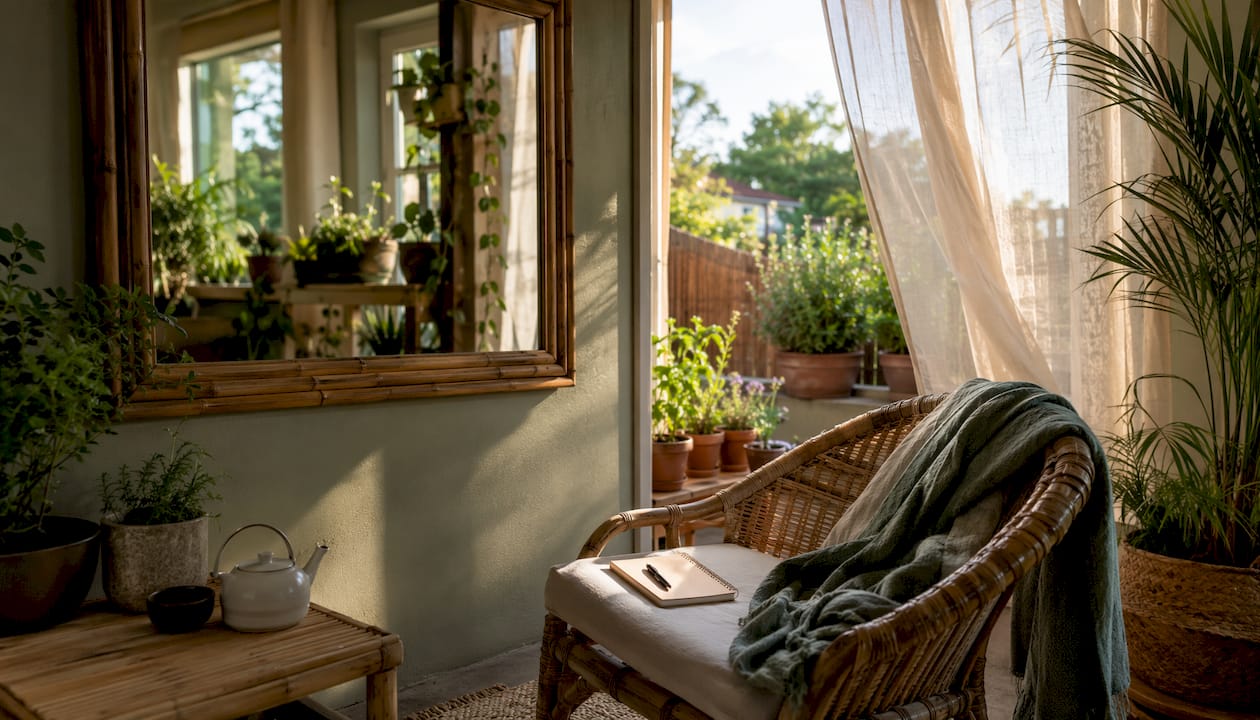
Chi, the vital life force in feng shui, moves along lines of sight. A mirror placed thoughtfully can guide that flow deeper into a room, making a narrow hallway feel more open or a dark corner feel alive. Practitioners consistently emphasise quality of reflection: a distorted or fragmented mirror scatters chi rather than directing it, which is why a single, clear sheet of glass is always preferred over mirrored mosaic tiles or antique glass with dark spots.
A simple illustration: position a mirror so it catches the view of a garden or a potted plant, and you effectively bring nature’s calm energy further into the room. That is the doubling effect working in your favour.
Room-by-room placement: where should you put mirrors?
Feng shui mirror placement is less about finding one perfect spot and more about avoiding reflections that create tension. Here is how that plays out room by room.
Entry and foyer: avoid placing a mirror directly opposite the front door. Design experts advise a perpendicular placement instead, so incoming energy is welcomed inward rather than bounced straight back out. Reflect a tidy console, flowers, or a softly lit wall.
Living room: use mirrors to reflect daylight, plants, or artwork. Avoid positioning them so they catch a busy television screen or constant movement, which adds stimulation rather than calm.
Dining room: a mirror reflecting a tidy, well-laid table is one of the most traditionally auspicious placements, symbolically doubling abundance and the warmth of shared meals.
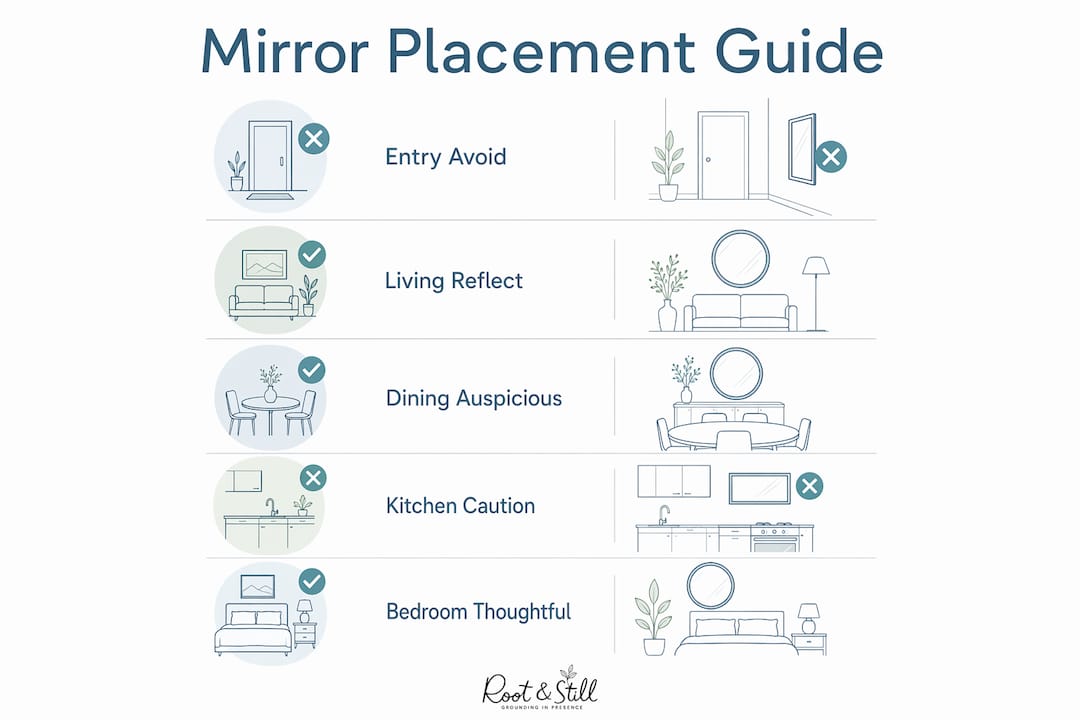
Kitchen: proceed with care here. Mirrors can amplify fire energy around the stove, so avoid reflecting burners directly. A mirror that catches a fruit bowl or a calm prep surface is a gentler choice.
Bedroom: this is where mirror placement requires the most thought. Avoid mirrors that face the bed or reflect you while sleeping, as this adds visual activity to a space that should feel settled and quiet. If you have built-in mirrored wardrobe doors, soft remedies such as a sheer fabric panel, a decorative film, or a tall plant placed in front can interrupt the direct reflection without replacing the furniture.
Pro Tip: Try the night test recommended by practitioners: cover bedroom mirrors for a week and notice whether your sleep feels more restful. If it does, the mirror’s position was likely affecting your rest.
Hallway and stair landings: mirrors can expand a narrow passage and keep energy moving, but avoid placing one at the very end of a long corridor, where it can trap rather than circulate chi.
Home office: a mirror positioned so you can see the door from your desk supports the commanding position, reducing the low-level alertness that comes from sitting with your back to an entrance. Keep the reflection clear of clutter or a busy background.
What kind of mirror should you choose?
The quality and shape of a mirror carry their own feng shui weight. Start with the most important rule: choose a single, continuous piece of clear glass. Broken, chipped, cloudy, or heavily segmented mirrors reflect distorted or broken energy, which practitioners consistently advise against.
| Mirror choice | Do | Avoid |
|---|---|---|
| Glass quality | Single, clear, undistorted sheet | Cracked, chipped, cloudy, or mosaic-tile mirrors |
| Shape | Round (metal/clarity), rectangular/tall (wood/growth), square (earth/stability) | Jagged, irregular, or sharply triangular frames |
| Size | Proportionate to the wall; reflects at natural eye level | Oversized mirrors that dominate a small room |
| Frame | Wooden frames (wood energy), metal frames (metal energy) | Heavily ornate frames that distract from the reflection |
| Placement angle | Hung so the reflection captures the room at eye level | Angled so it cuts across people’s heads or reflects only ceiling |
Shape carries symbolic meaning worth knowing. Round mirrors align with metal energy and bring clarity. Tall rectangular mirrors echo wood energy and a sense of upward growth. Square mirrors ground a space with earth energy. Sharply triangular or irregular shapes introduce fire energy, which can feel stimulating rather than restful in most rooms.
Sizing is straightforward: proportion the mirror to the wall and the sightline, not to the maximum space available. Hang it so the reflection sits at a natural eye level, giving it room to breathe rather than crowding the wall.
Pro Tip: The frame colour can nudge elemental balance. A pale wooden frame softens a room that already feels cool and metallic; a brushed brass frame adds warmth and grounding to a very neutral, earthy space.
How many mirrors is too many?
There is no fixed number, but moderation and intention are the governing principles. In rooms designed for relaxation, such as bedrooms and meditation spaces, fewer mirrors create a quieter atmosphere. One or two well-placed mirrors in a small room tend to serve better than several competing reflections.
Over-using mirrors in a single space can produce restless, overstimulated energy, the opposite of what most people are seeking. If a room already feels busy or unsettled, try covering or repositioning one mirror before adding soft textiles or plants to absorb some of that energy. Built-in mirrored wardrobes are a common challenge in UK bedrooms: a length of linen fabric hung across the doors, or a tall plant placed in front, can soften the reflection without any structural change.
Two mirrors facing each other create a visual loop that many people find disorienting. If a room already feels lively, one strong mirror with a calm reflection will serve it better than a pair.
Common myths and mistakes about feng shui mirrors
The most persistent myth is that more mirrors equal more prosperity. Overuse creates frenetic energy, not abundance, and intention always matters more than quantity.
Frequent mistakes to avoid:
- A mirror placed directly opposite the front door, which can push incoming energy back out rather than drawing it in.
- A mirror reflecting the bed, adding stimulation to a space meant for rest.
- Mirrors reflecting clutter, laundry, or unfinished workspaces, doubling visual stress.
- Two mirrors facing each other, creating a disorientating, repeating reflection.
- Cracked or cloudy mirrors left in place because they are decorative or sentimental.
Two quick corrective steps: run the night test for bedroom mirrors (cover them for a week and observe your sleep quality), and for any unfortunate reflection, place a plant or a decorative object to interrupt the line of sight before committing to moving furniture.
What a mirror reflects determines its feng shui effect far more than any fixed rule about compass direction or room type.
Styling mirrors with mindful decor
Mirrors work best when they amplify something genuinely worth doubling. Pair a mirror with a calm, intentional focal point and the reflection becomes an asset rather than a source of noise.
A practical example: place a Buddha Feng Shui Set on a console or shelf opposite a mirror, and the reflected image deepens the sense of calm the object already brings to the room. The mirror is no longer just reflecting space; it is amplifying a considered, peaceful presence. This is the principle of positive energy and well-being applied practically: choose what the mirror sees as carefully as you choose the mirror itself.
For meditation room accessories, the same logic applies. A single, clear mirror reflecting a singing bowl, a candle, or a plant creates a layered sense of depth and calm. The key is to test placements and observe the effect over a few days before settling on a position.
Understanding why Buddha statues face certain directions can also inform where you place a reflected focal point, since the direction a statue faces changes the quality of energy it brings to the room.
Your feng shui mirror checklist
Do:
- Reflect natural light, plants, artwork, or a tidy, beautiful surface.
- Use a single, unbroken piece of clear glass.
- Place mirrors at natural eye level so the reflection feels settled.
- Use a plant, fabric, or decorative film to soften unavoidable reflections.
Avoid:
- Mirrors directly opposite the front door.
- Mirrors reflecting the bed or a sleeping area.
- Mirrors reflecting clutter, laundry, or open storage.
- Cracked, chipped, or cloudy mirrors.
- Two mirrors facing each other in a room that already feels busy.
Test: try a new placement for three nights or three days and notice any shift in mood, light, or how settled the room feels. Small, incremental moves reveal more than a wholesale redesign.
How feng shui mirror practices translate to UK homes
Classical feng shui developed in a very different architectural context, so it is worth considering how its mirror principles adapt to the proportions and layouts common in British homes. Victorian terraces, for instance, often have long, narrow hallways with limited natural light. A mirror placed perpendicular to a window at the end of such a corridor can draw daylight deeper into the space without creating the trapped-energy effect of a mirror at the corridor’s very end.
Sash windows and bay windows, both common in UK properties, offer natural opportunities: a mirror angled to catch morning light from a south-facing sash can warm a north-facing room considerably. In open-plan kitchen-diners, which are increasingly standard in British new builds, the kitchen caution about fire energy still applies, but a mirror positioned to reflect the dining table rather than the hob achieves the abundance symbolism without amplifying heat.
Cultural interpretations of feng shui vary between traditional Chinese practice, the Western Black Hat school, and the more intuitive approaches that have become popular in the UK. All three converge on the same practical point: the reflection matters more than the compass bearing. For most UK homes, that means prioritising light, proportion, and what the mirror actually shows rather than seeking a single auspicious direction.
Using mirrors to correct or enhance specific feng shui areas
The bagua, feng shui’s energy map, divides a home into nine areas, each associated with a life aspect such as wealth, relationships, or career. Mirrors can be used to activate or correct specific areas, though the same quality and intention rules apply.
The wealth corner (south-east in classical feng shui) benefits from a mirror that reflects something abundant: a healthy plant, a bowl of fruit, or warm light. Placing two mirrors in the south-east to double prosperity energy is a traditional recommendation, though moderation still applies; one well-placed mirror with a clear, positive reflection often achieves more than two competing ones.
The relationship corner (south-west) responds well to mirrors that reflect paired objects or warm, soft light. Avoid placing a single mirror here that reflects an empty wall, as this can symbolically reinforce solitude rather than connection.
For the career area (north), a mirror that reflects flowing water, such as a tabletop water feature, or simply a window with a view of the sky, supports the water energy associated with this zone.
If a bagua area falls in a room with no natural light or a difficult layout, a mirror can correct the energy by bringing light and a sense of openness into that corner. The line of sight and what the mirror doubles determine its effect, so always stand at the mirror’s position and look at what it will reflect before committing to a placement.
Key takeaways
Mirrors in feng shui are amplifiers: what they reflect shapes the energy of a room, so intentional placement and good-quality glass matter above all else.
| Point | Details |
|---|---|
| Mirrors amplify what they face | Place mirrors to reflect light, nature, or calm decor; avoid clutter, beds, and open doors. |
| Quality of glass is non-negotiable | Use a single, clear, unbroken sheet; discard or replace cracked, cloudy, or fragmented mirrors. |
| Moderation in restful spaces | One or two mirrors in small or relaxation-focused rooms; avoid mirrors facing each other. |
| Test before committing | Try a placement for three days or nights and observe changes in mood and light before making it permanent. |
| Rootandstill focal points | Pairing a Buddha Feng Shui Set with a mirror amplifies calm rather than clutter. |
A practitioner’s perspective on small moves and real results
The most common mistake is treating mirror placement as a one-time decision. Rooms change with the seasons, with furniture rearrangements, with the way light shifts through a window in winter versus summer. A mirror that felt right in July can feel restless by November when the angle of light changes entirely.
What tends to work is keeping a simple observation log: note how a room feels on the first morning after a change, then again after three days. You are not looking for dramatic shifts. You are noticing whether the space feels slightly more settled, whether you linger in it a little longer, whether the light seems to reach further. Those small signals are the ones worth trusting. Wholesale redesigns are rarely necessary; a single mirror moved six inches, or covered with a length of linen at night, can shift the quality of a room in ways that feel genuinely measurable.
Mindful decor as a complement to mirrors
Mirrors are one tool, not the only one. If you want a calm, grounded focal point that a mirror can amplify, or a considered alternative when mirrors feel like too much, Rootandstill’s Buddha Feng Shui Set in Hamsa Grey offers exactly that kind of intentional presence. Place it on a console, a shelf, or a windowsill and let a nearby mirror do the work of deepening its calm rather than doubling visual noise.
The set pairs naturally with crystal prisms hung near a window, scattering light through the room in a way that complements rather than competes with a well-placed mirror. Choose what feels right for your space, test the arrangement for a few days, and trust what you observe.
Browse the full collection at rootandstill.com to find pieces that suit the energy you want to cultivate.
Useful sources and further reading
- How to Use Mirrors for Good Feng Shui — The Spruce: practitioner-informed placement guidance and quality rules.
- Feng Shui and Mirrors: Rules, Placement, and Common Mistakes — Tess Whitehurst: includes the bedroom night test and intention-led placement advice.
- Mirror Position Feng Shui — FengShuicore: explains the doubling effect and room-by-room examples.
- Mirror Placement Feng Shui Mistakes — FengShuied: focuses on what to avoid and why line of sight matters most.
- Where to Hang Mirrors for Good Feng Shui — Home Beautiful: design-focused guidance on entry and perpendicular placement.
- Feng Shui Mirrors — Common Mistakes — OkosKoti (UK): moderation and the myth of more mirrors equalling more prosperity.
- Crystal Suncatchers: Radiance and Energy for Your Space — CrystalPlace: partner article on using hanging crystals to redirect and scatter light.
- Why Buddha Statues Face Directions — Rootandstill blog.
- Best Decor for Meditation Room Spaces — Rootandstill blog.
FAQ
Do mirrors attract positive energy in feng shui?
Mirrors attract or amplify whatever they reflect. Placed to face light, nature, or calm decor, they can draw more of that quality into a room; placed to reflect clutter or a bed, they amplify those instead.
Where should you never place a mirror in feng shui?
Avoid placing a mirror directly opposite the front door, facing the bed, or reflecting areas of clutter or unfinished work. These positions tend to push energy out or amplify visual stress rather than supporting calm.
Does mirror shape matter in feng shui?
Shape carries symbolic meaning: round mirrors align with metal energy and clarity, tall rectangular mirrors with wood energy and growth, and square mirrors with earth energy and stability. Jagged or sharply irregular shapes introduce fire energy, which can feel unsettling in restful rooms.
How do you fix a mirror that is in the wrong position?
If a mirror cannot be moved, place a plant, a length of fabric, or a decorative object in front of it to interrupt the direct reflection. For bedroom mirrors, a temporary covering at night is a simple first step.
Can mirrors help with specific feng shui areas like the wealth corner?
A mirror in the south-east wealth corner that reflects something abundant, such as a healthy plant or warm light, can activate that area’s energy. The quality of the reflection still governs the effect, so keep the reflected view tidy and intentional.


