

Feng shui is defined as a 3,000-year-old Chinese system for arranging living spaces to harmonise energy flow and support well-being. The practice centres on chi (vital energy), the Bagua map, and the five elements: wood, fire, earth, metal, and water. Understanding feng shui means recognising it as a practical design discipline, not a mystical decoration trend. When you arrange your home with these principles in mind, you create an environment that feels settled, clear, and genuinely restful.
What is feng shui explained through its core principles?
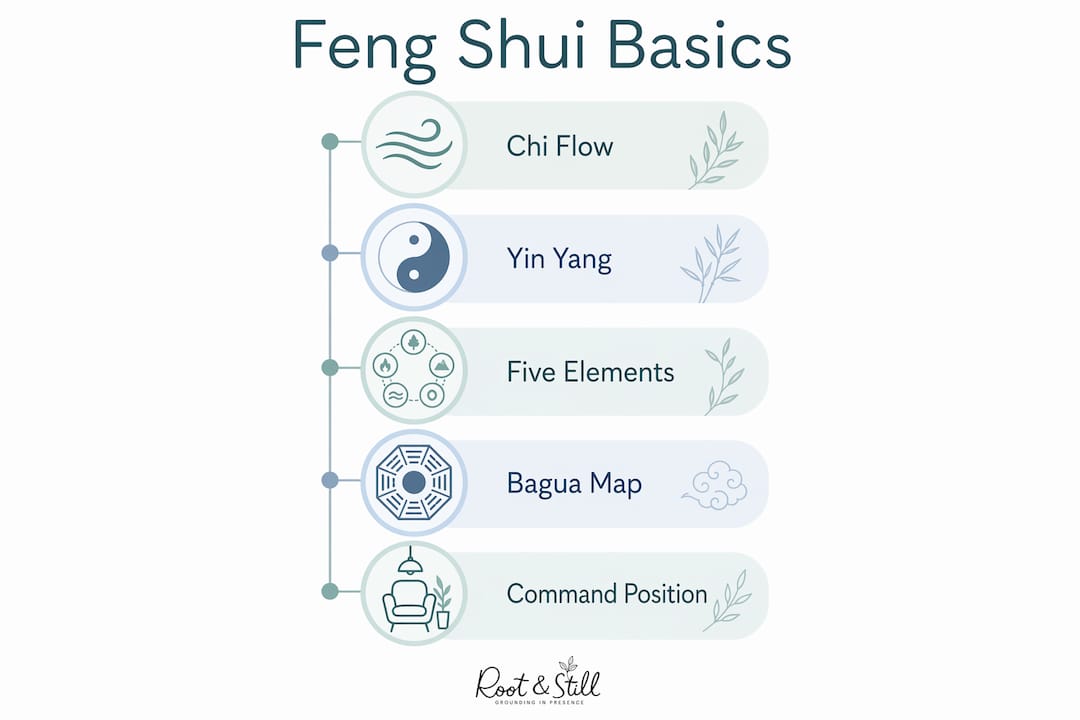
Feng shui is built on three interlocking concepts: chi, yin and yang, and the five elements. Chi is the vital energy that flows through every space, much like air through an open window. When chi moves freely, a room feels alive and welcoming. When it stagnates or rushes too fast, the space feels either heavy or unsettled.
Yin and yang describe complementary qualities rather than opposites. Bedrooms lean yin (restful, soft, cool) while kitchens and home offices lean yang (active, bright, warm). The goal is not strict equality but a balance suited to each room’s purpose. A bedroom flooded with harsh light and bold red walls works against its yin function, regardless of how stylish it looks.
The five elements guide colour, material, and shape choices throughout your home. Each element interacts with the others in either a productive cycle (wood feeds fire, fire creates earth) or a controlling cycle (water extinguishes fire, metal cuts wood). Choosing materials and colours that support rather than conflict with each other is the practical heart of this system.
The Bagua map is an eight-sector energy grid overlaid onto your home’s floor plan. Each sector corresponds to a life area: wealth, fame, relationships, family, health, creativity, knowledge, and career. Aligning the right colours, shapes, and elements within each sector is how feng shui connects your physical space to your personal life.
| Element | Colours | Shapes | Associated life area |
|---|---|---|---|
| Wood | Green, teal | Tall, columnar | Family, growth |
| Fire | Red, orange | Triangular, pointed | Fame, recognition |
| Earth | Yellow, terracotta | Square, flat | Relationships, health |
| Metal | White, grey | Round, circular | Creativity, helpful people |
| Water | Black, navy | Wavy, flowing | Career, wisdom |
How does feng shui work in a real home?
The commanding position is the single most practical concept in feng shui. Placing your bed so you have a clear view of the door without lying directly in line with it creates a sense of psychological safety. The same principle applies to your desk. When you can see who enters the room without being startled, your nervous system relaxes, and focus comes more naturally.
Clear pathways matter as much as furniture placement. Cluttered or blocked spaces reflect stalled energy and, symbolically, stalled opportunity. A hallway stacked with shoes and bags signals to your mind that movement is difficult before you have even sat down. Keeping routes through your home open and unobstructed allows chi to circulate rather than pool in corners.
Lighting and colour work together to support elemental balance. A room that needs more fire energy benefits from warm amber lighting and terracotta tones. A space that feels too stimulating can be softened with navy textiles and rounded metal accents. You do not need to redecorate entirely. Swapping a lampshade, adding a stone bowl, or hanging a piece of artwork in the right sector can shift a room’s feeling noticeably.
A few common placement mistakes disrupt energy flow more than most people realise:
- Doors blocked by furniture or clutter cannot open fully, which physically and symbolically impedes opportunity.
- Mirrors placed opposite windows reflect chi back out of the home rather than circulating it inward.
- Mirrors facing a fireplace create a water-over-fire conflict between the two elements.
- Forced symmetry that blocks natural traffic flow creates stagnant energy despite looking visually balanced.
- Beds or desks pushed against walls with no breathing room restrict the commanding position’s effectiveness.
Pro Tip: Treat your front door as the “mouth of chi.” Clear the entrance of clutter, repair any sticking hinges, and make sure the door opens fully. This single step has a greater effect on energy flow than any decorative object you could add.
What are the real benefits of feng shui, and what is it not?
Feng shui is not a magic fix, and consistency matters far more than symbolic objects. Buying an expensive lucky charm and placing it on a cluttered shelf achieves nothing. The practice works by removing environmental blocks that drain your attention and raise your stress levels without you noticing.
The connection to environmental psychology is genuine. Decluttering reduces cortisol. A clear, well-lit space with natural materials supports focus and lowers mental fatigue. Feng shui recommendations around bed placement and room layout align closely with sleep hygiene research, even though the two disciplines developed independently. That overlap is not coincidence. Both are observing how physical environments shape human behaviour.
The realistic benefits of a well-arranged home include:
- Reduced background stress from visual clutter and blocked pathways.
- Improved sleep quality through better bedroom layout and reduced stimulation.
- Greater focus at a desk positioned in the commanding position.
- A calmer, more welcoming entrance that sets the tone for your whole home.
- A stronger sense of intention and care in how you inhabit your space.
What feng shui does not do is substitute for addressing the root causes of life challenges. A well-arranged bedroom will not resolve a difficult relationship on its own. What it does is remove the environmental friction that makes everything harder. Think of it as clearing the ground rather than planting the seeds.
Pro Tip: Be careful with mirror placement. A mirror opposite a fireplace creates an elemental conflict between water and fire energies. Position mirrors on side walls instead, where they circulate light without disrupting the room’s elemental balance.
Pairing feng shui principles with crystals for energetic balance is a natural extension of the practice. Specific crystals are associated with particular elements and Bagua sectors, making them a considered rather than arbitrary addition to a feng shui-informed space.
How do you start applying feng shui to your home?
Beginning with feng shui does not require a full renovation or a specialist consultation. The most effective first steps are also the simplest, and they work in any home, from a studio flat to a four-bedroom house.
- Declutter your entrance. Remove shoes, bags, and anything that prevents your front door from opening fully. This is the highest-impact single action in feng shui.
- Overlay the Bagua map. Align the map with your front door as the base. Identify which rooms or zones correspond to which life areas, and note where you feel the most friction.
- Reposition your bed and desk. Move both so you have a diagonal view of the door without being directly in line with it. If your room layout makes this impossible, a mirror angled to reflect the door achieves a similar effect.
- Introduce the five elements thoughtfully. You do not need all five in every room. Choose one or two that support the room’s function. A wooden plant in the family sector, a round metal bowl in the creativity corner, or a small water feature near the entrance all count.
- Maintain the space regularly. Feng shui is not a one-time arrangement. Dust, clutter, and blocked pathways return. A weekly reset of key areas keeps chi moving.
For smaller homes and apartments, the Bagua map scales to any floor plan. You can apply it to a single room rather than the whole property. A studio flat benefits just as much from a well-positioned bed and a clear entrance as a larger home does. The principles do not change with square footage.
Exploring spiritual home décor alongside feng shui principles helps you make more intentional choices about the objects you bring into your space. Every item carries a quality, and choosing with awareness is itself a feng shui practice.
Key takeaways
Feng shui works by removing environmental blocks through deliberate arrangement, elemental balance, and consistent upkeep, not through symbolic objects or decorative luck.
| Point | Details |
|---|---|
| Chi flows through arrangement | Furniture placement and clear pathways determine how energy moves through your home. |
| Yin-yang balance is room-specific | Match the room’s energy quality to its function: restful for bedrooms, active for workspaces. |
| Five elements guide materials and colour | Use the productive cycle to choose colours, shapes, and textures that support each life area. |
| Commanding position improves well-being | Positioning your bed or desk with a door view supports psychological safety and better sleep. |
| Consistency outweighs decoration | Regular decluttering and maintenance have a greater effect than any symbolic object. |
Why I think feng shui deserves more credit than it gets
Most people dismiss feng shui as superstition, and I understand why. The language around chi and energy maps can sound abstract. But when you strip it back to what it actually asks you to do, the practice is remarkably grounded. Clear your entrance. Position your bed so you feel safe. Remove what you do not use. Balance stimulation with calm.
What struck me most, after spending time with these principles, was how much the small structural details matter. A door that sticks slightly. A desk facing a wall. A hallway that always feels slightly oppressive. These are not dramatic problems, but they create a low-level friction that accumulates over time. Feng shui gives you a framework for noticing and addressing that friction before it becomes chronic stress.
The one thing I would caution against is treating it as a shopping list. The instinct to buy a new object for every sector of the Bagua map misses the point entirely. The practice begins with subtraction, not addition. Once the space feels clear and settled, then you consider what to bring in, and why.
Feng shui is a supportive tool. It works best when you approach it with patience and genuine attention to how your home feels to live in, not just how it looks.
— Dhriti
Bring feng shui principles into your home with Rootandstill
Rootandstill curates handmade pieces designed to complement a mindful, balanced home. The Buddha Feng Shui Set brings together symbolic elements in a single, considered arrangement, making it a natural starting point for anyone applying feng shui to their space. For a grounding presence in a meditation corner or wealth sector, the antique Buddha figurine carries both aesthetic calm and elemental earth energy. Each piece is chosen for its quality and intention, not just its appearance. Browse the full range of wellness-focused home décor at Rootandstill to find pieces that feel right for your space.
FAQ
What does feng shui mean, literally?
Feng shui translates from Chinese as “wind and water,” referring to the natural forces that carry and shape energy through an environment.
Do I need to follow the Bagua map exactly?
The Bagua map is a guide, not a strict rule. Applying it to one room or your entrance area is a perfectly valid starting point, especially in smaller homes.
Is there any scientific basis for feng shui?
No peer-reviewed evidence validates feng shui as a complete system. However, many of its core recommendations, such as bed placement for sleep and decluttering for stress reduction, align with established environmental psychology research.
What is the most common feng shui mistake beginners make?
The most common mistake is adding decorative objects before addressing clutter and layout. Clearing blocked pathways and repositioning key furniture always comes first.
Can feng shui work in a small flat or studio?
The Bagua map and the five elements scale to any space. A studio flat benefits from the same core principles as a larger home, with the map applied to the single room or even a specific zone within it.


