

Tibetan Buddhism is defined as a branch of Mahayana Buddhism that incorporates Vajrayana tantric practices, aiming to achieve enlightenment within a single lifetime. This accelerated path to enlightenment contrasts sharply with traditional Mahayana timelines spanning countless aeons. Rooted in the high plateaus of Tibet and spread across the Himalayan regions of Bhutan, Nepal, and Mongolia, it draws directly from Indian Buddhist tantra transmitted by masters from the 8th century CE onward. Understanding what is Tibetan Buddhism means recognising a living tradition that is simultaneously a philosophy, a meditation science, and a complete cultural civilisation.
What are the main schools within Tibetan Buddhism?
Four primary schools define the Tibetan Buddhist tradition: Nyingma, Kagyu, Sakya, and Gelug. The four main schools share over 80% of their doctrinal foundations, with differences often rooted in terminology, lineage emphasis, and dedicated practices rather than fundamental disagreement. That degree of overlap means the schools are better understood as complementary streams than competing sects.
| School | Founded | Key emphasis |
|---|---|---|
| Nyingma | 8th century CE | Dzogchen (Great Perfection) meditation |
| Kagyu | 11th century CE | Mahamudra and oral transmission lineages |
| Sakya | 11th century CE | Scholarly study and tantric ritual |
| Gelug | 14th–15th century CE | Monastic discipline and Madhyamika philosophy |
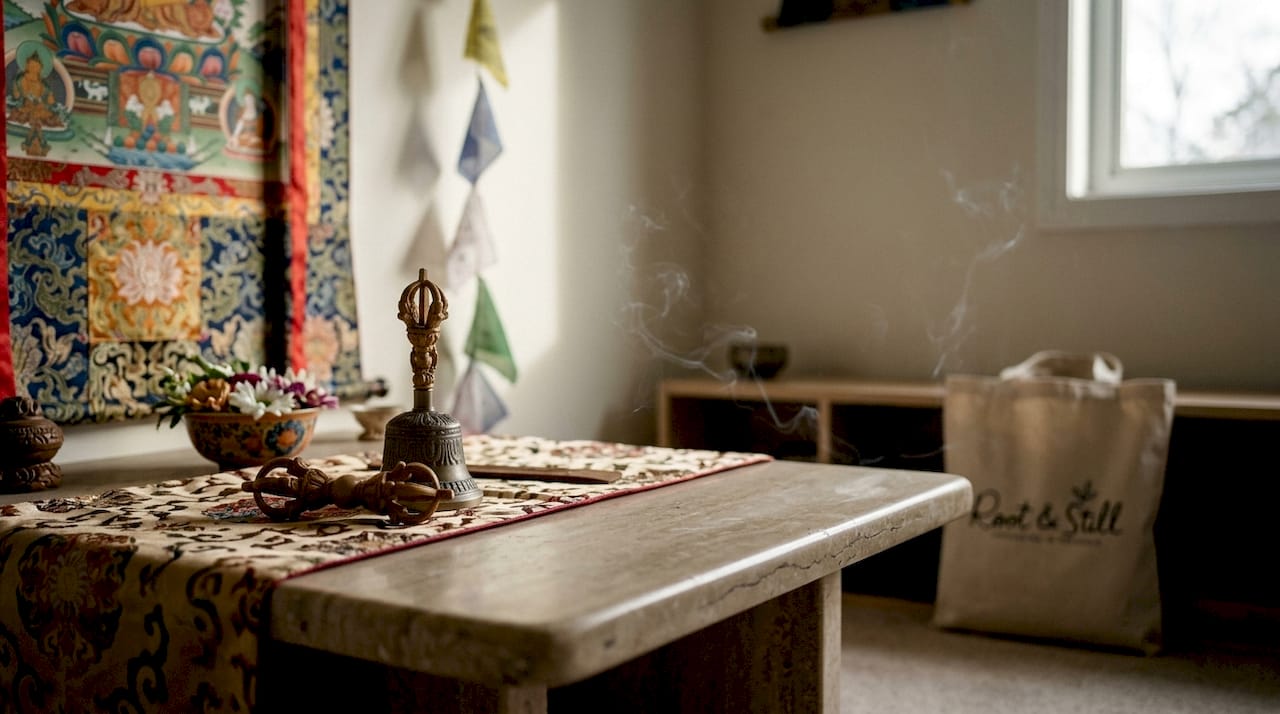
The Gelug school is the youngest and is most widely recognised in the West, largely because the Dalai Lama belongs to this lineage. Nyingma is the oldest, tracing its origins to the Indian master Padmasambhava, who is credited with establishing Buddhism in Tibet in the 8th century. Minor traditions such as Jonang and Bön, the pre-Buddhist indigenous religion of Tibet, have also shaped the broader Tibetan spiritual world, lending it a richness that no single school fully captures.
What do Tibetan Buddhists believe?
The philosophical heart of Tibetan Buddhism rests on two pillars: Mahayana compassion and Vajrayana transformation. The Mahayana ideal centres on the Bodhisattva, a being who vows to attain enlightenment not for personal liberation alone, but for the benefit of all sentient beings. This universal compassion is not a sentiment but a disciplined orientation that shapes every aspect of practice and daily life.
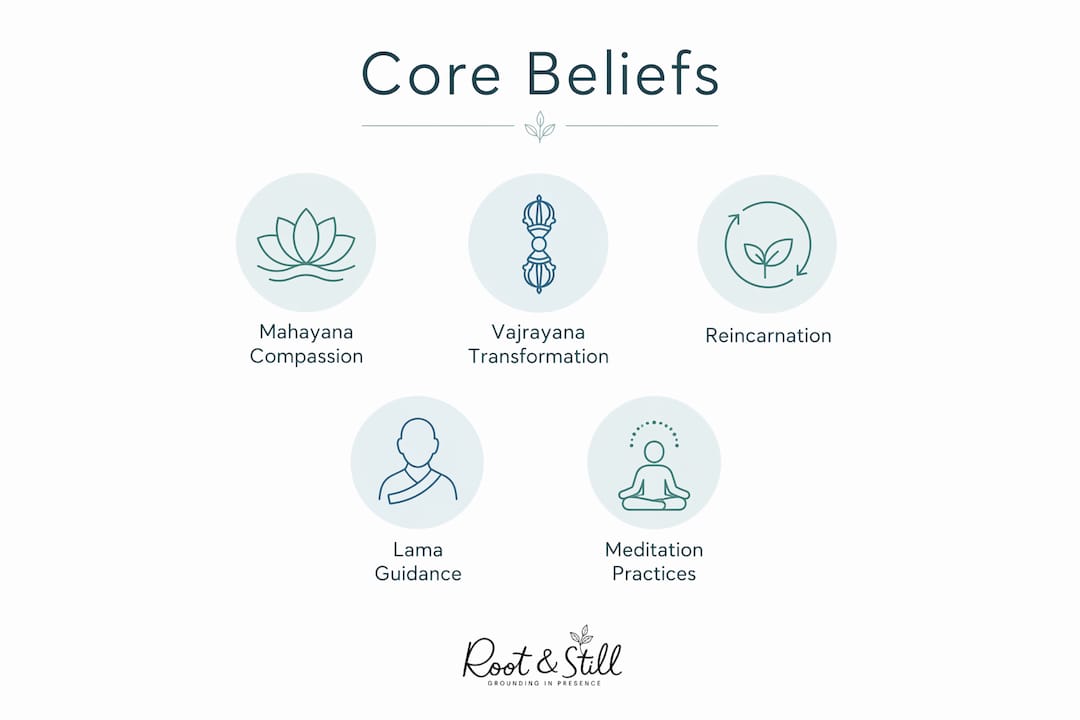
Vajrayana, often translated as the “diamond vehicle,” takes this compassionate aspiration and adds a powerful set of tantric methods. Vajrayana teaches practitioners to embody Buddhahood qualities immediately through visualisation and ritual, functioning as a sophisticated psychological system rather than anything resembling magic. The goal is to recognise and stabilise one’s own innate awakened nature, using the mind’s own energy as the path.
The philosophical foundation underpinning all of this is Madhyamika, the “middle way” philosophy. Madhyamika holds that ultimate truth is accessible only to a Buddha’s transcendent insight, while provisional teachings and rituals serve as skilful means guiding practitioners toward that realisation. This is why Tibetan Buddhism can appear elaborate and symbol-laden. Every ritual object, colour, and gesture points toward a deeper truth that words alone cannot convey.
“The genius of Tibetan Buddhism lies in integrating Mahayana universal compassion with tantric mind transformation within societal and supernatural contexts.” — Geoffrey Samuel, Introducing Tibetan Buddhism
A common misconception is that Tibetan Buddhist rituals involve supernatural manipulation of the world. The tradition itself is clear: rituals are tools for reshaping the mind, not the external environment. The colourful imagery of wrathful deities and elaborate mandalas represents psychological states and qualities of awareness, not literal beings to be appeased.
What are the key practices in Tibetan Buddhism?
Tibetan Buddhist practice follows a structured progression, beginning with foundational work before advancing to deeper meditation. The main stages are:
- Ngondro (preliminary practices): These involve thousands of repeated prostrations, prayers, and visualisations that purify the mind and prepare it for advanced tantra. Ngondro practices are often overlooked in favour of the tradition’s more colourful ritual elements, but they are the essential structural training that makes everything else possible.
- Shamatha (calm abiding): A foundational meditation that trains the mind to rest in stable, undistracted awareness. Without this settled quality of attention, deeper practices lack the ground they need.
- Lojong (mind training): A set of teachings, including the practice of Tonglen, that systematically cultivate compassion by training the practitioner to exchange their own happiness for the suffering of others.
- Mahamudra and Dzogchen: Advanced meditation systems pointing directly to the nature of mind. Both are considered the pinnacle of their respective lineages and are transmitted only through close teacher-student relationships.
- Mantra, mandala, and ritual: Mantras for mental transformation and ritual mandalas are used to align the practitioner’s body, speech, and mind with enlightened qualities. The famous mantra Om Mani Padme Hum is associated with Avalokiteshvara, the Bodhisattva of compassion.
The role of the lama, or spiritual teacher, is central to all of this. Without a qualified lama, tantric practices are considered incomplete or ineffective, because the teacher provides the transmission and context that give the techniques their power. This is not blind deference. It is a recognition that certain forms of knowledge pass from person to person, not from page to page.
Pro Tip: If you are new to Tibetan Buddhist meditation, begin with Shamatha practice before anything else. Even ten minutes of daily breath awareness builds the mental stability that all other practices depend on. You can support this with a calm, dedicated space at home, using singing bowls for meditation to mark the beginning and end of your sessions.
How has Tibetan Buddhism shaped culture and society?
Tibetan Buddhism has been inseparable from Tibetan social and political life for over a millennium. The Dalai Lama has historically served as both spiritual and temporal leader, a role that reflects how deeply the tradition shaped governance, law, and community identity. Since the 1959 exile, diaspora communities in India, Nepal, and across the West have preserved and actively spread these teachings, ensuring the tradition’s continuity beyond its homeland.
The cultural contributions of Tibetan Buddhism extend well beyond meditation:
- Monastic scholarship: Tibetan monasteries produced vast libraries of philosophical commentary, medical texts, and astronomical knowledge, preserving Indian Buddhist thought that was lost elsewhere.
- Sacred art: Thangka paintings, sand mandalas, and ritual sculpture are not decorative objects. Each follows precise iconographic rules designed to evoke specific qualities of mind in the viewer.
- Music and chant: Overtone chanting and the use of ritual instruments such as the dungchen (long horn) and singing bowls create sonic environments intended to support meditation and ceremony.
- Global mindfulness: Modern mindfulness practices derive narrowly from Tibetan and other Buddhist traditions. The full system, however, embodies a civilisation of ritual, monastic learning, and philosophy that popular wellness culture rarely acknowledges.
The tradition has also adapted creatively in the West. Practices like Tonglen have been integrated into psychotherapy, and teachers have developed approaches that make ancient methods accessible without stripping them of their depth. That said, Tibetan Buddhism’s global spread is most meaningful when it carries the full weight of its philosophical and ethical framework, not just its most photogenic elements. If you are drawn to the aesthetic of Tibetan Buddhist art, a thoughtful gift for a philosophy lover can be a meaningful way to honour that connection.
Key takeaways
Tibetan Buddhism is a complete spiritual civilisation, combining Mahayana compassion, Vajrayana transformation, and a structured path of practice that requires both a qualified teacher and sustained personal commitment.
| Point | Details |
|---|---|
| Unique accelerated path | Tibetan Buddhism aims for enlightenment in one lifetime through Vajrayana tantric methods. |
| Four main schools | Nyingma, Kagyu, Sakya, and Gelug share over 80% of their doctrine but differ in lineage and emphasis. |
| Philosophy and ritual | Madhyamika philosophy underpins all ritual, which functions as skilful means toward realisation. |
| Role of the lama | A qualified teacher is not optional; lineage transmission gives tantric practices their effectiveness. |
| Cultural depth | The tradition encompasses monastic scholarship, sacred art, music, and a living diaspora community. |
Why Tibetan Buddhism deserves more than a surface reading
by Dhriti
What strikes me most about Tibetan Buddhism is how thoroughly it resists being reduced to an aesthetic. People encounter a singing bowl, a thangka painting, or a statue of a serene Buddha, and they feel something real. That feeling is not an accident. These objects carry centuries of intentional design, each one calibrated to evoke a specific quality of awareness. But the tradition behind them is far more demanding and far more rewarding than the objects alone suggest.
The teacher-student relationship is the element most misunderstood in Western contexts. We tend to think of spiritual guidance as something we can access through books or apps. Tibetan Buddhism insists otherwise. The lama does not simply teach concepts; they transmit a living current of practice that has passed from person to person since the 8th century. That is not mysticism for its own sake. It is a recognition that certain forms of understanding require a human relationship to take root.
What I find most compelling is the tradition’s refusal to separate compassion from wisdom. Lojong mind training, for instance, is not a feel-good exercise. It is a systematic dismantling of the self-centredness that causes suffering, done with rigour and patience over years. The colourful rituals are the surface. Beneath them is one of the most psychologically sophisticated systems of human development ever devised. Approach it with respectful curiosity, and it will meet you with extraordinary depth.
— Dhriti
Bring a sense of stillness into your home
Tibetan Buddhist art and ritual objects carry a presence that is hard to describe but easy to feel. At Rootandstill, you will find a thoughtfully chosen range of pieces inspired by this tradition, from antique Buddha figurines that carry a quiet, settled quality, to brass meditation Buddha figures suited to a personal altar or a calm corner of your home. Rootandstill also offers Tibetan singing and healing bowls that bring the resonance of traditional practice into everyday spaces. Each piece is chosen with care, for those who want their home to feel grounded, restful, and genuinely intentional.
FAQ
What is Tibetan Buddhism in simple terms?
Tibetan Buddhism is a form of Buddhism that combines Mahayana philosophy, which focuses on compassion for all beings, with Vajrayana tantric practices designed to accelerate the path to enlightenment within a single lifetime.
How is Tibetan Buddhism different from Zen?
Tibetan Buddhism uses elaborate rituals, visualisations, mantras, and a structured relationship with a lama, while Zen emphasises direct, silent meditation and minimal ritual. Both aim at awakening but use very different methods and cultural frameworks.
What are the four schools of Tibetan Buddhism?
The four main schools are Nyingma, Kagyu, Sakya, and Gelug. They share the vast majority of their doctrine but differ in lineage, meditation emphasis, and the specific tantric systems they prioritise.
Do Tibetan Buddhists believe in reincarnation?
Tibetan Buddhists hold that consciousness continues through successive rebirths until enlightenment is attained. The recognition of reincarnated lamas, including the Dalai Lama, is a distinctive and central feature of the tradition.
Can anyone practise Tibetan Buddhism?
Tibetan Buddhist teachings are open to anyone with sincere interest, but advanced tantric practices require initiation and guidance from a qualified lama. Foundational practices such as Shamatha meditation and Lojong mind training are accessible starting points for any curious reader.


