The Bodhi Tree is defined as the sacred fig tree (Ficus religiosa) under which Siddhartha Gautama attained enlightenment at Bodh Gaya, India, making it the most revered natural symbol in Buddhist tradition. The word “Bodhi” translates directly from Sanskrit as awakening or enlightenment. Understanding what does the Bodhi tree mean goes well beyond a single historical event. The tree carries layered symbolism rooted in wisdom, patience, interconnectedness, and liberation — qualities that remain as relevant to modern mindfulness practice as they were over 2,500 years ago.
What does the bodhi tree mean in buddhist tradition?
The Bodhi Tree is not simply a species of fig. It is a sacred symbol of awakening, wisdom, steadiness, and interconnectedness in Buddhist practice. The distinction matters because it shapes how practitioners relate to the tree, not as a magical object, but as a living reminder of what the human mind is capable of.
The tree belongs to the Ficus religiosa species, widely known across South Asia as the peepul or peepal tree, belonging to the Moraceae family. It is a large, long-lived tree with distinctive heart-shaped leaves that tremble in the lightest breeze. That constant, gentle movement has itself become a metaphor for the responsive, aware mind.

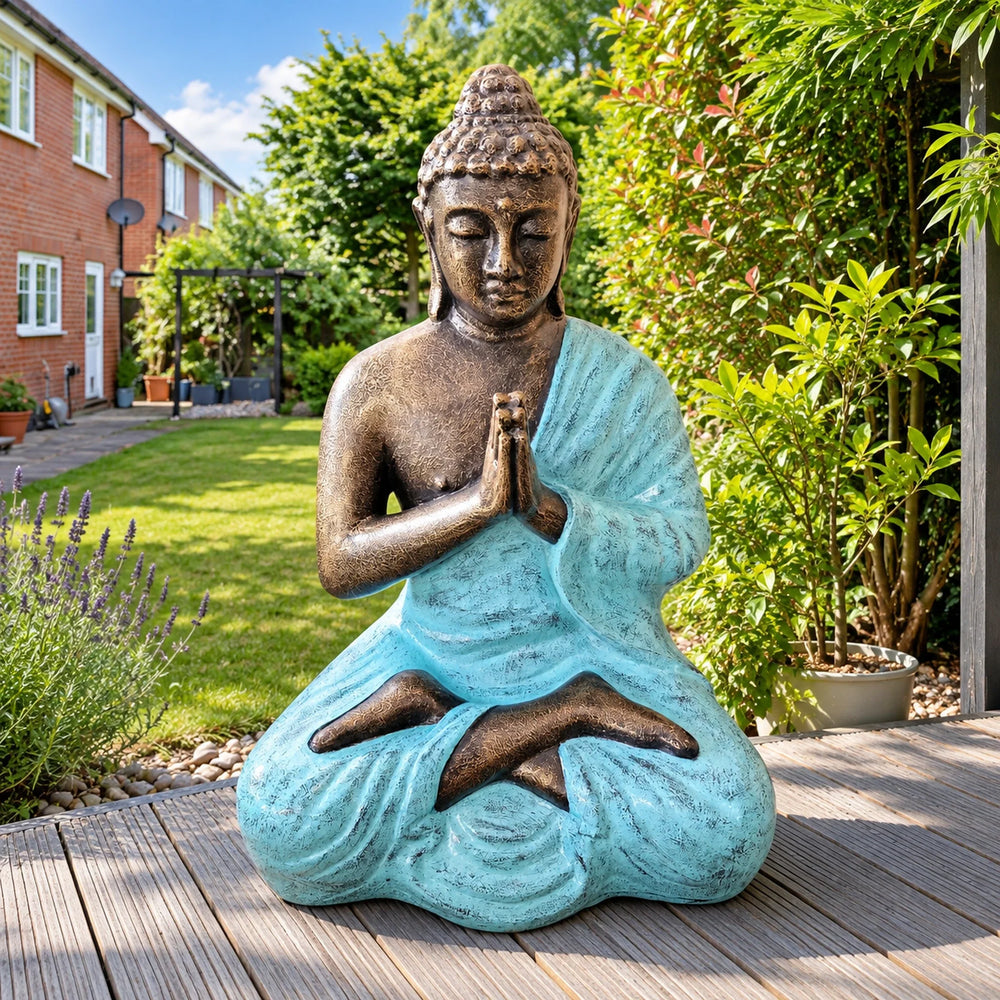
Shop Now: Large Outdoor Garden Buddha Teaching Statue on Lotus - Turquoise & Stone - 2m
What sets an authentic Bodhi Tree apart from any ordinary peepul is lineage. Authentic Bodhi Trees are genealogically traced descendants of the original tree at Bodh Gaya. Not every Ficus religiosa qualifies. The sanctity arises from the historic event of enlightenment, not from the species itself.
The tree holds significance across multiple traditions. Buddhism, Hinduism, Jainism, and Sikhism each revere the peepul, though with different associations. In Hinduism, the tree is connected to the Pushya star and is considered an abode of Vishnu. In Jainism, it is associated with the enlightenment of Mahavira. This cross-religious significance speaks to the tree’s deep roots in South Asian spiritual culture.
| Tradition | Significance of the Bodhi Tree |
|---|---|
| Buddhism | Site of the Buddha’s enlightenment; symbol of awakening |
| Hinduism | Sacred to Vishnu; associated with the Pushya star |
| Jainism | Connected to the enlightenment of Mahavira |
| Sikhism | Revered as a sacred tree in spiritual practice |
What does the bodhi tree symbolise in buddhism?
The Bodhi tree symbolism in Buddhism operates on several levels at once. At its most direct, the tree represents the moment of awakening — the point at which Siddhartha Gautama saw clearly through the nature of suffering, impermanence, and the self. That clarity is described in Buddhist teaching not as a supernatural gift but as the result of sustained, disciplined attention.
Each part of the tree carries its own meaning. Roots symbolise stability, the trunk represents integrity, and the leaves embody responsiveness to the world around us. Together, they mirror the qualities a practitioner cultivates through meditation: groundedness, uprightness, and open awareness.
The tree also serves as a metaphor for Paticca Samuppada, the Buddhist teaching of conditioned arising. This teaching holds that all phenomena arise in dependence upon conditions. A tree cannot exist without soil, water, sunlight, and air. Photosynthesis and ecological relations illustrate this interdependence in a way that is immediately visible and tangible. The Bodhi Tree makes an abstract philosophical concept feel grounded and real.
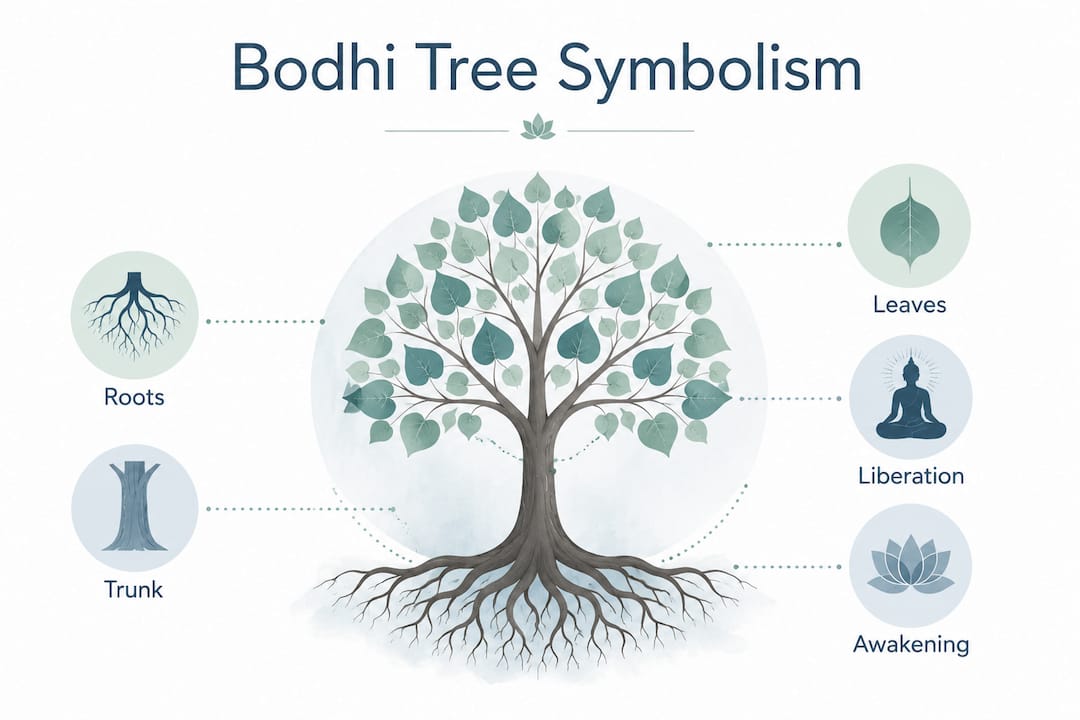
The Bodhi tree spiritual meaning also includes liberation from suffering. The tree symbolises liberation through steady discipline rather than impulsive action. Siddhartha did not attain enlightenment by striving harder. He sat still, observed, and allowed insight to arise. That quality of patient, steady presence is central to what the tree represents.
Pro Tip: When you feel scattered or restless during meditation, bring to mind the image of the Bodhi Tree. Its stillness under the open sky is a quiet invitation to settle, observe, and return to the breath.
One important nuance is the difference between reverence and worship. The Bodhi Tree is not an object of blind devotion. It acts as a cue for mindfulness, prompting practitioners to pause, notice reactivity, and allow clarity to arise from steady presence. The tree teaches by example, not by doctrine.
How is the bodhi tree woven into ritual and daily practice?
The meaning of the Bodhi tree becomes most tangible in lived practice. Across Buddhist and Hindu communities in South Asia and Southeast Asia, the tree is not simply admired from a distance. It is engaged with through specific, repeated rituals that bring its symbolism into the body and the breath.
The most well-known practice is Pradakshina, the ritual of circumambulation. Practitioners perform seven meditative circumambulations around the Bodhi Tree, typically in the morning, accompanied by chanting. Each round is not a mechanical repetition. It is an act of focused attention, a way of honouring the tree while simultaneously training the mind to remain present.
Beyond formal ritual, the Bodhi Tree inspires several forms of daily practice:
- Seated meditation beneath or near the tree. Temples across Sri Lanka, Thailand, Myanmar, and India maintain living Bodhi Trees as focal points for meditation. Practitioners sit in their shade as a direct echo of the Buddha’s own practice.
- Offering flowers, incense, and water. These offerings are gestures of gratitude and intention, not requests for supernatural favour. They mark the beginning of a period of reflection.
- Mindful walking around the tree. Slower than formal Pradakshina, this practice encourages awareness of each step, each breath, and the quality of attention in the present moment.
- Incorporating Bodhi imagery into home shrines. Many practitioners keep a small image or carving of the Bodhi Tree at home as a daily reminder of the qualities they are cultivating.
The significance of Bodhi Tree practice in temples extends beyond individual devotion. In Sri Lanka, the Jaya Sri Maha Bodhi in Anuradhapura is a 2,300-year-old cutting from the original tree at Bodh Gaya. It is the oldest living tree in the world with a documented planting date. Pilgrims travel from across the world to sit in its presence, making it one of the most visited sacred sites in Asia.
Why is the bodhi tree still relevant for mindfulness today?
The Bodhi tree history stretches back millennia, yet its relevance to contemporary mindfulness practice is immediate and practical. Modern practitioners are not drawn to the tree out of nostalgia. They return to it because its symbolism addresses something enduring about the human experience.
“The tree is a silent teacher. It does not speak, but it demonstrates everything the Buddha taught: patience, rootedness, responsiveness, and the capacity to remain still while the world moves around it.”
The Bodhi Tree functions today as what teachers sometimes call a “pedagogical cue,” a practical reminder to foster mindfulness and insight rather than a magical talisman. When you encounter an image of the tree in a meditation space or on a piece of home décor, it is designed to prompt a particular quality of attention. That prompt is the point.
A common misconception is that the tree’s power lies in the tree itself. The Buddha’s enlightenment was a result of insight, not from any supernatural quality of the fig. The tree was the setting, not the source. This distinction matters because it shifts the emphasis from external objects to internal practice.
The Bodhi tree’s symbolism has also found a natural home in wellness culture, spiritual art, and mindful home décor. Incorporating Bodhi motifs into a living space is a growing practice among those who want their environment to reflect their inner intentions. A carved wooden Buddha, a wall hanging featuring the sacred fig, or a meditation corner anchored by a Buddha statue can all serve as quiet, daily reminders of the qualities the tree embodies.
Pro Tip: You do not need to travel to Bodh Gaya to connect with Bodhi symbolism. A small Buddha statue or a piece of Bodhi-inspired art placed where you begin your day can serve as a grounding anchor for your morning intention.
The tree also speaks to impermanence in a way that feels honest rather than abstract. The original Bodhi Tree at Bodh Gaya has been replaced multiple times over the centuries. The current tree is a descendant, not the original. That fact, rather than diminishing the tree’s significance, deepens it. The teaching continues even as the physical form changes. That is precisely what impermanence means.
Key takeaways
The Bodhi Tree is defined as the sacred fig under which the Buddha attained enlightenment, and its symbolism of awakening, patience, and interconnectedness remains a living guide for Buddhist practice and modern mindfulness alike.
| Point | Details |
|---|---|
| Core meaning | The Bodhi Tree represents awakening, wisdom, and liberation rooted in sustained, disciplined attention. |
| Botanical identity | Authentic Bodhi Trees are genealogically traced descendants of the original Ficus religiosa at Bodh Gaya. |
| Symbolic layers | Roots, trunk, and leaves each carry distinct meaning: stability, integrity, and responsive awareness. |
| Living practice | Pradakshina, seated meditation, and daily offerings connect the tree’s symbolism to embodied ritual. |
| Modern relevance | Bodhi imagery in home décor and mindfulness spaces serves as a practical cue for presence and clarity. |
Why the bodhi tree speaks to something deeper than religion
I have spent years exploring how spiritual symbols translate into everyday life, and the Bodhi Tree consistently stands apart. Most symbols ask you to believe something. The Bodhi Tree asks you to notice something. That is a meaningful difference.
What strikes me most is how the tree resists sentimentality. It does not promise comfort or reward. It simply sits there, rooted and patient, demonstrating through its very existence what steadiness looks like. For anyone who has ever sat in meditation and felt the mind pull in ten directions at once, that image of the tree is genuinely useful. It is not decorative. It is instructive.
I also think the cross-religious significance of the peepul tree is underappreciated. The fact that Buddhism, Hinduism, Jainism, and Sikhism all find meaning in this species suggests something worth pausing over. Different traditions, different theologies, yet the same tree. There is something in its presence, its longevity, its shade, that speaks to human beings across centuries and cultures.
For those exploring spiritual home décor, I would encourage you to think of Bodhi-inspired pieces not as decoration but as anchors. A Buddha statue placed thoughtfully in your home is not just an aesthetic choice. It is a daily invitation to return to the qualities the tree embodies: stillness, clarity, and the quiet courage to simply be present.
— Dhriti
Bring bodhi tree symbolism into your home
If the meaning of the Bodhi tree resonates with you, Rootandstill offers a carefully considered collection of Buddha statues and spiritual décor designed to carry that symbolism into your everyday space. Each piece is crafted to feel grounded and intentional, from the weight of an antique Buddha statue to the quiet presence of a meditation sitting Buddha placed on a shelf or beside a reading chair. These are not generic ornaments. They are objects chosen to soften a room, anchor a morning routine, and remind you, gently, of the qualities you are working to cultivate. Browse the full collection at Rootandstill and find the piece that feels right for your space.
FAQ
What does “bodhi” mean in sanskrit?
“Bodhi” translates from Sanskrit as awakening or enlightenment. It refers specifically to the clear, direct insight into the nature of reality that the Buddha attained beneath the sacred fig tree.
Is every peepul tree a bodhi tree?
No. The Ficus religiosa species is widely known as the peepul tree, but an authentic Bodhi Tree must be a genealogically traced descendant of the original tree at Bodh Gaya. The sanctity comes from lineage, not species.
Where is the oldest living bodhi tree?
The Jaya Sri Maha Bodhi in Anuradhapura, Sri Lanka, is over 2,300 years old and is considered the oldest living Bodhi Tree with a documented planting date. It was grown from a cutting of the original tree.
How is the bodhi tree used in meditation practice?
Practitioners use the image or presence of the Bodhi Tree as a mindfulness cue, a prompt to pause, settle, and observe the quality of their attention. Formal practice includes Pradakshina, seven meditative circumambulations performed with chanting.
Why is the bodhi tree significant beyond buddhism?
The Ficus religiosa holds sacred meaning in Hinduism, Jainism, and Sikhism as well. In Hinduism it is associated with Vishnu and the Pushya star, making it one of the most widely revered trees across South Asian spiritual traditions.