

Spiritual home decor is the purposeful arrangement of your living environment to create a sanctuary that supports inner peace, mindful presence, and emotional calm. Unlike conventional interior styling, which prioritises visual trends, spiritual interior design prioritises emotional and energetic impact. It draws on natural materials, symbolic objects, dedicated sacred spaces, and intentional lighting to shift your home from a place you inhabit to a place that genuinely restores you. The practice is sometimes called mindful decor or sacred home design, and both terms point to the same core idea: your surroundings shape how you feel, and you can shape them with purpose.
What is spiritual home decor made of?
The foundation of any spiritual decorative scheme is natural texture. Wood, stone, cotton, linen, and rattan all carry a grounded, tactile quality that synthetic materials simply cannot replicate. These surfaces calm the eye and signal to the nervous system that the space is safe and settled. Pairing them with soft, warm lighting, whether beeswax candles, salt lamps, or low-wattage LEDs, completes the sensory atmosphere.

Shop Now: Buddha Feng Shui Set - Om - Grey & Black
Beyond texture and light, symbolic objects give a space its spiritual character. Crystals are among the most widely used spiritual home accessories for this reason. Clear quartz promotes openness, darker stones such as obsidian or black tourmaline ground the energy, and warmer stones like carnelian or citrine add creativity and warmth. A single well-chosen crystal on a windowsill or shelf does more for the atmosphere than a crowded collection.
Decluttering is not optional in this approach. It is the first step. Light, neutral palettes reduce stress, and avoiding bulky furniture maintains the sense of openness that allows energy to move freely through a room. Think of it as giving your space room to breathe before you add anything meaningful to it.
- Remove objects that carry no personal meaning or positive association
- Choose one or two focal pieces rather than filling every surface
- Use closed storage to keep spiritual accessories tidy when not in use
- Introduce natural scent through incense, essential oils, or dried botanicals
- Position seating or meditation cushions to face a natural light source where possible
Feng shui and vastu vs. modern personalised spiritual decor
Traditional systems like Feng Shui and Vastu Shastra have guided spiritual interior design for centuries. Feng Shui, rooted in Chinese philosophy, maps the flow of qi (life energy) through spatial arrangement, compass directions, and the five elements: wood, fire, earth, metal, and water. Vastu Shastra, the ancient Indian system, aligns rooms with cardinal directions and cosmic forces to support health, prosperity, and harmony. Both systems offer detailed rules for where to place furniture, altars, and symbolic objects.
Modern approaches to spiritual home design have shifted away from strict universal rules towards what some practitioners call a living intelligence framework. This means aligning each room’s function with your personal intentions rather than following a fixed placement chart. Your bedroom might prioritise rest and emotional safety. Your study might anchor focus and clarity. The design evolves as you do.
| Approach | Core Principle | Strengths | Challenges |
|---|---|---|---|
| Feng Shui | Energy flow via spatial layout and compass directions | Structured, time-tested, widely documented | Can feel rigid or culturally unfamiliar |
| Vastu Shastra | Cosmic alignment of rooms with cardinal directions | Deeply holistic, considers architecture and lifestyle | Difficult to apply in modern Western homes |
| Modern personalised decor | Intention-led design aligned with individual spiritual path | Flexible, accessible, evolves with the individual | Requires self-awareness and ongoing reflection |
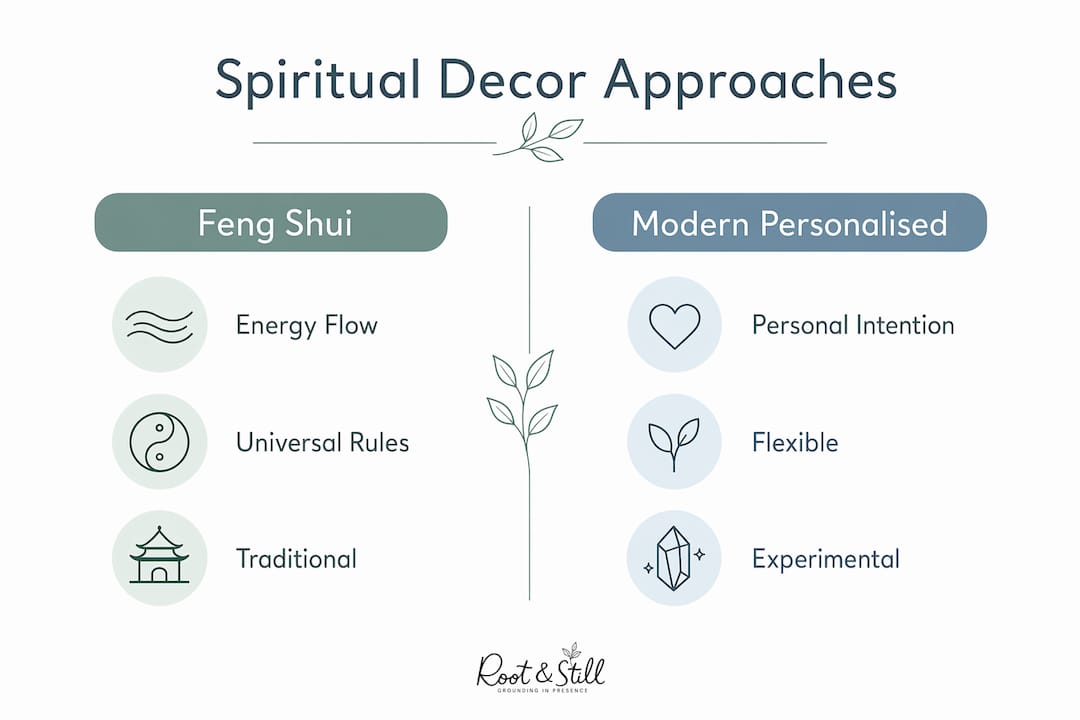
The contemporary approach encourages experimentation. You might borrow the Feng Shui principle of keeping the entrance clear and welcoming, while also placing a Buddha statue in a spot that simply feels right to you. The role of statues in interior design is less about following rules and more about choosing objects that carry genuine meaning for you. Neither approach is superior. The most grounded spaces tend to blend structural wisdom with personal resonance.
How do you create a meaningful spiritual corner at home?
A dedicated spiritual corner or altar is the most concentrated expression of sacred home decor. It gives your practice a physical home, and over time, that physical home reinforces the practice. Sacred spaces gain their spiritual quality from ritualised intention and consistent use, not from the objects themselves. The corner you tend every morning becomes something different from a shelf you arranged once and forgot.
Here is a practical sequence for creating yours:
- Choose a dedicated spot. Select a location that is unobstructed, relatively quiet, and used exclusively for spiritual activity. A corner of your bedroom, a low shelf in your living room, or a windowsill with a clear view all work well. Exclusive use for spiritual activities is what maintains the space’s function over time.
- Clear and clean the area. Remove everything that does not belong. Wipe surfaces, open a window if possible, and allow the space to feel genuinely empty before you begin placing objects.
- Choose two or three meaningful objects. A Buddha statue, a candle holder, a small crystal, or a personal photograph are all appropriate. Quality and personal resonance matter far more than quantity. The role of altars in Buddhist homes illustrates how a single well-placed figure can anchor an entire room’s atmosphere.
- Add sensory elements. Incense, a small oil diffuser, or a softly lit lamp completes the sensory environment. These cues signal to your nervous system that this space is for stillness.
- Establish a daily ritual. Light a candle, sit quietly for five minutes, or simply pause and breathe before you leave the space each morning. Effective maintenance includes daily rituals alongside light dusting and seasonal rotation of objects to keep the space energetically alive.
- Use closed storage nearby. Proper storage solutions such as a small cabinet or lidded box keep spare incense sticks, matches, and accessories out of sight, preserving the visual calm of the space.
Pro Tip: Resist the urge to add more objects as time passes. Beginners often accumulate too many symbolic items, and the result is visual noise rather than stillness. One meaningful object in clean surroundings outperforms ten items crowded together.
What are the real benefits of spiritual home decor?
Physical surroundings condition mood and behaviour, and a consistent, intentional space helps the nervous system shift into a receptive, calm state. This is not abstract. When you walk into a room that smells of sandalwood, holds soft warm light, and contains objects you associate with peace, your body responds. Breathing slows. Attention settles. The space acts as a physiological anchor.
“Sacredness derives from the ritual intention invested in a space rather than the objects themselves.” — Inspirituality
Beyond the immediate physical response, a well-tended spiritual space reinforces your values over time. It reminds you, daily, of what you are working towards: balance, presence, personal growth. This is what separates genuine spiritual decor from superficial decoration. A mass-produced ornament placed without thought does not carry the same weight as an object you chose deliberately and return to with intention.
The long-term benefits compound. People who maintain dedicated spiritual areas at home report feeling more anchored during stressful periods, more consistent in their mindfulness practice, and more at ease in their own environment. The space becomes a resource rather than just a room. For those exploring yoga room decor or meditation corners, this principle applies equally: the physical environment and the inner practice reinforce each other.
What pitfalls should you avoid in spiritual home styling?
The most common mistake in spiritual home styling is overbuying. Over-accumulation of mass-produced spiritual items dilutes the authentic experience and creates the very clutter you are trying to move away from. A shelf crowded with crystals, figurines, and candles of varying styles does not feel sacred. It feels busy.
A second pitfall is confusing decorative objects with genuinely spiritual ones. An object becomes spiritually meaningful through your relationship with it, not through its label or price point. A small stone you picked up on a meaningful walk carries more energetic weight than an expensive imported figurine you bought without thought.
- Avoid purchasing items simply because they are trending in spiritual decor circles
- Do not neglect your space once it is set up; neglected altars lose their vibrancy and the connection between you and the space fades
- Resist mixing too many cultural traditions without understanding their meaning
- Keep the space reserved for its intended purpose; using it as a general storage area erodes its function
- Review and refresh your sacred corner seasonally rather than leaving it static for months
The commercialisation of spiritual decor is a genuine concern. Genuine emotional connection is what gives a space its quality. No product, however beautifully made, replaces the intention you bring to it.
Key takeaways
Spiritual home decor works because intentional spaces, tended with consistent ritual and meaningful objects, condition the nervous system towards calm and reinforce the values you want to live by.
| Point | Details |
|---|---|
| Declutter before decorating | Clear the space completely before adding any spiritual objects to allow energy to move freely. |
| Choose objects with personal meaning | Two or three meaningful pieces create stronger presence than a crowded collection of trend-led items. |
| Dedicate the space exclusively | A corner used only for spiritual practice develops a quality that multi-use areas cannot hold. |
| Maintain with daily ritual | Light dusting, seasonal rotation, and a brief daily pause keep the space energetically alive. |
| Prioritise intention over aesthetics | The emotional connection you bring to a space matters more than the objects you place in it. |
Why intention matters more than the objects you buy
I have spent years observing how people approach spiritual decor, and the pattern is consistent. Those who feel most at ease in their homes are not the ones with the most carefully curated collections. They are the ones who return to their space with genuine attention, even if that space is just a single candle on a windowsill.
There is a tendency, particularly when you are starting out, to believe that the right object will create the right feeling. It rarely works that way. The feeling comes first, from the act of choosing deliberately, placing thoughtfully, and returning consistently. The object is a prompt, not a source.
What I find most encouraging about the shift towards personalised spiritual design in 2026 is that it releases people from the pressure of doing it correctly. You do not need to follow Feng Shui rules to the letter or replicate a Vastu-compliant layout. You need to ask yourself what this space is for, and then honour that intention every time you enter it. Start with one corner. Tend it. See what it gives back.
— Dhriti
Bring your sacred space to life with Rootandstill
Rootandstill curates handcrafted-looking spiritual home accessories designed to anchor calm and presence in everyday rooms. Each piece is chosen for its quality, symbolism, and ability to work within modern interiors without feeling out of place. If you are building a meditation corner or refreshing an existing altar, the gold finish Buddha head and the mini meditating sitting Buddha are two of the most versatile starting points. For ambient lighting, the cherry crackle meditation lamp adds warm, restful light that softens any corner. Rootandstill also offers a range of terracotta incense plates that bring both function and natural texture to a sacred space.
FAQ
What is the difference between spiritual and mindful decor?
Spiritual decor centres on sacred symbolism, ritual objects, and dedicated practice spaces, while mindful decor focuses more broadly on intentional, calming design choices. The two approaches overlap significantly and are often used together.
How many objects should a spiritual corner contain?
Two or three meaningful objects are sufficient. Research consistently shows that fewer, well-chosen pieces create a stronger energetic atmosphere than a crowded arrangement of symbolic items.
Do i need to follow feng shui rules for spiritual home decor?
No. Modern spiritual interior design encourages aligning your space with your personal intentions rather than following strict placement rules. Feng Shui and Vastu offer useful principles, but personalisation is equally valid.
How often should i maintain my spiritual space?
Daily attention, even a brief pause or lighting a candle, keeps the space feeling alive. Seasonal refreshes, including dusting, rotating objects, and clearing anything that no longer resonates, sustain its energetic quality over time.
Can spiritual decor work in a small flat?
A single dedicated corner, shelf, or windowsill is enough. The size of the space matters far less than the consistency and intention you bring to it.


