

In Buddhism, compassion — known as karuna — is the active wish for all beings to be free from suffering and its causes. It is not a passive feeling of sympathy; it is an orientation toward action, always guided by wisdom. His Holiness the 14th Dalai Lama has written that cultivating compassion is a necessity for humanity’s survival, not a luxury. Karuna sits alongside loving-kindness, sympathetic joy, and equanimity as one of the Four Sublime States, or Brahma-vihāras. Try this now: pause, take one slow breath, bring to mind someone who is struggling, and silently offer the intention “May you be free from this pain.” That single moment is karuna in practice.
What does compassion mean in Buddhism, and where does it sit in the teachings?
The Pali and Sanskrit word karuna carries the sense of being moved by another’s suffering and responding with the wish to remove it. It differs from the everyday English word “compassion,” which can imply little more than feeling sorry. Karuna is defined precisely as the wish that others be free from suffering and its causes, with the characteristic of allaying that suffering rather than simply acknowledging it.
Within Buddhist teaching, karuna is one of the four Brahma-vihāras, sometimes called the Divine Abodes or Sublime States. Nyanaponika Thera described these as states to dwell in rather than rare emotional visits. The table below shows how each state relates to the others.
| Brahma-vihāra | English name | Short definition | A simple practice |
|---|---|---|---|
| Metta | Loving-kindness | Unconditional wish for happiness | Silently wish “May you be well” to each person you pass |
| Karuna | Compassion | Active wish to relieve suffering | Pause and ask “What small step could ease this?” |
| Mudita | Sympathetic joy | Delight in others’ good fortune | Notice someone’s success and let yourself feel glad |
| Upekkha | Equanimity | Stable, non-reactive presence | Breathe steadily when outcomes are outside your control |
Together, the four states form what one teacher describes as the four legs of a sturdy table: remove any one and the whole structure loses balance.
How does karuna differ from metta, empathy, and pity?
Understanding karuna clearly means separating it from terms that look similar but work differently.
Karuna versus metta: Metta is the warm wish for happiness; karuna responds specifically to suffering. Metta says “May you be well.” Karuna says “May you be free from this pain, and I will do what I can to help.” Both are necessary. Metta provides the warm engagement; karuna provides the strength to face difficulty without turning away.
Karuna versus empathy: Empathy is the capacity to feel another’s pain. Compassion goes further — it motivates action to alleviate that pain. Feeling someone’s distress without moving toward relief is empathy alone; adding the intention and effort to help is karuna.
Karuna versus pity: Pity creates distance. It positions you above the person who suffers, looking down with a kind of sorrowful detachment. Buddhist compassion, by contrast, arises from recognising shared vulnerability — the understanding that suffering is a universal human condition, not someone else’s problem. As Nyanaponika Thera observed, genuine compassion does not blame others for their suffering; it understands that all beings are caught in the same currents of cause and effect.
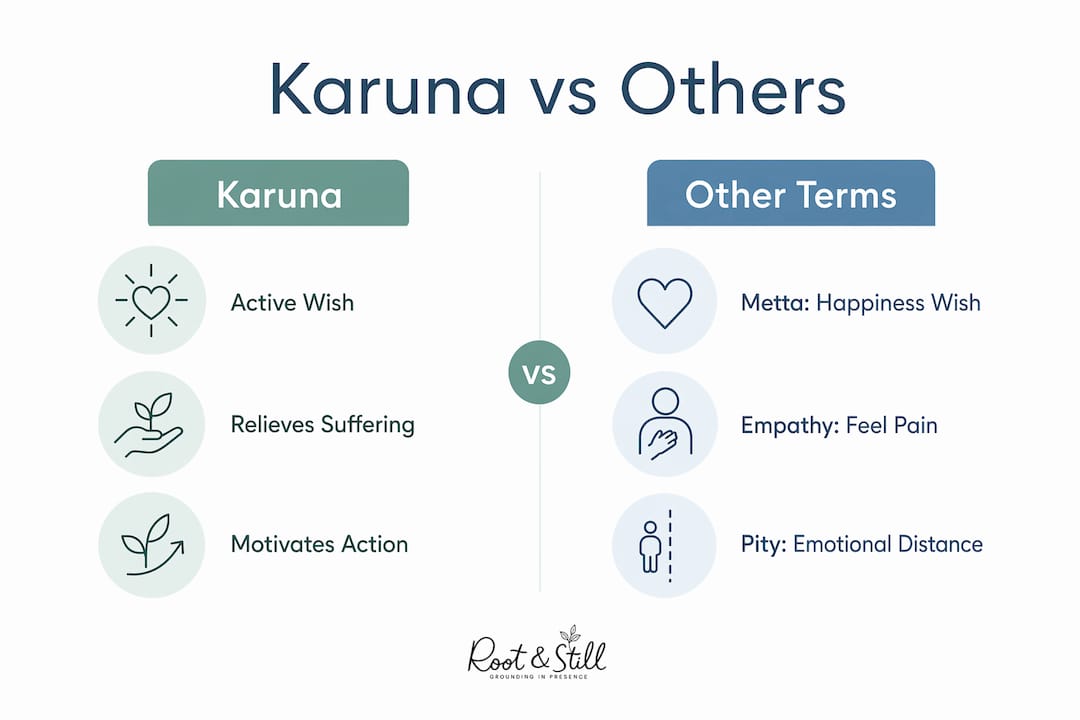
The practical difference is clear in ordinary life. Feeling sorry for a friend who has lost their job is pity. Sitting with them, asking what they need, and offering a concrete word of support or a connection to someone who can help — that is karuna.
Why compassion in Buddhism must be paired with wisdom
Karuna without wisdom can cause harm, even when the intention is good. Compassion is most effective when combined with knowledge and discernment, so that the action chosen actually addresses the root of suffering rather than its surface.
“Compassion should be active, motivating us to take responsibility to alleviate others’ suffering. Our ability to help might be limited, but still we do whatever we can, because it is unbearable to stand idly by while people are unhappy and in pain.” — Study Buddhism, paraphrasing core Buddhist teaching
A well-meaning but unwise response might, for example, shield someone from a consequence they need to experience in order to grow. A wise compassionate response asks first: what does this person actually need, and what am I genuinely able to offer? That discernment is what daily compassion looks like in practice — moving from passive distress to a small, considered action.
One common pitfall is absorbing others’ suffering so completely that you become depleted. Healthy boundaries are not a failure of compassion; they are what make compassion sustainable. Self-compassion is not selfishness — it is the foundation that keeps the practice alive.
How to practise compassion in Buddhism: tonglen, phrases, and progressive extension
Begin with yourself. Teachers consistently advise that self-compassion comes first — without it, outward practice can become exhausting or performative.
Tonglen (“sending and taking”) is a Tibetan practice that cultivates karuna through the breath. Here is a gentle starter version:
- Sit quietly and take three slow breaths to settle.
- Bring to mind your own suffering or discomfort — something real but not overwhelming.
- On the in-breath, imagine drawing that discomfort toward you with openness, as dark smoke.
- On the out-breath, send out relief, warmth, and ease — imagine it as clear light.
- After two or three rounds, extend the practice to someone you care about, then to a neutral person, then to all beings.
Compassion phrases are simpler and suit any moment. Repeat silently: “May you be free from suffering. May you find ease.” Extend them progressively: yourself → a loved one → a neutral person → someone difficult → all beings everywhere.
Time options:
- One minute: One breath, one phrase, one person. Before your morning tea.
- Five minutes: Three rounds of tonglen, then phrases extended to three people.
- Ten minutes: Full progressive extension, ending with all beings, followed by a moment of stillness.
How your home environment can support compassionate practice
The Brahma-vihāras are meant to be states you return to throughout the day, not experiences confined to a cushion. Your home can make that return easier. Research into how decor influences mood shows that a calm, intentional environment provides the inner steadiness that keeps compassion active rather than theoretical.
A dedicated corner — even a small shelf — with a few meaningful objects gives your eye somewhere to land and your mind a cue to pause. Natural textures like stone, wood, and linen soften a room and invite a slower pace. Warm, low lighting in the evening shifts the atmosphere toward reflection. A single object placed at eye level, something that carries meaning for you, can serve as a quiet prompt throughout the day.
Pro Tip: Ring a singing bowl once before you sit down for your one-minute compassion pause. The sound is a physical cue that signals a shift in attention — far more reliable than trying to remember an abstract intention mid-morning.
Incense is another gentle anchor. The ritual of lighting it — the small, deliberate act — marks a boundary between ordinary busyness and a moment of intention. For ideas on weaving these cues into your space, the Rootandstill guide on mindful home decor ideas offers practical room-by-room suggestions.
Three micro-routines to keep compassion alive through the day
True compassionate action is often small and ordinary. Reducing unnecessary friction in daily exchanges — pausing before speaking, choosing a softer interpretation, refraining from escalating a disagreement — is a mark of mature practice.
30 seconds, after the kettle boils: While you wait for your tea to brew, bring one person to mind and offer a silent phrase: “May you be well today.” No cushion, no ritual. Just a breath and an intention.
2 minutes, before replying to a difficult email: Pause. Ask what the other person might be carrying. Choose one word or phrase in your reply that softens rather than sharpens the exchange.
5 minutes, before leaving home: Sit briefly with your hands in your lap. Run through the progressive extension — yourself, your household, your neighbours, your wider community. Notice how the quality of attention shifts as it widens.
For a weekly rhythm, consider a small regular donation to a local food bank or volunteering an hour with a community group. The act of giving, however modest, is karuna made concrete.
Start today — a short checklist:
- Choose one daily cue (kettle, bowl, incense) and use it consistently this week.
- Learn one compassion phrase and repeat it three times each morning.
- Identify one person to extend karuna toward today — someone easy, to begin.
- Place one meaningful object where you will see it at eye level throughout the day.
Key takeaways
Karuna is the active wish to relieve suffering, always paired with wisdom and expressed through small, consistent actions rather than grand gestures.
| Point | Details |
|---|---|
| Karuna defined | Compassion in Buddhism is the active wish for all beings to be free from suffering and its causes. |
| Distinct from pity and metta | Metta wishes happiness; karuna responds to suffering; pity creates distance, karuna recognises shared humanity. |
| Wisdom is required | Compassion without discernment can be ineffective; always ask what action genuinely helps. |
| Practice starts with self | Begin tonglen and compassion phrases with yourself before extending outward. |
| Rootandstill supports practice | Rootandstill’s statues, singing bowls, and incense holders serve as daily cues that bring karuna off the cushion and into ordinary life. |
A quiet word on bringing this home
The aspect of karuna that most articles overlook is how ordinary it is meant to be. Buddhist teachers are not describing a state reserved for monastics or advanced meditators — they are pointing to the quality of attention you bring to the person in front of you, the email you are about to send, the moment before you speak. The home environment matters precisely because that is where most of those moments happen.
What I find worth saying plainly: you do not need a perfect meditation room or an elaborate altar. A single object placed with intention, a sound that calls you back, a phrase you have practised enough times that it arises naturally — these are enough. The decor is not the practice. It is the cue that makes the practice possible on an ordinary Tuesday morning when everything else is pulling your attention elsewhere.
Rootandstill objects that support your practice
Rootandstill curates objects designed to serve as quiet anchors in daily life — not replacements for practice, but the kind of considered, beautiful things that make returning to intention feel natural rather than effortful.
The Antique Small Buddha Figurines Classic Statue works well as a meditation corner anchor, its aged finish giving it a settled, grounded presence on a shelf or low table. The Resin Silver Mini Buddha Statue is compact enough for a desk or windowsill — a small, daily reminder at eye level. For a more striking focal point, the Tranquility Buddha Head Statue in Green Copper brings a calm, sculptural quality to a mantel or meditation space.
Customers describe a noticeable shift in the atmosphere of a room when these pieces are placed thoughtfully — a sense of the space feeling more settled and purposeful. For further ideas on arrangement and symbolism, the Rootandstill guide on the role of Buddha in home decor is a good place to start. Browse the full collection at rootandstill.com to find the piece that feels right for your space.
Further reading and sources
The following sources informed this article and are worth exploring for deeper study:
- Lion’s Roar — Compassion (Karuna): clear doctrinal overview; best for understanding karuna’s place among the Brahma-vihāras.
- Study Buddhism — What Is Compassion?: accessible introduction to karuna with practical framing; good for beginners.
- Shambhala — Introduction to Tonglen: the clearest step-by-step guide to tonglen available online; use this for practice instructions.
- BBC Bitesize — The Four Sublime States: concise doctrinal summary; best for grounding the Brahma-vihāras in context.
- Encyclopedia of Buddhism — Karuṇā: scholarly definition and etymology; use for doctrinal precision.
- One Mind Dharma — Compassion (Karuna): practical framing of karuna versus pity; good for everyday application.
- Gassho — How to Practise Compassion Daily: micro-practice ideas and the case for small, ordinary actions.
- Nyanaponika Thera — The Four Sublime States: the classical Theravāda text on the Brahma-vihāras; best for doctrinal depth.
- Rootandstill — Meditation room accessories that feel right: practical guide to choosing objects that support daily practice.
FAQ
What is karuna in Buddhism?
Karuna is the Pali and Sanskrit word for compassion, defined as the active wish for all beings to be free from suffering and its causes. It is one of the four Brahma-vihāras alongside loving-kindness, sympathetic joy, and equanimity.
How is Buddhist compassion different from pity?
Pity creates emotional distance and positions the observer above the person suffering. Buddhist compassion recognises shared human vulnerability and motivates practical action to relieve suffering rather than simply feeling sorry.
How do you practise karuna at home?
Begin with a one-minute pause: bring someone to mind, breathe steadily, and offer the silent phrase “May you be free from suffering.” A consistent daily cue — a singing bowl, incense, or a meaningful object at eye level — helps make the practice a natural part of your routine.
What is the difference between karuna and metta?
Metta is the unconditional wish for happiness and well-being. Karuna responds specifically to suffering with the wish to remove it. Both are necessary: metta provides warm goodwill, while karuna provides the strength to face and address pain.
Can compassion practice be harmful?
Without wisdom and self-compassion, practice can lead to exhaustion or unhelpful actions. Teachers recommend beginning with self-compassion, setting clear boundaries, and always asking what action genuinely helps rather than simply acting on impulse.


