Mindfulness is defined as the inherent human capacity to maintain present-moment awareness without judgement. It is not a religious practice, a personality trait, or a skill reserved for seasoned meditators. Mindful.org describes it as something you can access at any time, often practised for just a few minutes a day. You do not need a cushion, a retreat, or a quiet room. You need only the willingness to pay attention to what is happening right now, without labelling it as good or bad.
How is mindfulness defined across disciplines?
Mindfulness, as a term, carries weight across psychology, clinical medicine, and contemplative traditions. The word itself traces back to the Pali term sati and the Sanskrit smṛti, both pointing to present-centred awareness. That ancient root has been translated into a clinically recognised skill: the intentional, moment-by-moment observation of bodily sensations, thoughts, and surroundings, held with a non-judgmental attitude.
Psychology Today defines mindfulness as having two foundational ingredients: awareness and acceptance. Awareness means directing attention inward, noticing thoughts, feelings, and physical sensations as they arise. Acceptance means observing those experiences without labelling them as good or bad, without trying to push them away or hold on to them. These two qualities work together. Without acceptance, awareness alone can tip into self-criticism or anxiety.

Shop Now: Large Outdoor Garden Buddha Teaching Statue on Lotus - Turquoise & Stone - 2m
Meditation and mindfulness are related but not the same thing. Meditation is a deliberate practice for training attention and awareness, using methods such as breath focus, body scanning, or walking with intention. Mindfulness is the quality that meditation cultivates. You can meditate without being mindful, and you can be mindful without formally meditating. The distinction matters because it opens the door to informal practice throughout your day.
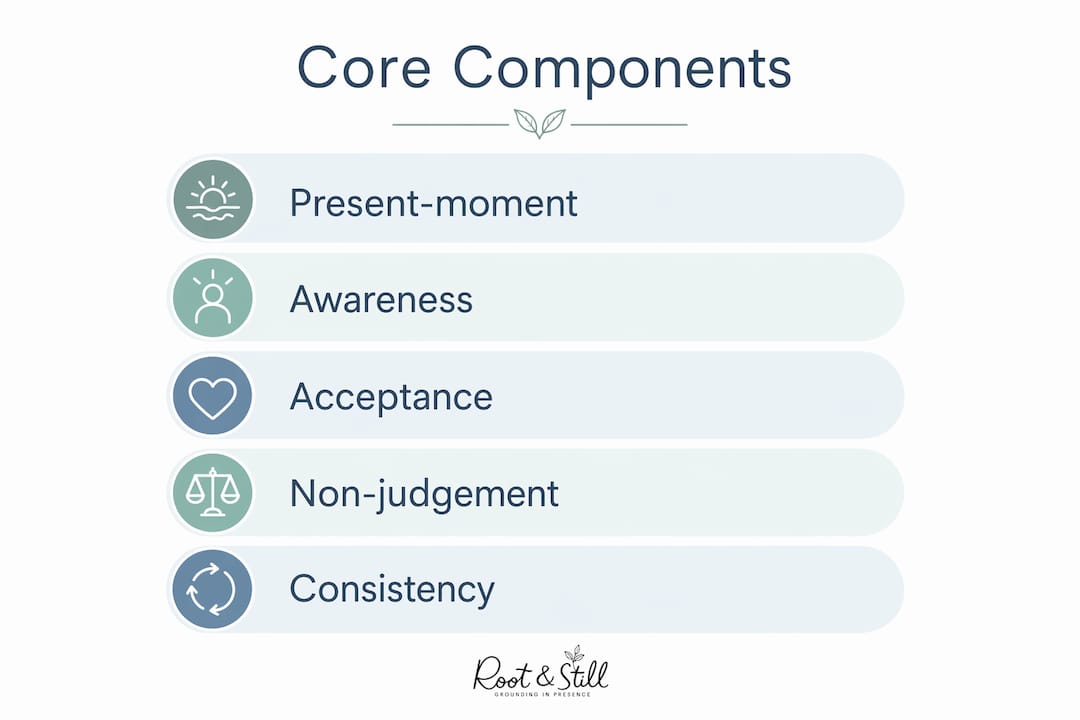
Core components at a glance
| Component | What it means in practice |
|---|---|
| Present-moment focus | Attending to what is happening now, not replaying the past or rehearsing the future |
| Non-judgmental attitude | Observing thoughts and feelings without rating them as good or bad |
| Awareness | Noticing inner processes: sensations, emotions, and mental activity |
| Acceptance | Allowing experiences to exist as they are, without resistance |
| Intentionality | Choosing to pay attention, rather than drifting on autopilot |
What does science reveal about the benefits of mindfulness?
Research published in 2026 confirms that mindfulness training improves emotional regulation by training both attention and acceptance. Staying present with difficult thoughts, rather than avoiding them, produces better emotional outcomes over time. This is a counterintuitive finding. Most people assume that distraction or positive thinking is the healthier response to discomfort. The evidence points the other way.
One of the most useful concepts in mindfulness research is what Buddhist psychology calls the “second arrow.” The first arrow is unavoidable pain: a difficult conversation, a moment of grief, physical discomfort. The second arrow is the psychological struggle you add on top of it, the self-criticism, the rumination, the resistance. Mindfulness softens the second arrow by teaching you to accept reality as it is, rather than fighting it. That shift builds genuine resilience.
Mindful.org describes mindfulness as a muscle. Regular meditation strengthens it, making present-moment awareness easier to access throughout the day, even without formal practice. This analogy is useful because it reframes the goal. You are not trying to achieve a permanent state of calm. You are building a capacity that grows with use and weakens with neglect.
“Mindfulness helps us handle the psychological struggle we add to unavoidable pain. Accepting reality as it is, rather than resisting it, is where resilience is built.”
Pro Tip: Formal meditation sessions and informal mindful moments both build the same capacity. A five-minute body scan in the morning and a mindful cup of tea in the afternoon are equally valid forms of practice.
What are the common misconceptions about mindfulness?
The most persistent misconception is that mindfulness requires you to clear your mind. It does not. Proper practice means observing thoughts non-judgmentally, the way you might watch guests arrive at a door, acknowledge them, and let them pass. Trying to suppress thoughts tends to increase stress rather than reduce it. The mind will wander. That is not failure. Noticing the wandering and returning your attention is the practice itself.
A second misconception is that mindfulness is goal-oriented. Mindfulness is not a goal-directed activity. Approaching it with a target, such as “I will feel calm by Friday,” sets up frustration when the experience does not match the expectation. The practice is the point. What arises during it is simply what arises.
A third misunderstanding is that mindfulness is about relaxation. Relaxation may follow, but it is a by-product, not the aim. You might sit down to practise and notice irritability, restlessness, or sadness. That is not a sign that something has gone wrong. It is a sign that you are paying attention.
Here are the most common misconceptions, and what the evidence actually shows:
- “I need to clear my mind.” Mindfulness asks you to observe thoughts, not eliminate them. A busy mind during practice is normal and expected.
- “It only works if I feel calm afterwards.” Emotional outcomes vary. The value lies in the quality of attention you bring, not the feeling you leave with.
- “I need long sessions to see any benefit.” Consistency in small doses outperforms long, infrequent sessions. A few minutes daily is genuinely effective.
- “Mindfulness is a spiritual or religious practice.” Its roots are contemplative, but its application is secular and evidence-based. Clinical programmes such as Mindfulness-Based Stress Reduction (MBSR) are used in NHS settings across the UK.
- “If my mind wanders, I am doing it wrong.” Mind-wandering is the starting point. Returning your attention, again and again, is the exercise.
Pro Tip: When you notice frustration during practice, treat it as data rather than failure. Frustration is a thought, and observing it without judgement is mindfulness in action.
How can you integrate mindfulness into daily life?
The most effective approach to building a mindfulness practice is integrating brief, consistent moments into routines you already have, rather than carving out extra time. This removes the barrier of scheduling and makes the practice sustainable.
Formal practice gives you a dedicated space to train attention. Options include:
- Breath-focused meditation: sit quietly and follow the sensation of each breath for five to ten minutes.
- Body scanning: move attention slowly through each part of the body, noticing sensation without trying to change it.
- Walking meditation: walk slowly and deliberately, attending to the feeling of each step and the sounds around you.
- Mindful movement: practices such as yoga or tai chi combine physical awareness with present-moment attention.
Informal practice is where mindfulness becomes part of daily life. You can bring full attention to brushing your teeth, noticing the texture, temperature, and sensation rather than planning the day ahead. You can drink your morning coffee with genuine attention, noticing warmth, aroma, and taste. Conversations become a form of practice when you listen without planning your response. Even washing up can become a moment of grounded presence.
The key principle is curiosity. Approach each moment with a gentle interest in what is actually there, rather than what you expect or wish to find. That quality of open attention is what mindfulness practices explained in therapeutic and everyday contexts have in common.
Your physical environment also plays a quiet role. A space that feels settled and intentional makes it easier to return to presence. Objects that carry meaning, a candle, a statue, a bowl, can serve as gentle anchors, reminding you to pause and attend. Rootandstill explores this connection in its guide on statues and stress relief, which looks at how symbolic objects support a calmer state of mind.
Key takeaways
Mindfulness is the practised capacity to observe present-moment experience with awareness and acceptance, and consistency in small daily doses builds this capacity more effectively than occasional long sessions.
| Point | Details |
|---|---|
| Core definition | Mindfulness is present-moment awareness held without judgement, not a religious or goal-oriented practice. |
| Two key ingredients | Awareness and acceptance work together; one without the other is incomplete. |
| The second arrow | Mindfulness reduces the psychological suffering you add to unavoidable pain by teaching acceptance. |
| Misconceptions matter | Clearing the mind is not the goal; observing thoughts without judgement is the actual practice. |
| Small steps work | A few consistent minutes daily builds mindfulness more effectively than long, infrequent sessions. |
What I have learned from sitting with discomfort
When I first started practising mindfulness, I approached it the way most beginners do: I wanted results. I wanted to feel calmer, think more clearly, and handle stress with something resembling grace. What I found instead, at least initially, was how loud my own mind was. That was unsettling. It felt like failure.
What shifted things was understanding that the discomfort itself was the practice. The moment I stopped trying to achieve a particular feeling and started simply noticing what was present, something loosened. Not dramatically. Quietly. The way a room feels different when you open a window, not transformed, just a little more breathable.
The formal sessions helped, but the informal moments changed more. Paying attention while walking to the kitchen. Noticing the weight of a mug in my hands. These small pauses accumulated into something that felt like steadiness. Not the absence of difficulty, but a slightly wider space around it.
If you are beginning, I would encourage you to resist the urge to measure your progress. Mindfulness is not a ladder. It is more like tending to something quiet that grows when you give it attention and wilts when you do not. The practice is simply showing up, with whatever is there.
— Dhriti
Creating a space that supports your practice
A mindful environment does not create mindfulness, but it can hold the conditions for it. When your surroundings feel intentional and calm, returning to presence becomes a little easier. Rootandstill curates handmade decor with exactly this in mind: objects that carry stillness rather than noise.
The antique Buddha figurines make a grounded addition to a meditation corner or reading nook, offering a quiet visual anchor without demanding attention. For those who use incense as part of their practice, the ceramic incense burner plate combines function with a restful aesthetic. Each piece is chosen to support the kind of intentional living that mindfulness encourages, not as decoration for its own sake, but as an invitation to pause.
FAQ
What is the simplest definition of mindfulness?
Mindfulness is the capacity to pay attention to the present moment without judgement. It includes awareness of thoughts, feelings, and bodily sensations as they arise.
Is mindfulness the same as meditation?
Mindfulness and meditation are related but distinct. Meditation is a formal practice that trains attention; mindfulness is the quality that practice cultivates, and it can be applied informally throughout the day.
How long do I need to practise mindfulness each day?
A few minutes daily is more effective than long, infrequent sessions. Consistency matters more than duration, especially for beginners.
Does mindfulness require religious belief?
Mindfulness has roots in Buddhist contemplative traditions but is practised secularly worldwide. Clinical programmes such as Mindfulness-Based Stress Reduction (MBSR) are evidence-based and non-religious.
What is the biggest mistake beginners make with mindfulness?
The most common mistake is trying to clear the mind or achieve calm. Observing thoughts without judgement, rather than suppressing them, is the correct approach and produces better outcomes.