When a Buddha statue arrives, give yourself time to check it before putting it on display. A useful order is: prepare a clear space, open the packaging carefully, compare the item with your order, record anything uncertain, then choose its final position.
This checklist is for a newly purchased decorative statue or Buddha head that you can handle safely. Large, heavy, unstable or damaged pieces need an appropriate handling plan, not a general lifting recipe. Follow any instructions supplied with your particular item.
Before opening: have the right information beside you
Keep your order confirmation and the product page handy. Check the product name, finish and any selected option. Put the delivery date and order number in a note on your phone so they are easy to find if you need help.
Prepare somewhere clean, stable and large enough for the item and its packaging. Clear the route to that space. Do not decide how to lift a statue from its height or photograph alone; if the weight or handling requirements are unclear, ask Root & Still before moving it.
Dhriti, founder of Root & Still, has previously emphasised choosing a piece that fits your routine and your room. That room-first approach is useful here too: decide where the statue will stand before you start moving it around to try different spots.
Open the packaging without testing the statue
Check for any opening instructions or orientation labels first. Photograph visible damage to the outer packaging before changing it. Open the outer closure carefully, keeping cutting tools away from the item, then remove accessible packing in stages. Do not tip a box upside down or pull a statue free by a projecting detail.
If packing catches around a hand, ear or other detail, stop and look at how it is arranged rather than tugging. Avoid rubbing the surface to remove a mark while you are still checking the condition. Keep loose packing separate from the item so small components or fragments are not accidentally discarded.
The Canadian Conservation Institute's handling guidance stresses inspecting an object before moving it, preparing the route and supporting it appropriately. It concerns heritage collections rather than retail deliveries, but those basic principles are useful. Do not lift a figure by its head, arms or decorative projections.
Use a simple arrival record
The aim is to describe what you can actually see, not to diagnose the cause of a mark. These notes give you a clear starting point if you contact us.
| Check | Record | If something is unclear |
|---|---|---|
| Item and option | Product name, finish and order number | Compare with the confirmation, then ask us about a mismatch. |
| Outer packaging | An overall photograph and any visibly damaged area | Describe the condition without assuming how it happened. |
| Whole statue | A clear overall photograph in neutral light | Include the whole shape, not only a close-up. |
| Area of concern | One close view and one wider view showing its location | Do not scratch, rub or try to repair it to find out more. |
| Listed contents | What is present compared with the specific listing | Ask about a missing component; photographed props are not automatically included. |
| Instructions | Any care or assembly information supplied | Contact Root & Still before improvising an unclear step. |
Separate a finish question from an obvious problem
A textured or deliberately distressed finish may look different from a smooth painted surface. Compare the exact product description and photographs, rather than another statue with a similar colour name. Natural variation does not mean that every unexplained crack, loose part or flaking area should be accepted as normal.
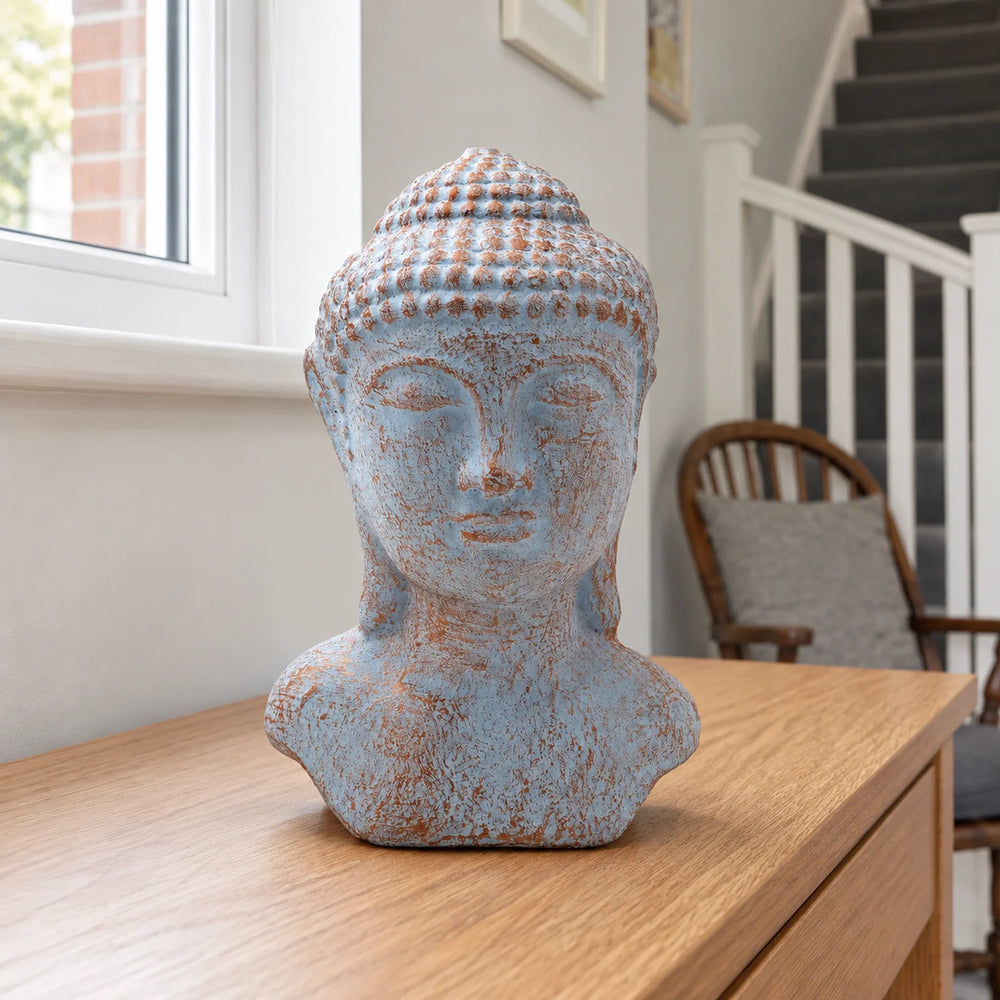
For example, the Tranquility Buddha Head in Blue Copper has a mottled blue and copper-coloured appearance. The colour name describes the finish; it is not a reason to dismiss a new chip or loose section. If you cannot tell whether a detail is intentional, send us photographs.

Checking on arrival is not a material test. Do not scrape the underside, tap the figure to judge its construction or apply water or polish. Our Buddha figurine buying checklist explains what photographs and product descriptions can, and cannot, establish.
If something is damaged or does not match
Stop unnecessary handling and keep the item in a secure place. Do not put an unstable piece on display or attempt to glue a loose part back on. Keep packaging and any detached pieces safely aside while asking for advice, without handling sharp fragments unnecessarily.
Contact Root & Still with your order number, the product name, a short description and the photographs you can safely take. Tell us whether the issue concerns the item, its finish, a missing listed component or the packaging. You do not need to decide on a repair method before contacting us.
This is a practical checking guide, not a statement of return deadlines or a promise of a particular remedy. Use the current Root & Still returns policy for that information. For an older statue you already own, our separate guide to assessing a chipped statue covers the questions to ask before considering a repair.
Move from checking to displaying
Once you are happy that the item matches the order and there is no unresolved concern, follow its display and care instructions. Check that the whole base is supported on a suitable surface. An indoor piece should not be moved outside simply because the finish looks like stone or metal.
Keep the order details and useful photographs together for future reference. For ongoing care, use our statue cleaning and finish guide. If you are still choosing a piece, compare the individual details in our Buddha heads and wooden Buddha statues collections.