

The lotus flower appears on cushion covers, wall art, candle holders, and ceramic pieces across countless homes — often chosen simply because it looks beautiful. And it is beautiful. But there is something far deeper beneath those layered petals. The lotus has served as one of the most enduring spiritual symbols in human history, carrying meanings that span continents, centuries, and traditions. If you have ever felt drawn to lotus imagery without quite knowing why, this guide will help you understand what you are responding to, and how to honour that resonance in your own living space.
Key Takeaways
| Point | Details |
|---|---|
| Multi-layered symbolism | The lotus symbolises purity, resilience, and spiritual growth in many traditions. |
| Universal yet diverse | Its meanings shift across cultures, from enlightenment to impermanence and desire. |
| Intentional decor choices | Choosing lotus art thoughtfully brings harmonising energy and mindfulness to your home. |
| Authenticity enriches design | Understanding original symbolism deepens your connection to lotus-inspired pieces. |
Why the lotus flower matters in spiritual symbolism
It is easy to see the lotus and simply appreciate its elegant form. The symmetry of its petals, the way it seems to float serenely above still water — these qualities make it a natural choice for decorative objects. But the reason this flower has endured in art, architecture, and spiritual practice for thousands of years runs much deeper than aesthetics.
The lotus grows in muddy, murky water. It pushes upward through the sediment and opens into a clean, luminous bloom above the surface. This simple, extraordinary fact is the heart of its symbolism. According to the Rubin Museum of Art, in many spiritual traditions, the lotus symbolises purity, spiritual growth, resilience, and rebirth because it rises cleanly from muddy water. The physical reality of the plant becomes a living metaphor for the human journey through difficulty toward clarity.
“The lotus is one of the most ancient and deepest symbols of our planet. The lotus grows in muddy water and rises above the surface to bloom with remarkable beauty.”
This is why the lotus appears so consistently across Buddha symbolism for home harmony and other forms of sacred art. The themes it carries, including purity, strength, renewal, and resilience, are universal human concerns that resonate regardless of one’s specific spiritual background.
What makes the lotus particularly fascinating is that its symbolic weight did not emerge from one single tradition. Independent cultures across Asia, the Middle East, and beyond arrived at similar interpretations through their own observation of this flower. When a symbol recurs across unconnected traditions with overlapping meanings, it often points to something genuinely archetypal, a truth that transcends cultural boundaries.
Lotus meanings in Buddhism and Hinduism
Understanding the general importance of the lotus sets the stage. Let us look more closely at how two major traditions interpret this symbol, because the nuances matter when you are choosing decor that carries genuine meaning.
In Buddhism, the lotus occupies a central position in both art and philosophy. The Buddha teaching on lotus statue is one of the most recognisable forms of sacred imagery, and it is not coincidental. The Rubin Museum notes that in Buddhism, lotus imagery represents awakening and enlightenment, and the mind becoming purified and clarified through practice. The muddy water in this context represents the confusion, desire, and suffering of ordinary life. The blooming lotus represents the awakened mind that has risen above these conditions, clear and untouched.
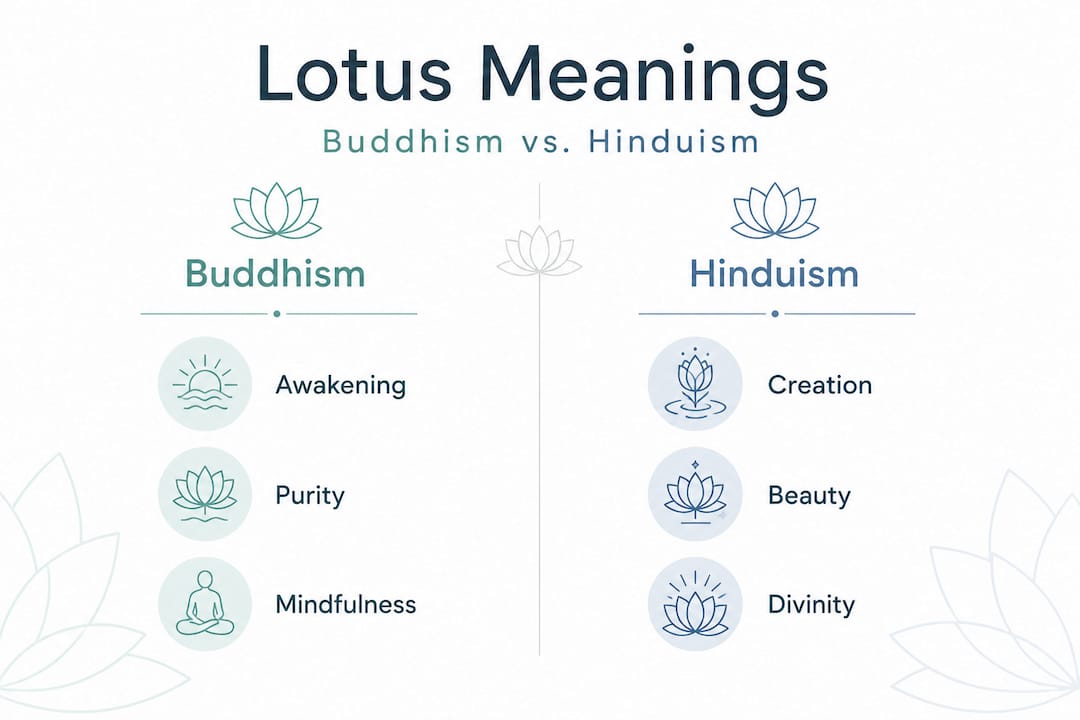
In Hinduism, the lotus carries a related but distinct quality. Hindu mythology frequently places deities such as Brahma and Lakshmi on or holding lotus flowers. The flower is associated with purity and transcendence, specifically the capacity to rise above worldly and muddy conditions to blossom in sunlight. The lotus in Hinduism also connects to the concept of divine beauty and the unfolding of creation itself. A Buddha painting with lotus flower often draws from both traditions simultaneously, reflecting centuries of artistic exchange across the Asian subcontinent.
| Tradition | Core lotus meaning | Associated qualities |
|---|---|---|
| Buddhism | Spiritual awakening, purified mind | Enlightenment, clarity, practice |
| Hinduism | Purity, transcendence, divine beauty | Rising above the material, creation |
| Both traditions | Resilience through difficulty | Growth, renewal, inner light |
Pro Tip: When selecting lotus decor with a Buddhist or Hindu connection in mind, pay attention to how the flower is depicted. A fully open lotus often represents complete enlightenment or full spiritual blossoming, while a budding lotus can signify potential and the beginning of a spiritual journey. Choosing the stage of bloom that resonates with where you are in your own life can add a deeply personal layer of meaning to the piece.
The shared ground between these two traditions is significant. Both see the lotus as a bridge between the difficult and the divine, between the earthly and the transcendent. This shared quality is part of why lotus imagery speaks so broadly, crossing religious and cultural lines with unusual ease.
Cultural variations and layers of meaning
After exploring Buddhist and Hindu frameworks, it is vital to see the wider cultural variations and multi-layered symbolism the lotus holds worldwide. Reducing the lotus to a single meaning, such as “purity,” does a disservice to its extraordinary richness.
In Indian classical texts, the lotus carries meanings that may surprise those accustomed to its more serene associations. As discussed in an exploration of lotus symbolism in Indian texts, the lotus is also connected to beauty, desire, and impermanence — themes that are rarely mentioned in Western discussions of the symbol. This is a reminder that the lotus is not solely a symbol of stillness. It also acknowledges the full spectrum of human experience, including longing and the fleeting nature of beauty itself.
In ancient Egypt, the blue lotus held an entirely different but equally profound significance. Egyptian tradition connected the lotus to the sun, to creation, and to rebirth after death. The flower closes at night and reopens each morning, mirroring the daily cycle of the sun and the promise of new beginnings. This parallel with rebirth and renewal is strikingly similar to its Asian interpretations, arrived at independently.
In Chinese culture, the lotus is closely associated with harmony and moral integrity. The Confucian scholar Zhou Dunyi famously wrote of the lotus as a symbol of the gentleman who maintains inner purity despite living amid the impurity of the world. This moral dimension adds yet another layer to a symbol most people encounter simply as a decorative motif.
| Culture | Core lotus associations | Unique emphasis |
|---|---|---|
| Buddhist | Awakening, purity of mind | Meditative clarity |
| Hindu | Divine purity, transcendence | Connection to deities |
| Indian classical texts | Beauty, desire, impermanence | Full human experience |
| Ancient Egyptian | Rebirth, creation, solar energy | Cycle of day and night |
| Chinese | Moral integrity, harmony | Inner purity in the world |
The progression of meanings across cultures reveals something important. The lotus does not carry one fixed message. It holds space for purity and desire, for transcendence and impermanence, for stillness and renewal. Choosing a Buddha and lotus flower water feature for your home, for instance, can simultaneously invoke the calm of Buddhist practice and the cyclical renewal of ancient traditions. The meaning you bring to the piece is as important as the meaning woven into its origins.
Understanding these variations also helps you avoid oversimplification. When lotus imagery is reduced to a generic “zen” aesthetic, something vital is lost. When you recognise the depth behind it, the object in your home becomes something more alive and resonant.
Bringing lotus symbolism into your home decor
With cultural subtleties understood, it is time for a practical look at how to use lotus symbolism effectively in your own surroundings. The goal is not to create a museum or a place of worship. It is to bring genuine intention and a sense of grounded beauty into the spaces where you live.
Lotus imagery connects to calming and harmonising energy, and in Feng Shui practice it is often used to invite new beginnings and positive renewal into a space. This makes it particularly well-suited to areas of your home where you want to feel settled and restored, such as a bedroom, a reading nook, or a dedicated meditation corner.

When selecting pieces, consider what the lotus image is doing in the composition. A large, open lotus bloom rendered in soft stone tones brings a sense of arrival and completion. Smaller lotus motifs on a flower mandala blue decor set can layer quiet symbolic detail throughout a room without overwhelming it. Wall art featuring a lotus, such as an elegant Buddha painting, works beautifully as a focal point that the rest of the room can breathe around.
Many museum sources emphasise that lotus symbolism links to awakening, purity, and transcendence rather than purely decorative ideas, which means the best approach is to treat decor meanings as modern extensions of older spiritual symbolism. This is an important distinction. You do not need to adopt a specific religious practice to benefit from lotus imagery. You simply need to engage with it consciously, allowing it to carry its meaning into your daily experience rather than hanging it on a wall and forgetting it.
A tabletop water feature with a lotus motif is a particularly evocative choice. The sound of moving water combined with the visual of the lotus connects directly to the flower’s natural environment. It can soften the mood of a living room or create a genuinely restorative atmosphere in a bedroom. For those interested in spiritual wellness wall art, pairing meaningful imagery with considered materials and placement amplifies the effect considerably.
Pro Tip: Place lotus decor at eye level or slightly below when you are seated. When you rest in your favourite chair or sit in meditation, the piece should enter your field of vision naturally, offering a quiet visual reminder of the qualities it represents, without you needing to consciously seek it out.
Why understanding lotus symbolism changes how you decorate
Here is something worth sitting with: most lotus decor is chosen for how it looks, and there is nothing wrong with that as a starting point. But there is a real difference between hanging a lotus print because it matches your cushions and placing it because you understand what it carries.
We have noticed that when people learn the full story behind a symbol, their relationship with it changes. A piece of decor stops being background and becomes something you actually see each day. The lotus in particular carries an invitation. Its message, rising from difficulty into clarity, is not abstract. It is directly applicable to ordinary life. A difficult week, a period of transition, a practice of rebuilding — all of these are mirrored in what the lotus does naturally, every single morning.
The key nuance is that lotus symbolism is not singular. It is multi-layered. Purity, enlightenment, and rebirth are the most commonly cited themes, but specific traditions emphasise different aspects, including desire or impermanence in Indian classical texts, moral integrity in Chinese thought, or the solar cycle in Egyptian tradition. This richness means you can bring a lotus into your home with a very particular intention, whether that is resilience, awakening, or simply the reminder that beauty is possible even in difficult conditions.
Authenticity matters here too. Honouring the cultural and spiritual origins of this symbol, rather than simply enjoying its aesthetic, is a form of respect that enriches your own experience. It is the difference between wearing a piece of jewellery and understanding what it means. The object is the same. Your relationship with it is entirely different. The symbolism for mindfulness that runs through so much of our decor philosophy is grounded in exactly this principle: that knowing the meaning deepens the experience of living with an object every day.
Find meaningful lotus and Buddha decor for your mindful home
Ready to bring genuine symbolic depth into your living space? At Root & Still, we curate decor that bridges ancient spiritual meaning with modern, considered design. Whether you are drawn to the quiet presence of a lotus mandala blue set or the soothing movement of a tabletop water feature with lotus and Buddha motifs, each piece is chosen to offer more than decoration. It is an invitation to create a home that feels genuinely anchored and restful. Browse our full collection and find the piece that speaks to where you are right now.
Frequently asked questions
What are the main colours of lotus and what do they symbolise?
Lotus colours carry distinct meanings across traditions: white represents purity and spiritual perfection, pink is associated with divinity and the Buddha himself, blue symbolises wisdom and the victory of spirit over the senses, and red is linked to love, compassion, and the heart.
Why is the lotus associated with rebirth?
The lotus closes each night and emerges fresh each morning from its murky environment, making it a natural emblem of renewal. As the Rubin Museum of Art explains, many spiritual traditions connect the lotus to rebirth and spiritual growth precisely because it rises cleanly from muddy water each day.
How can lotus imagery support a mindfulness practice?
Placing lotus decor in a space where you sit quietly creates a visual anchor that gently returns your attention to values like clarity and growth. Lotus imagery connects to calming energy in Feng Shui and mindfulness traditions, supporting a settled, intentional atmosphere throughout the day.
Is lotus imagery only relevant for Buddhist or Hindu homes?
Not at all. The lotus appears across ancient Egyptian, Chinese, and other world traditions, each offering its own interpretation of universal themes. Lotus symbolism spans cultures, embracing purity, strength, renewal, and resilience in ways that speak to anyone drawn to meaningful, intentional living.


