A large Buddha statue can fit its intended corner and still be difficult to bring into the room. Before ordering, compare the whole delivery route with the packed dimensions, the statue’s full dimensions and the space needed for the agreed handling method. Height alone cannot answer the question.
This guide gives you a measurement record to send to Root & Still. It is a pre-purchase access check, not instructions for lifting a heavy statue or a guarantee that a route is suitable.
Start with three separate sets of information
The statue has a height, two other overall dimensions and a net weight. Projecting hands, robes and the base can matter as much as the central body. Check which measurement is height and whether the figures include the entire piece.
The delivery package has its own dimensions and weight. A crate, protective packing or pallet may take up more space than the statue. Do not substitute the product measurements when the package measurements are missing.
The moving arrangement needs working space too. The person assessing the move must consider access for people and any appropriate equipment. A parcel fitting mathematically through a rectangle does not establish that it can be moved safely through your home.
Record the route from arrival point to display position
Walk the route without carrying anything. In a flat, include the communal entrance, corridors and any lift or stairs before measuring your own front door. In a house, include a gate or porch if it is part of the proposed route.
Measure the usable opening with the door open, rather than the door leaf or the outside of its frame. Note handles, radiators and other projections that reduce the space. Use one unit throughout; centimetres are convenient for comparing our product listings.
| Point on the route | Measurements to record | Extra detail to photograph or note |
|---|---|---|
| Gate, porch and entrance | Clear width and height at each opening | Steps, thresholds, uneven ground and how far each door opens |
| Hall or corridor | Narrowest clear width and lowest overhead clearance | Fixed cupboards, radiators and hanging lights |
| Each corner | Widths before and after the turn, plus the space at the corner | A simple sketch showing the turn and any obstruction |
| Lift, if relevant | Door opening and internal cabin dimensions | Posted load information and building delivery arrangements |
| Stairs or landing | Clear width, headroom and landing dimensions | Turns, handrails and steps for a competent mover to assess |
| Final room and display | Room entrance, approach space and available support area | Whether the support’s load capacity and stability are confirmed |
The Canadian Conservation Institute’s handling guidance recommends checking the route, doorway clearances, turning space and destination before moving an object. It concerns heritage collections, but those planning principles are useful for a new decorative piece too.
A clearance calculation can identify a question, not approve a move
Suppose an entrance has a clear opening of 72 cm and a delivery box is confirmed as 68 cm across in its permitted moving orientation. The difference is:
72 − 68 = 4 cm total spare width.
That is 4 cm across the whole opening, not 4 cm on each side. It says nothing about a handle further along the route, a corner immediately behind the door, protection around the box or space for handling. These are hypothetical measurements, not the dimensions of a Root & Still delivery.
If the package width is unknown, write “not confirmed” rather than calculating from the statue’s width. If the package exceeds an opening in the agreed orientation, that route has failed the initial check. If it appears smaller, the route still needs assessment. Do not assume tipping the package, removing packing outside or taking a door off will provide an acceptable solution.
Why a shorter statue is not automatically a light one
These three indoor wooden statues show why height and weight belong in separate columns. The measurements below describe the products, not their packaging; their order is retained as listed rather than presented as a universal width–depth–height convention.
| Statue | Approximate product dimensions | Net weight |
|---|---|---|
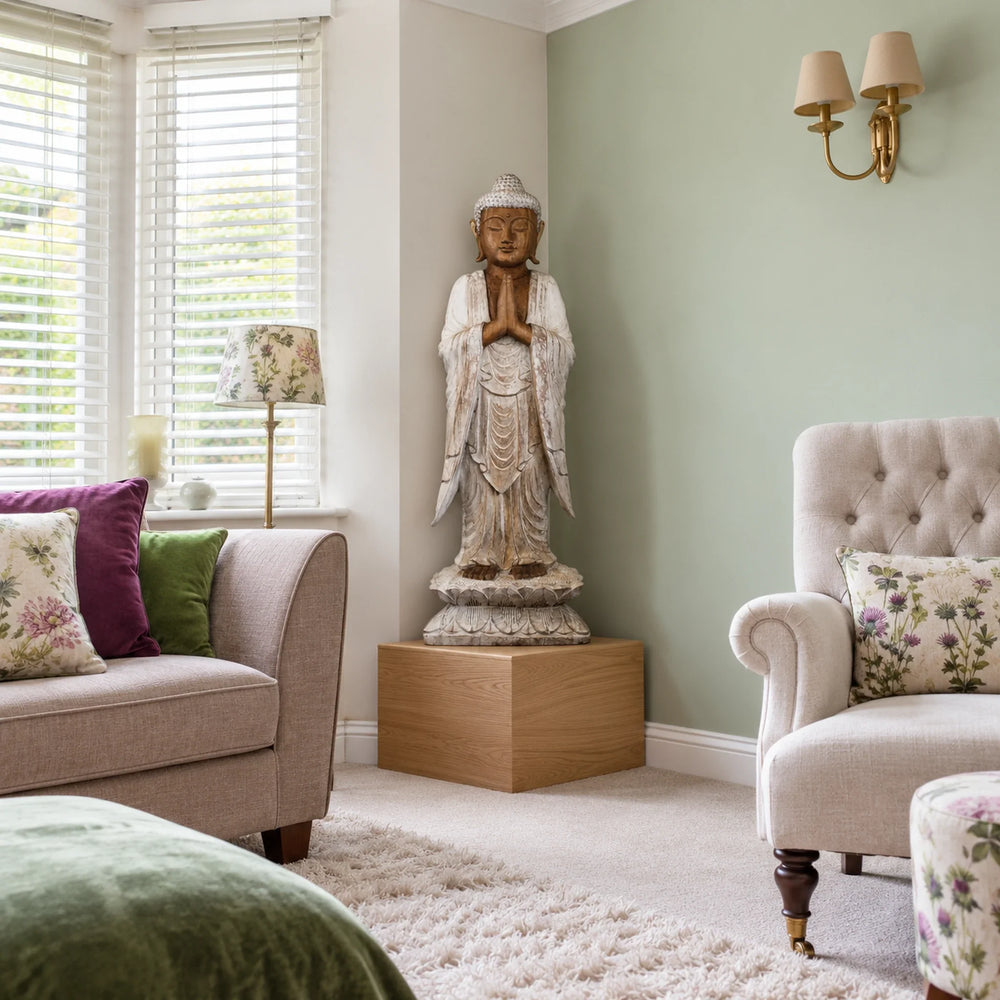
| 1 m whitewashed standing Welcome Buddha | 40 × 28 × 100 cm; height 100 cm | 23 kg |
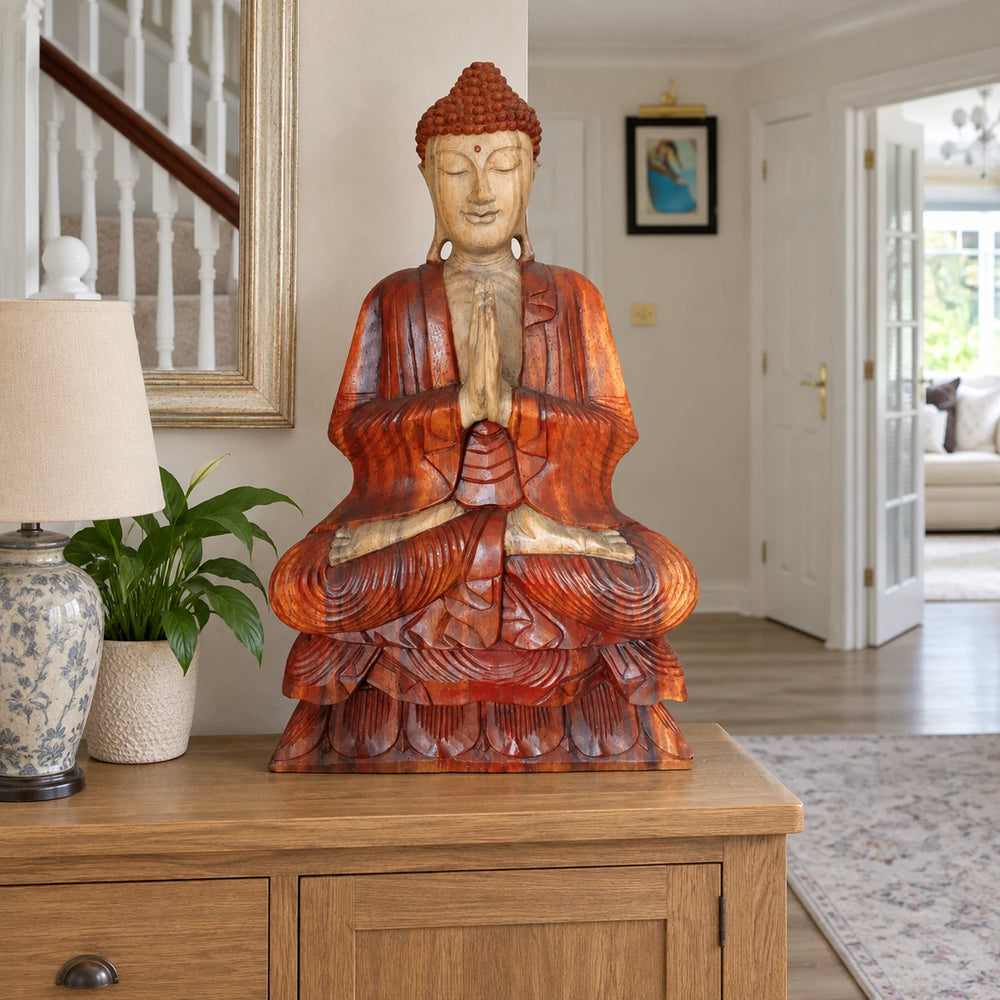
| 80 cm seated Welcome Buddha | 80 × 50 × 25 cm; height 80 cm | 22.5 kg |
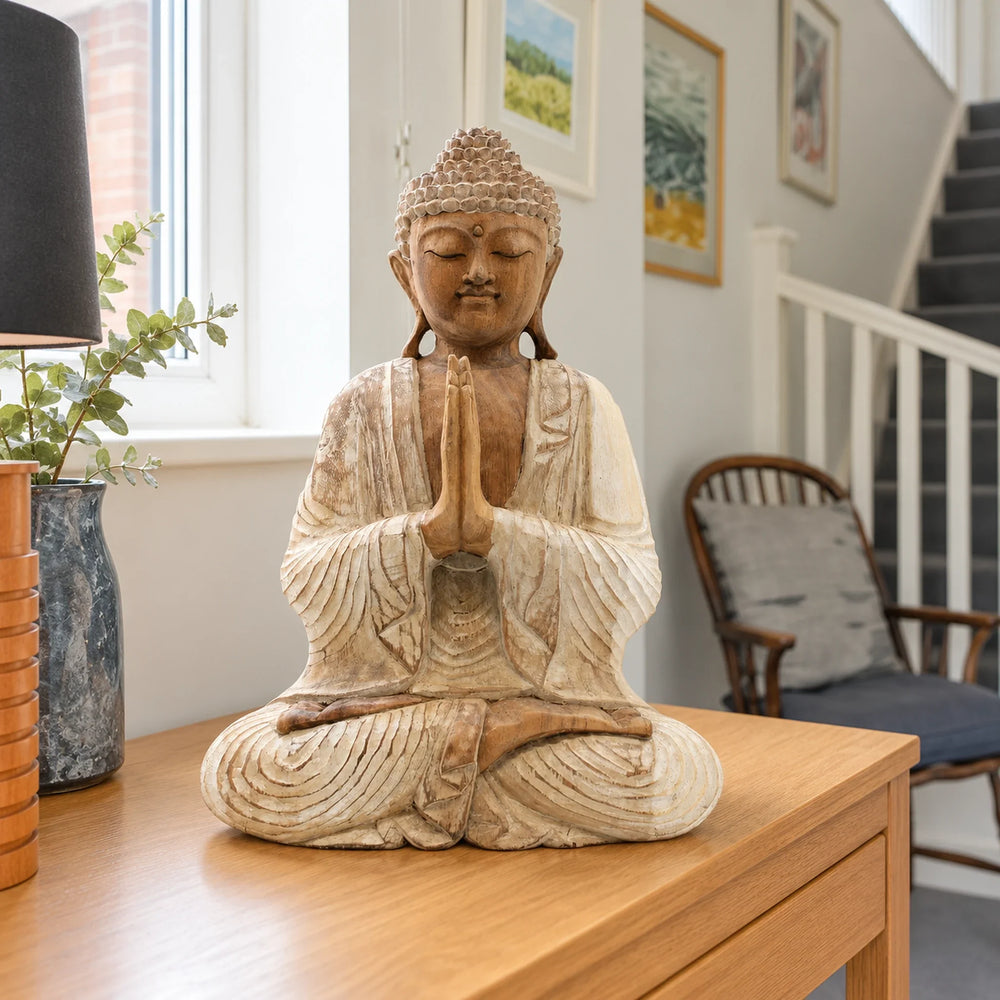
| 40 cm whitewashed seated Welcome Buddha | 32 × 16 × 40 cm; height 40 cm | 4.5 kg |
The 80 cm example is 20 cm shorter than the standing figure but only 0.5 kg lighter. Choosing by height alone would miss that difference. None of these weights establishes how many people should carry the piece, which equipment is suitable or whether a shelf can support it.
Compare the individual listings in our hand-carved wooden Buddha collection. A smaller option can simplify the access question, but it still needs suitable handling and stable support. The cover is an illustrative arrangement, not a scale drawing or installation specification.
Send us one clear access enquiry before ordering
Include the product link, postcode, intended room and floor, your route measurements, a few photographs and a sketch of any tight turn. Ask us to confirm the packed dimensions and weight, the intended delivery point, and what handling or placement is included. Tell us about communal access or building restrictions at the outset.
For example: “I’m considering the 1 m whitewashed Welcome Buddha for a ground-floor room. My clear entrance is ___ cm wide by ___ cm high, followed by the corner shown in the attached sketch. Please confirm the packed size, delivery point and handling arrangements before I order.”
Do not assume that delivery to an address includes carrying upstairs, unpacking or installation. Where the route or handling remains uncertain, arrange an assessment by a competent mover and resolve it before purchase. You can contact Root & Still with the information above.
Dhriti Howlader, founder of Root & Still, has previously emphasised choosing a piece that fits your routine and your room. Here, that means considering the journey into the room as part of the choice. For visual scale, use our large-statue size guide; after delivery, follow the separate arrival-checking guide.