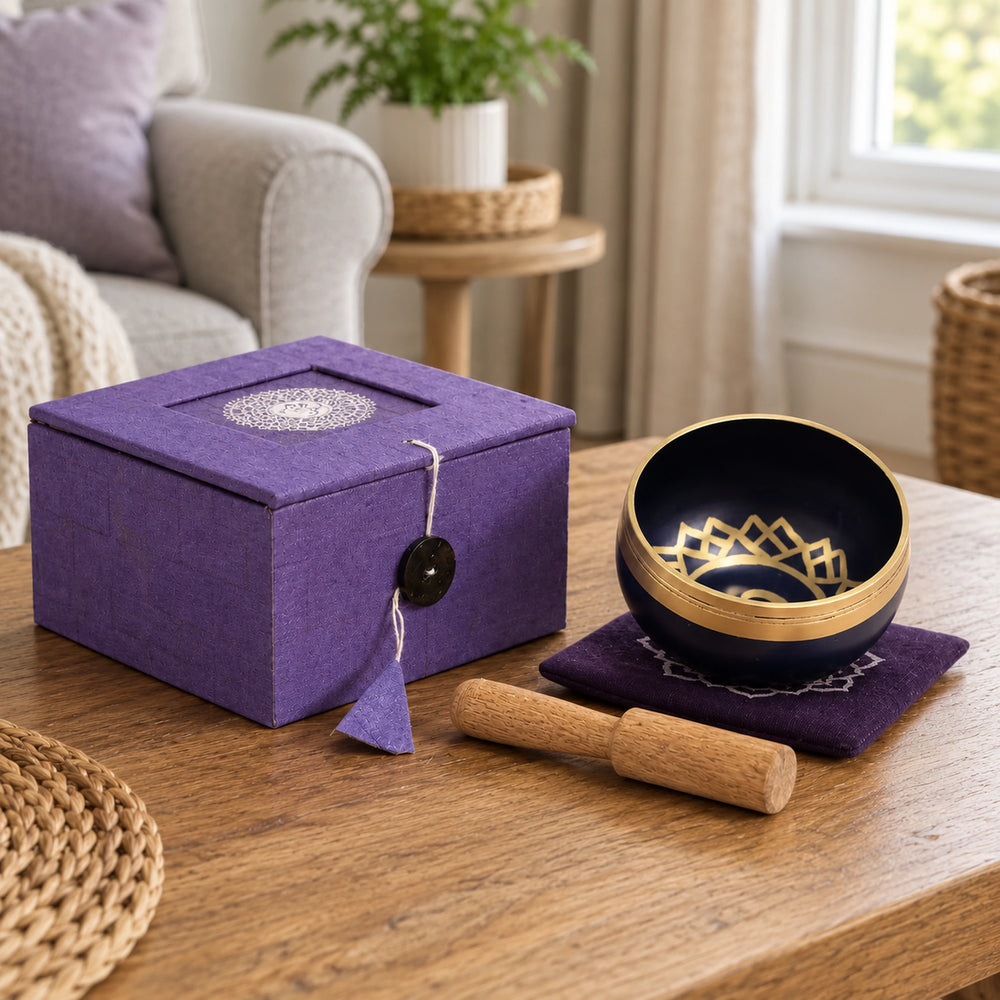
A change in a singing bowl’s sound deserves a careful check, but a dull note alone does not diagnose a crack. Support, contact, technique and the playing tool can all affect what you hear. If you can see damage, stop playing and have the bowl assessed.
Start with a safe visual check
Place the bowl securely on a stable surface and inspect it in good light. Look for a new line, chip, deformation or loose material. Do not run a finger along a potentially sharp rim or suspend a heavy bowl by a fingertip pinch to test it.
A photograph may help a retailer or specialist understand your concern. Include the area of damage, the whole bowl and the model details if you have them. Explain when the change appeared and whether the bowl was dropped or knocked.
If there is no visible damage
- Check that the support and hand position follow the instructions and do not unnecessarily grip the vibrating walls.
- Confirm that the striker is compatible, secure and in good condition.
- Check whether the bowl is intended for striking, rimming or both.
- Follow its care guidance for dust or residue; do not add oil, abrasive polish or an improvised cleaner.
If a gentle test is appropriate under the instructions, keep the bowl securely supported. Stop if anything looks unstable or the sound has changed unexpectedly. Repeated hard tapping is not a safe substitute for an assessment.
What sound can and cannot tell you
A buzz or shortened sustain may justify further investigation, but neither proves a crack. Conversely, a clear note does not certify that an instrument is undamaged. Avoid buying or dismissing a second-hand bowl solely on a quick hanging tap test.
Compare with how the same bowl sounded under similar conditions, if you have a recording. The room, support and microphone can make a comparison less reliable, so describe those differences when asking for help.
Repair and reuse
Whether a repair is possible depends on the material, damage and intended use. A specialist would need to assess it; restoring the original sound cannot be promised. Do not attempt home soldering, filling or grinding based on a general article.
A damaged instrument should not automatically become a water vessel, candle holder or incense burner. Cracks, sharp edges, finish and heat suitability still matter. Seek advice before reuse, and keep damaged items away from children and pets.
Storage and handling
Use a secure position away from shelf edges and protect the bowl from knocks. Use suitable padding during transport and avoid allowing bowls to strike one another. Follow the maker’s guidance on nesting, cases, cleaning and temperature exposure rather than assuming all metals or crystal bowls behave alike.
For related checks, read our guide to mallet compatibility. When considering a replacement from our singing bowls, check its specifications and inspect it on arrival; buying new does not remove the need for a condition check.
Questions people ask
Is a dull sound proof of a crack?
No. It is one observation to investigate alongside condition, support and playing method.
Should I keep playing a visibly cracked bowl?
No. Stop and ask the retailer or a suitable specialist to assess it.
Can every cracked bowl be repaired?
No universal answer is possible. The damage and material need assessment, and the original tone may not be recoverable.