Fair trade home goods are items produced under verifiable conditions that protect workers, pay fair prices, and reduce environmental harm. The single most useful action you can take on any product page is to look for a named certifier — such as the WFTO’s Guaranteed Fair Trade label or the FAIRTRADE Mark — and then check that certifier’s own searchable registry to confirm the seller is listed.
For artisan and handcrafted homeware, you will most often encounter enterprise-level verification rather than the familiar FAIRTRADE Mark. Here is what each term signals:
- FAIRTRADE Mark — issued by Fairtrade International, primarily for commodity goods such as cotton, coffee, and sugar; less common on handcrafted decor
- WFTO ‘Guaranteed Fair Trade’ — verifies the entire enterprise against 10 Principles covering wages, working conditions, transparency, and environmental care; the standard most artisan homeware producers use
- Fair for Life — a third-party social and fair-trade certification covering both agricultural and non-agricultural supply chains
- Named certifier with no registry link — a yellow flag; always cross-check on the certifier’s own website before purchasing
What does ‘fair trade’ actually mean for home goods?
The phrase covers a specific set of commitments, not a single universal standard. At its core, fair trade for home goods means producers receive a price that covers the true cost of sustainable production, workers are paid fairly and work in safe conditions, no child or forced labour is used, and environmental responsibility is built into the supply chain.
The distinction between “Fairtrade” (one word) and “Fair Trade” (two words) matters more than most shoppers realise. “Fairtrade” refers to the certification scheme governed by Fairtrade International, while “Fair Trade” (two words) describes a broader movement that includes craft producers monitored by organisations such as the WFTO.
The FAIRTRADE Mark is primarily designed for commodity products — coffee, tea, sugar, cotton — and has different auditing mechanics to WFTO enterprise verification. Absence of the FAIRTRADE logo on artisan home goods does not indicate unethical sourcing; it often simply means the product category sits outside the FAIRTRADE scheme’s scope.
“WFTO members describe the 10 Principles as a holistic approach that governs trading practice, producer well-being and environmental care — a business-model commitment rather than a single-product standard.” — WFTO, Our 10 Principles of Fair Trade
The WFTO verifies entire enterprises rather than individual products. A business that passes WFTO monitoring across all 10 Principles may carry the ‘Guaranteed Fair Trade’ label on everything it sells — which is why this system suits handmade homeware so well. A ceramic bowl and a woven basket from the same artisan cooperative can both carry the label, even though neither is a commodity crop.
From a UK consumer-protection standpoint, any label making a social or environmental claim should be verifiable by an issuing body. Vague terms without an audit trail should be treated with caution.

Which home goods are commonly sold as fair trade?
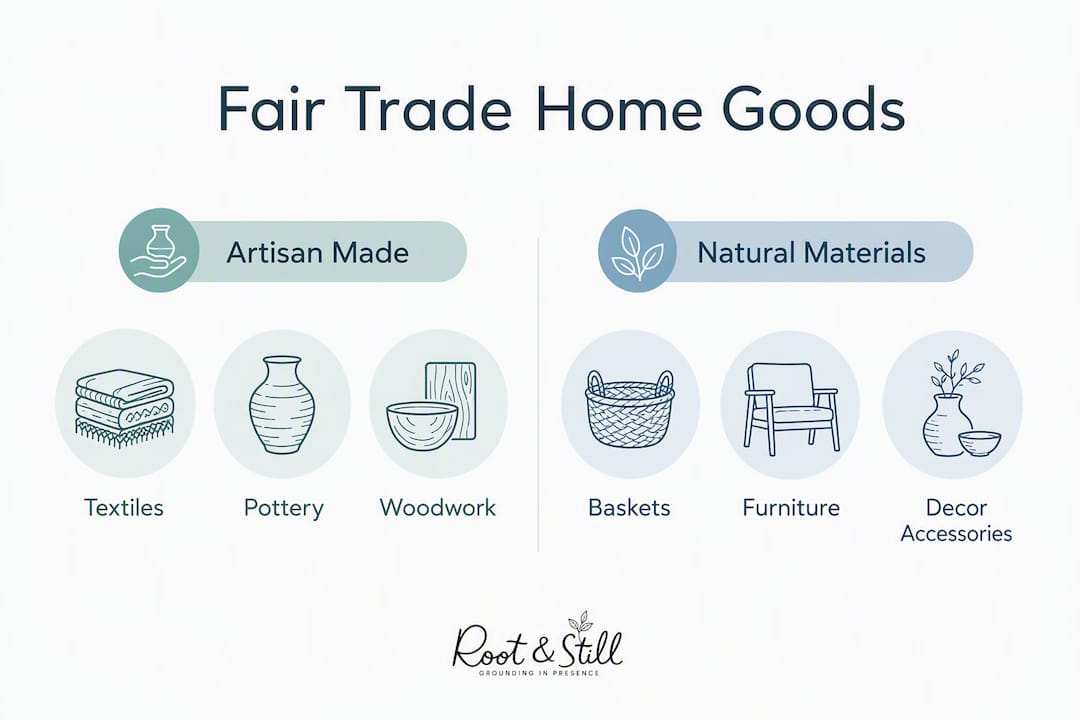
Artisan-made and natural-material homeware dominates the fair-trade category. The table below maps common product types to the certification or verification approach you are most likely to encounter.
| Product type | Likely certifier / verification | What to expect on the product page |
|---|---|---|
| Handwoven textiles, rugs, cushion covers | WFTO enterprise verification or Fair for Life | Cooperative name, country of origin, weaver story |
| Ceramics and pottery | WFTO enterprise verification | Maker name, workshop location, production photos |
| Wicker, rattan, and bamboo baskets | WFTO enterprise verification | Artisan group name, village or region, material sourcing note |
| Candles and incense | WFTO or Fair for Life (where ingredients are commodity-sourced, FAIRTRADE Mark may appear) | Ingredient origin, producer name, certifier badge |
| Decorative crafts and figurines | WFTO enterprise verification or BAFTS-member retailer | Maker story, origin country, enterprise audit reference |
| Cotton-based homeware (throws, napkins) | FAIRTRADE Mark possible; WFTO also common | Cotton origin, certifier badge, licence number |
A few practical notes on what the labels actually verify:
- The FAIRTRADE Mark on a cotton throw guarantees the cotton was sourced under Fairtrade standards; it does not automatically cover every stage of manufacture
- A WFTO ‘Guaranteed Fair Trade’ badge on a figurine means the producing enterprise as a whole has been audited — a stronger whole-chain signal for handcrafted goods
- Some UK furniture and homeware businesses have completed WFTO guarantee-system audits and can use the Guaranteed Fair Trade label after independent audits at supplier sites, demonstrating that enterprise verification applies beyond small crafts
Pro Tip: When you see a certifier badge, note whether it links directly to a registry entry. A badge image alone is not verification — the clickable link to the certifier’s member search is.
How can you verify fair-trade claims and spot greenwashing?
The phrase “ethically made” carries no legal definition in the UK. The most reliable indicator of genuine ethical sourcing is specificity: brands that name factories, workers, and supply-chain partners, and that link to independent certifications such as WFTO, Fairtrade, B Corp, or SA8000, offer far stronger evidence than unaudited claims.
Here is a practical verification checklist for any homeware listing:
- Named certifier — WFTO, FAIRTRADE, Fair for Life, or similar; not just “ethical” or “sustainable”
- Registry link — a URL to the certifier’s searchable member or product database
- Producer or maker story — names the artisan group, cooperative, or workshop with a specific location
- Audit or verification details — references an enterprise audit, monitoring visit, or third-party inspection
- Traceability information — batch codes, lot numbers, or a named supply-chain partner
Common red flags to watch for:
- “Ethically sourced” or “sustainably made” with no certifier named
- No maker details, no country of origin beyond a broad region
- Charity donation claims with no verifiable link to the producer community
- Conflicting origin statements (e.g. “handmade in Bali” on one page, “made in China” on the returns label)
- A certifier logo that does not link to a registry and cannot be verified
UK consumer guidance cautions that any label should be verifiably certified by an issuing body; vague terms without an audit trail should be treated with caution.
Pro Tip: Cross-check a seller’s claim in under two minutes: search the WFTO member directory at wfto.com, the FAIRTRADE licensee database at fairtrade.org.uk, or the BAFTS member listing at bafts.org.uk. If the seller does not appear in any of these, ask them directly which body audits their claims.
Why do fair-trade home goods often cost more?
The price premium on genuinely fair-trade homeware reflects real costs that conventional supply chains typically externalise. Understanding what drives the price helps you judge whether a higher figure reflects verified practice or simply a marketing choice.
The main cost drivers are:
- Producer-determined pricing — artisans set prices that cover living wages and production costs, rather than accepting the lowest price a buyer will accept
- Pre-finance or advance payments — many fair-trade buyers pay a portion of the order upfront, giving producers cash flow without exploitative loans
- Community development premiums — a portion of the sale price funds shared projects such as schools, healthcare, or equipment for the cooperative
- Longer-term supplier relationships — fair-trade buyers commit to ongoing orders, which allows producers to invest in quality and training rather than chasing short-term contracts
- Safer working conditions — compliance with health and safety standards costs money; that cost is built into the price rather than avoided
What a price premium should not automatically mean is that the money reaches producers. A homeware item labelled “artisan” and priced at a premium without any certifier or maker story may simply reflect a retail margin decision. The premium is only meaningful when it is tied to a verified system.
For artisanal homeware, the price difference compared to mass-produced equivalents can be noticeable. A handwoven basket or hand-finished figurine from a verified fair-trade enterprise will typically cost more than a factory-produced version, because the labour time, skill, and fair wage are priced in rather than compressed out.
Your practical checklist before buying fair-trade home goods
Work through this in order when you land on a product page or contact a seller.
- Check the product page for a named certifier. WFTO, FAIRTRADE, Fair for Life, or B Corp are the most credible for homeware. If none is named, move to step 2.
- Look for a maker or producer story. A named cooperative, workshop, or artisan group with a specific country and region is a positive signal. A vague “handmade by skilled artisans” is not.
- Search the certifier’s registry. Visit wfto.com or fairtrade.org.uk and search for the seller or producer name. Confirmed listing: proceed with confidence. Not listed: ask the seller directly.
- Check for audit or verification references. Product pages from verified enterprises often mention monitoring visits, enterprise audits, or third-party inspections. Their absence is not conclusive, but their presence is reassuring.
- Look at the origin details. Country of origin, production region, and material sourcing notes should be consistent across the product page, packaging, and any returns information.
Template questions to ask sellers directly:
- Which certifying body audits your fair-trade claims, and can you share your registry listing?
- Can you name the cooperative, workshop, or artisan group that made this item?
- Is a portion of the sale price paid as a community development premium, and how is it distributed?
- When was your last third-party audit or monitoring visit?
When to walk away: if a seller cannot name a certifier, cannot identify the maker, and responds only with general statements about caring for communities, the claim is unverifiable. That is the moment to look elsewhere.
Where can UK shoppers buy and verify fair-trade home goods?
Several reliable routes exist for finding and independently confirming ethical homeware in the UK.
- WFTO member search at wfto.com lists verified enterprises worldwide; many sell directly to UK consumers or through UK stockists
- BAFTS (British Association for Fair Trade Shops and Suppliers) at bafts.org.uk maintains a directory of UK-based fair-trade retailers; member shops have agreed to source from verified fair-trade producers
- FAIRTRADE Mark registry at fairtrade.org.uk allows you to search licensed products and retailers; most relevant for commodity-based homeware such as cotton throws
- Oxfam shops and online store — Oxfam advises shoppers to look for the FAIRTRADE Mark where present and to prioritise suppliers with accountable sourcing; their homeware range includes verified artisan goods
- Specialist ethical homeware retailers listed on BAFTS or the Ethical Consumer website offer curated ranges with sourcing details on product pages
- Charity shops with dedicated fair-trade or artisan ranges can be a source of verified goods, particularly for ceramics, textiles, and woven items
When browsing UK retail sites more broadly, look for a certifier badge on the individual product page rather than a general “we support fair trade” statement on the homepage. Retail partnerships with Fairtrade can be a positive signal, but a long-term Fairtrade partnership does not mean every homeware item a retailer sells is covered by the FAIRTRADE Mark. Product-level verification is always the more reliable check.
For mindful home decor that sits within a spiritual or wellness aesthetic, specialist retailers with clear artisan sourcing notes are often the most transparent option, because their product pages tend to include maker stories and material provenance as standard.
How Rootandstill approaches ethical sourcing
Rootandstill selects handmade and artisan-crafted pieces with care for origin, material, and maker. The focus is on items that carry a genuine sense of place and craft — not mass-produced replicas of spiritual forms, but pieces where the hand of the maker is present in the finish.
On Rootandstill product pages, shoppers will find:
- Material descriptions that name specific finishes and construction methods (resin, copper patina, stone-effect, hand-carved wood)
- Origin and production notes where available, including the style tradition or regional craft the piece draws from
- Honest descriptions of how each item is made and finished, without inflated claims
The following pieces from the Rootandstill collection illustrate this approach. The Buddha Wall Art Painting — Copper Face and Buddha Wall Art Painting — Copper Brocade Detail both carry detailed notes on their textured finishes and the craft tradition they reference. The Buddha Wall Art Painting — Grey Sand Finish describes its muted, tactile surface in a way that lets you understand the material before it arrives.
For figurines and statues, the Antique Small Buddha Figurines — Classic Statue and Resin Silver Mini Buddha Statue (Assorted Colours) each include finish and material details that reflect the care taken in selection. The Tranquility Buddha Head Statue — Green Copper is described with attention to its aged copper finish and the calm presence it brings to a space.
Rootandstill does not claim WFTO or FAIRTRADE certification. What it does offer is transparency about materials, finishes, and the craft traditions each piece draws from — the kind of specificity that, as Temango’s ethical sourcing guidance notes, is the best available signal when independent certification is absent.
Key takeaways
Fair trade home goods are most reliably verified by a named certifier with a searchable registry, a specific maker story, and evidence of third-party auditing — not by marketing language alone.
| Point | Details |
|---|---|
| FAIRTRADE Mark vs WFTO | The FAIRTRADE Mark covers commodity goods; WFTO enterprise verification covers artisan homeware and handcrafted decor. |
| Verification first step | Search the WFTO member directory or FAIRTRADE registry to confirm a seller’s claim before purchasing. |
| Red flag to watch | “Ethically made” with no named certifier and no maker story is unverifiable under UK consumer-protection expectations. |
| Price premium rationale | Higher prices in verified fair-trade homeware reflect fair wages, advance payments, and community premiums — not just retail margin. |
| Rootandstill’s approach | Rootandstill provides material, finish, and craft-tradition details on every product page — a transparency signal for shoppers who want to understand what they are buying. |
Why ethical sourcing matters for a mindful home
There is a quiet contradiction at the heart of a lot of “wellness” home decor: the idea that a space can feel genuinely calm and grounded when the objects in it were made under conditions nobody has bothered to check. A Buddha figurine produced in a factory with no worker protections and no transparency carries a different kind of energy to one made by a named artisan in a cooperative that pays fairly and works sustainably. That distinction may sound abstract, but it becomes very concrete the moment you try to verify a claim and find nothing there.
What I find most useful about the WFTO framework is that it asks the whole enterprise to commit, not just a single product line. That means when you buy from a verified WFTO member, the sourcing conditions apply to everything they sell — the candle, the basket, the ceramic bowl — not just the items that happen to carry a badge. For shoppers building a spiritual home decor environment with genuine intention, that systemic commitment is far more meaningful than a product-by-product claim.
The other thing worth saying plainly: transparency is not the same as certification, but it is not nothing. A brand that names its makers, photographs its workshops, and describes its materials honestly is offering you something real to evaluate. That is where the conversation about ethical sourcing should start — with specificity, not slogans.
Rootandstill’s curated collection for mindful, artisan-inspired spaces
Rootandstill brings together handmade Buddha statues, wall art, figurines, and spiritual accessories chosen for their craft quality and the calm they bring to a room. Each product page describes the material, finish, and making tradition in plain language, so you can understand what you are bringing into your home before it arrives.
If you are ready to explore pieces with that level of detail, the Antique Small Buddha Figurines — Classic Statue and the Tranquility Buddha Head Statue — Green Copper are good starting points — both carry thorough material and finish descriptions. For wall art with a textured, handcrafted feel, the Buddha Wall Art Painting — Copper Brocade Detail shows how much character a well-described artisan piece can carry. Browse the full collection at rootandstill.com and use the product pages to ask any sourcing questions directly before you buy.
Useful sources and certifier registries
These are the primary resources UK shoppers can use to verify fair-trade claims and learn more about certification systems.
- WFTO — Our Fair Trade System — explains enterprise verification and links to the member search directory
- WFTO — 10 Principles of Fair Trade — the full framework that verified enterprises must follow
- Fairtrade Foundation (UK) — searchable licensee database for FAIRTRADE Mark products; most relevant for commodity-based homeware
- BAFTS — British Association for Fair Trade Shops and Suppliers — directory of UK-based verified fair-trade retailers; use the member search to find local and online shops
- CDEC — Fairtrade and Fair Trade: What’s the Difference? — clear explanation of the naming distinction for shoppers
- Ethical Trading Initiative — explains the difference between ethical trade and Fairtrade certification
| Certifier / body | What they verify | What to look for on a product page |
|---|---|---|
| WFTO | Entire enterprise against 10 Principles | ‘Guaranteed Fair Trade’ badge with registry link |
| Fairtrade International | Commodity products (cotton, coffee, sugar) | FAIRTRADE Mark with licence number |
| Fair for Life | Agricultural and non-agricultural supply chains | Fair for Life seal with certifier reference |
| BAFTS | UK retailer membership and sourcing commitments | BAFTS member logo; check bafts.org.uk directory |
BAFTS member shops are a particularly reliable channel for artisan homeware in the UK. Members have agreed to source from verified fair-trade producers, and the BAFTS directory is searchable by location and product type. Charity shop ranges from organisations such as Oxfam offer another route to verified artisan goods, often at accessible prices, with sourcing accountability built into the organisation’s mission.
This article provides general information about fair-trade certification and ethical sourcing. It is not professional legal or consumer-rights advice. For specific queries about product claims, consult the relevant certifier directly or seek guidance from the Citizens Advice Bureau.
FAQ
What does ‘fair trade’ mean for home goods?
Fair trade home goods are produced under conditions that guarantee fair wages, safe working environments, no child or forced labour, and environmental responsibility. Verification comes from named certifiers such as WFTO or Fairtrade International, not from unaudited marketing language.
What are the main Fairtrade products?
The FAIRTRADE Mark is primarily associated with commodity goods — coffee, tea, cocoa, sugar, bananas, and cotton. For handcrafted home goods such as ceramics, baskets, and figurines, WFTO enterprise verification is the more common standard.
Is a retailer’s Fairtrade partnership enough to trust their homeware?
Not on its own. A long-term Fairtrade partnership with a retailer does not mean every homeware item they sell carries the FAIRTRADE Mark. Always check the individual product page for a certifier badge and a registry link rather than relying on a general brand-level claim.
What does Fairtrade mean in simple terms?
Fairtrade means producers in developing countries receive a guaranteed minimum price for their goods, plus an additional premium to invest in their communities, in exchange for meeting social and environmental standards audited by an independent body.
How do I quickly verify a fair-trade homeware claim in the UK?
Search the seller’s name in the WFTO member directory at wfto.com or the FAIRTRADE licensee database at fairtrade.org.uk. If they are not listed, check the BAFTS directory at bafts.org.uk, or ask the seller directly which body audits their claims and when their last audit took place.