

A zen garden is one of those things many people recognise immediately but rarely understand fully. You might picture raked gravel and a few well-placed stones in a Japanese courtyard, and think: decorative, calm, vaguely spiritual. But that surface reading misses almost everything that matters. A zen garden is a deliberate, meditative space rooted in centuries of Buddhist philosophy, where every stone, every raked line, and every stretch of empty ground carries intention. This article covers the zen garden meaning in full, the design principles behind it, and how to create one that genuinely supports your sense of stillness at home.
Key takeaways
| Point | Details |
|---|---|
| Rooted in Zen Buddhism | Zen gardens emerged in 14th–15th century Japan as contemplative tools for monks, not decorative features. |
| Symbolism drives every choice | Raked gravel represents water, stones symbolise mountains, and empty space reflects Zen philosophical principles. |
| Designed for stillness, not strolling | A traditional zen garden is observed from a fixed seated position, which shapes how you design your own. |
| Raking is the practice | Daily raking is a meditative act, not maintenance. The patterns change; that is the point. |
| Simple to start at home | A small defined area, gravel, a few stones, and a boundary is enough to begin a meaningful zen garden. |
What is a zen garden, really?
The traditional Japanese name is karesansui, which translates loosely as “dry landscape.” Karesansui gardens use stones and raked gravel or sand to symbolise land and water without any actual water being present. That distinction is more profound than it first sounds. These gardens do not represent a specific scene from nature. They suggest qualities: flow, stillness, weight, space. The mind fills in the rest.
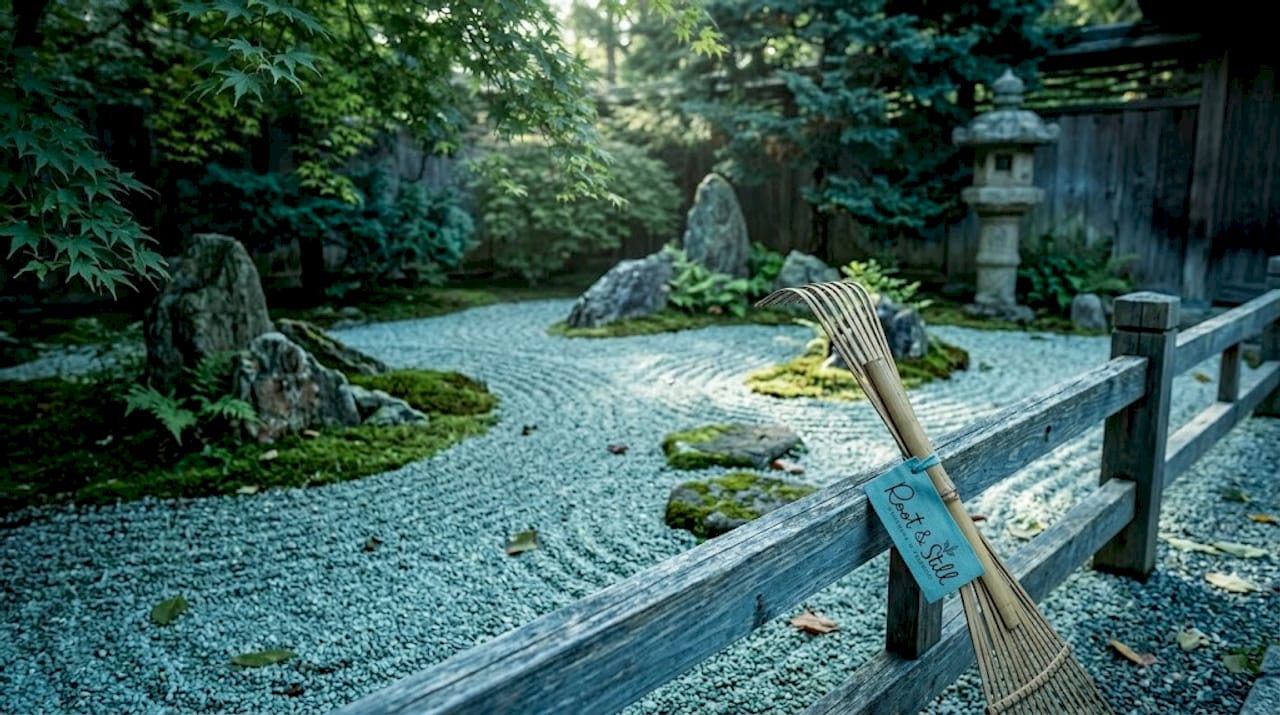
They originated in the Muromachi period of Japan, roughly the 14th to 15th century, closely tied to Zen Buddhist temples and the contemplative lives of monks. Unlike the ornate strolling gardens found elsewhere in Japanese culture, karesansui spaces were created for seated or standing observation from outside the garden itself. You looked at them. You sat with them. You did not walk through them.
This distinction matters for the zen garden meaning because it tells you the purpose of every element. Nothing is decorative in the ordinary sense. Each stone, each raked furrow in the gravel, each stretch of empty ground is there to give the observing mind something to rest on and gently work through.
The symbolism draws from core Zen philosophical principles: simplicity, asymmetry, austerity, stillness, and what might be called openness to interpretation. These principles guide the designer not toward a perfect picture, but toward a composition that prompts reflection rather than closes it down.
The symbolism woven into the design
Once you understand what each element represents, a zen garden begins to feel less like a minimalist garden and more like a quiet, physical form of philosophy.
Raked gravel and sand are the most visually distinctive feature, and their purpose is specific. Wavy lines suggest rivers or ocean swells, while concentric circles mimic the ripple a stone makes on still water. The gravel is not decorative texture. It is abstracted water, and the patterns across it are abstracted movement. The designs are intentionally open to interpretation, inviting the viewer to engage personally rather than read a fixed meaning.
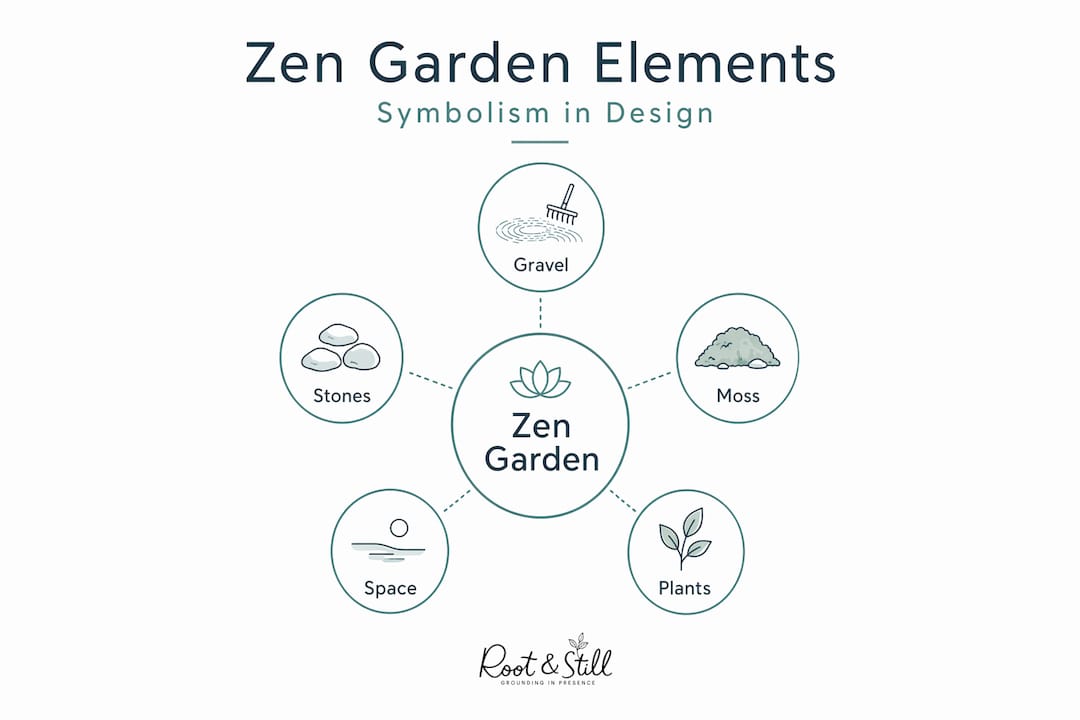
Stones carry enormous weight in zen garden design, both literally and symbolically. Larger stones represent mountains or islands rising from water. Their placement follows principles of asymmetry and natural tension, never uniformly spaced, never arranged in obvious patterns. The most celebrated example is the Ryōan-ji garden in Kyoto, which arranges 15 stones so that only 14 are visible from any single viewpoint. The unseen stone is not an oversight. It is an invitation to keep looking, to accept that some things remain just beyond full understanding.
Empty space is treated as a design element in its own right. In Zen philosophy, emptiness is not absence. It is potential. A garden that feels too full, too busy, too complete leaves nothing for the mind to settle into. The open stretches of raked gravel are where the real contemplation happens.
Minimal planting may appear at the edges: moss creeping along a boundary wall, a clipped shrub placed with care. These touches are restrained deliberately. The garden does not want to become a natural landscape. It wants to suggest one, abstractly, and give your attention room to breathe.
Pro Tip: When thinking about zen garden design ideas for your own space, resist the urge to add more. The power of a zen garden comes from what is left out, not what is put in.
How to create a zen garden at home
The purpose of a zen garden translates remarkably well to a domestic setting, even a modest one. You do not need a large garden. You need a defined, quiet space and a clear sense of what the garden is for.
Here is a grounded approach to getting started:
-
Choose your viewing position first. A zen garden is designed to be observed from a fixed point, such as a bench, a low seat, or a doorway. Decide where you will sit before you decide how to arrange the garden. This single decision shapes everything else, from stone placement to the direction of your raked lines.
-
Define a boundary. A low wooden frame, a line of flat stones, or even a change in ground material creates the psychological separation that makes a zen garden feel intentional rather than just tidy. The enclosure is not about keeping things out. It is about holding the contemplative atmosphere in.
-
Lay your gravel or sand. Fine gravel or coarse sand works well. Pale grey or buff tones feel restful and neutral. Spread it evenly across your defined space, allowing enough depth that a rake leaves a clear impression. For ideas on how different stone and gravel textures can shift the feel of a garden, it is worth exploring a range of options before committing.
-
Place your stones with care. Three to five stones of varying sizes and shapes is often enough. Arrange them in odd numbers, avoid symmetry, and consider how they will look from your chosen viewing position. Step back frequently as you work. What you see from the bench matters far more than what you see standing in the garden itself.
-
Add the rake and begin a practice. Choose a wide-toothed wooden or bamboo rake. The first time you rake the gravel into gentle lines or concentric circles around a stone, you will notice something shift. The act of raking is quiet, repetitive, and entirely present. Daily raking is how monks at Ryōan-ji maintain the garden, and it is not considered upkeep. It is the practice itself.
-
Add a single meaningful object. A small Buddha statue, a lantern, or an incense holder placed at the garden’s edge can anchor the space emotionally without cluttering it. Choose one piece, placed with intention. Indoor garden decoration ideas can offer useful guidance even for outdoor spaces when you are thinking about scale and placement.
Pro Tip: Do not aim for a finished garden. Weather will disturb your raking patterns, and that is entirely right. Because patterns shift with weather, the garden is always becoming, never complete. That is the philosophy made visible.
The benefits of zen gardens
The benefits of zen gardens are well worth understanding before you commit to building one, because they will shape how you use the space once it is made.
The most immediate effect is mental quiet. The design principles of simplicity, asymmetry, and open space actively support the brain in letting go. The lack of visual noise leaves the mind with less to process and more room to settle. Many people find that five minutes of seated observation produces a calm that is difficult to achieve through other means.
Regular raking deepens this. The act is meditative in the truest sense: slow, rhythmic, and completely absorbing. It draws your attention into the present moment without demanding concentration. It is effort without tension.
There is also the quality of connection to nature that a zen garden offers. Gravel suggests water. Stones suggest mountains. Even in a small back garden in England, you are briefly in relationship with something ancient and elemental. That sense of scale and groundedness is quieting in a way that a pot plant or a flower border, beautiful as those are, rarely achieves.
Finally, the principles of zen garden design spill naturally into the rest of your home. Once you understand the power of empty space, asymmetry, and considered restraint, you start seeing your living room differently. Minimalism in home decor is often discussed as a style trend, but through the lens of zen garden meaning, it becomes something more grounded: a deliberate choice to let what is present breathe.
My honest reflection on zen gardens
I have to be direct about something most introductory guides to zen gardens quietly sidestep. The hardest part is not the design. It is the emptiness.
When I first started thinking seriously about karesansui principles, I kept wanting to add things. Another stone. A small plant. Something at the centre. The pull toward fullness is strong, especially for anyone who loves beautiful objects and thoughtful home decor. The zen garden resists this completely, and that resistance is the lesson.
What I have come to appreciate is that the empty gravel is not nothing. It is the most active part of the garden. Your eye moves across it. Your mind follows. The stones only mean something because of what surrounds them. Remove the empty space and you just have a rocky gravel patch. Keep it, and the whole composition starts to feel alive.
I have also found that the seasons genuinely change a zen garden in ways that no other garden element does. Rain disturbs the raking. Frost catches the light differently on pale gravel. The garden requires you to return to it, to re-rake, to re-engage. What looks like impermanence is actually the most reliable form of practice I know.
If you are approaching a zen garden as a finished decor project, I would gently encourage you to reconsider. It is an ongoing conversation between you and a small, quiet patch of ground. That is worth more than any completed design.
— Root
Bring quiet presence to your garden
At Rootandstill, we believe the objects you place in a contemplative space should earn their place. A single piece chosen with care will always outperform a collection assembled for effect. For a zen garden or a meditation corner, consider a standing Buddha statue as a grounding anchor: tall enough to hold presence, simple enough not to compete with the stillness around it. For indoor spaces that echo your garden’s calm, the Cherry Crackle Buddha lamp casts a warm, settled light that softens the mood after dark. Explore the full collection at Rootandstill and find the piece that feels right for your space.
FAQ
What does karesansui mean?
Karesansui is the Japanese term for a dry landscape garden, combining the characters for “dry,” “mountain,” and “water.” It describes a garden that uses stones and raked gravel to suggest land and water through abstraction rather than literal representation.
What is the purpose of a zen garden?
The purpose of a zen garden is to support meditation and quiet contemplation. Designed to be observed from a fixed viewpoint rather than walked through, every element, from raked gravel to placed stones, is intended to calm the mind and encourage mindful stillness.
What do the rocks in a zen garden represent?
Rocks in a zen garden typically symbolise mountains or islands, while the raked gravel surrounding them represents water. Their asymmetric arrangement reflects Zen philosophical principles of naturalness and open interpretation.
How do I start creating a zen garden at home?
Choose a defined area, lay fine gravel or sand to a rakeable depth, arrange three to five stones asymmetrically, and select a fixed viewing position. Begin raking the gravel into gentle patterns and treat that daily act as your meditative practice, not a gardening chore.
What are the benefits of having a zen garden?
The benefits of zen gardens include reduced mental stress, improved focus, and a deeper sense of connection to nature. The design principles of simplicity and empty space actively help the brain release tension, while regular raking builds a grounding daily ritual.


