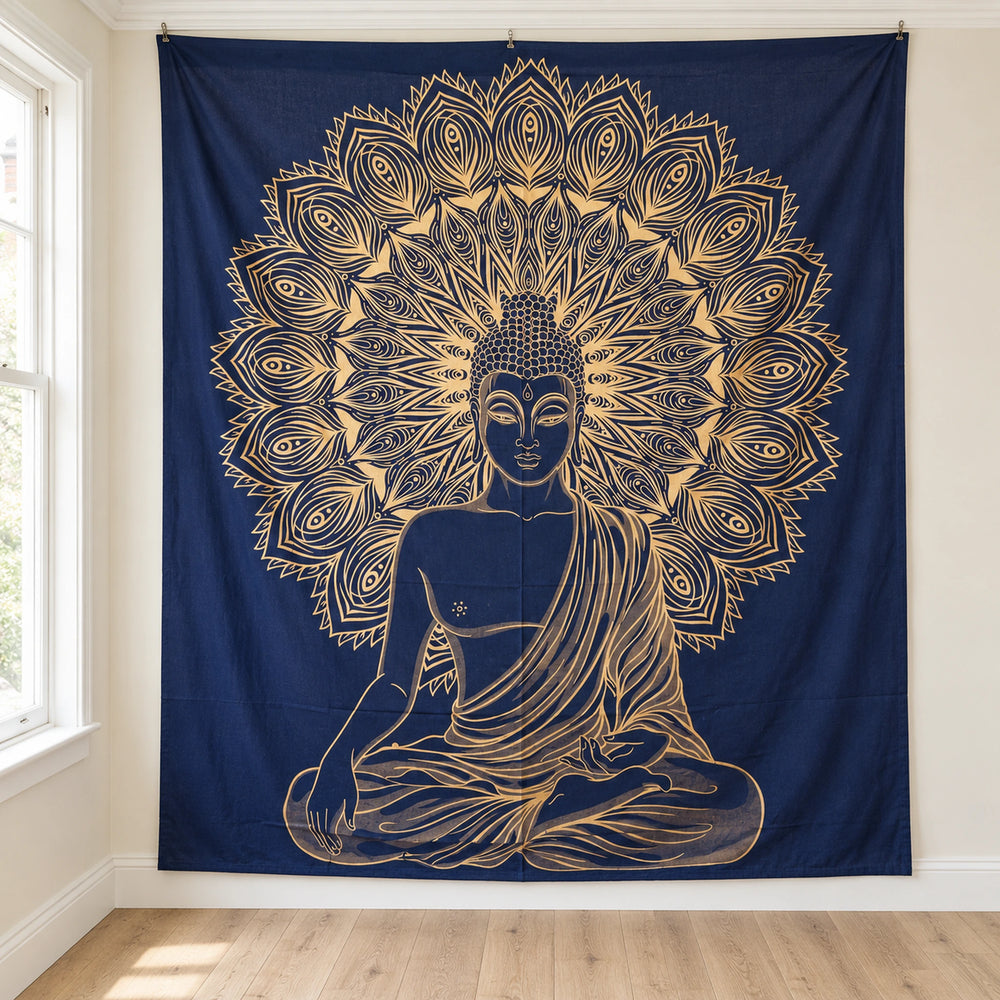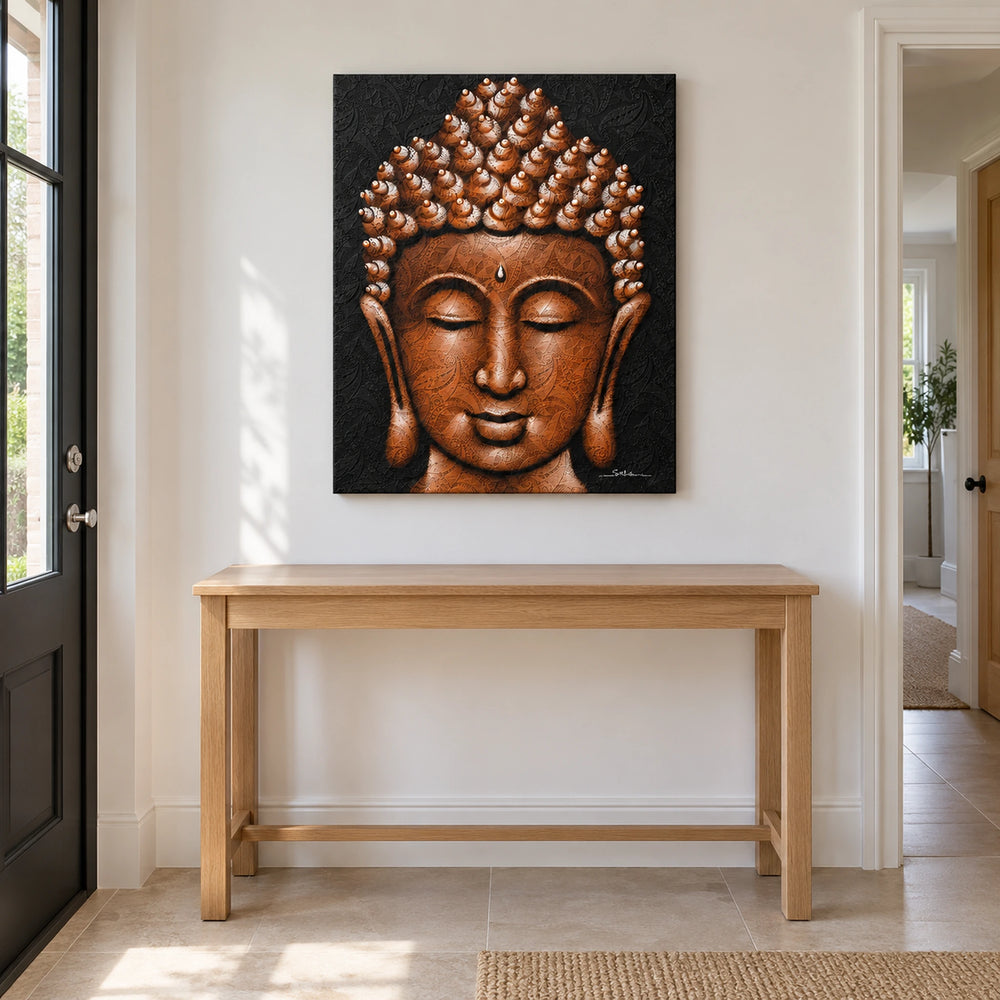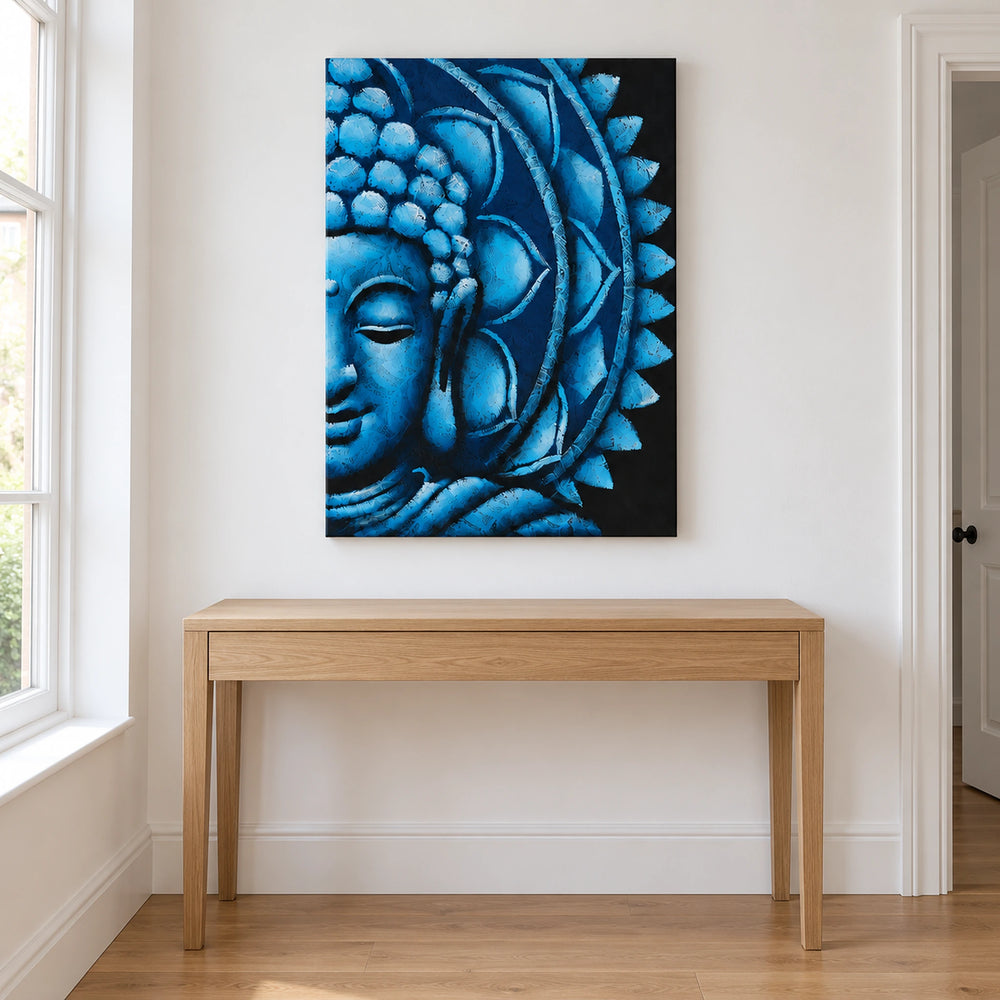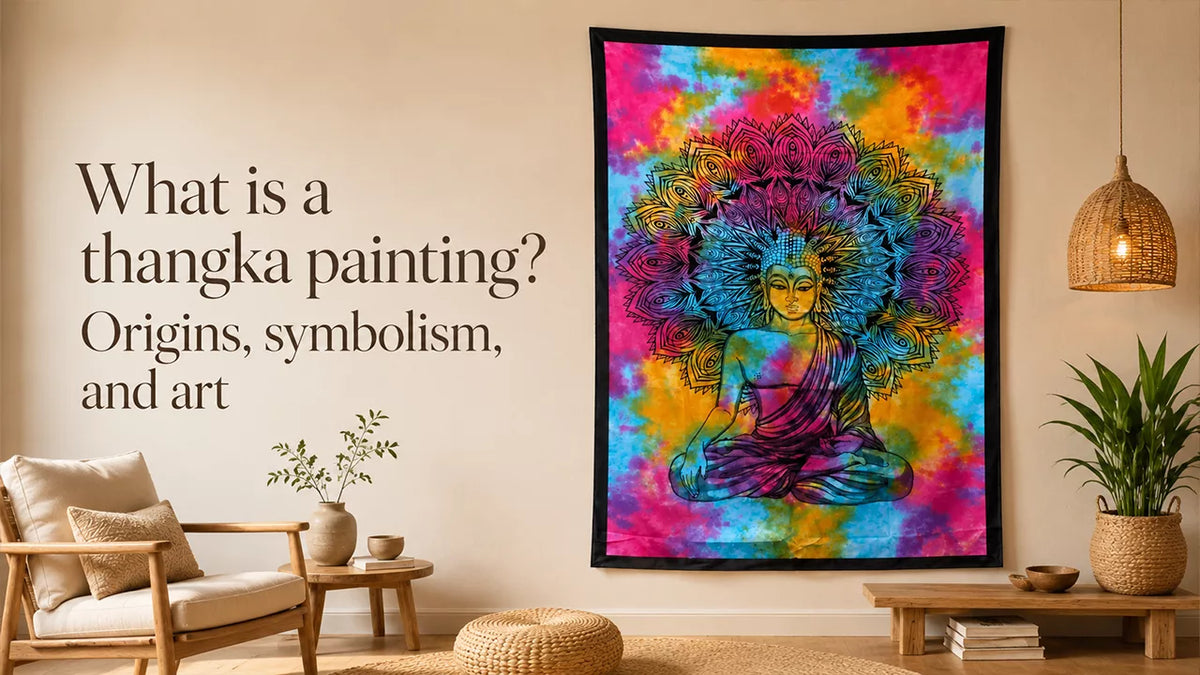
A thangka painting is a traditional Tibetan Buddhist scroll painting on cotton or silk, depicting deities, mandalas, or revered teachers, and designed to serve as a meditational tool and sacred religious record. Unlike decorative art made purely for aesthetic pleasure, a thangka carries spiritual weight. It is rolled up when not in use, mounted on textile backing, and brought out for meditation, ritual, or teaching. The artist does not work freely; every proportion, colour, and gesture follows centuries-old sacred rules.
At its heart, a thangka is:
- A scroll painting on cotton or silk, kept rolled when not displayed
- A meditational focus, helping practitioners visualise deities with precision
- A record of Buddhist teachings, iconography, and lineage
- A ritual object, activated through consecration by a lama
- A vehicle for accumulating spiritual merit, both for the commissioner and the artist
Where did thangka painting come from?
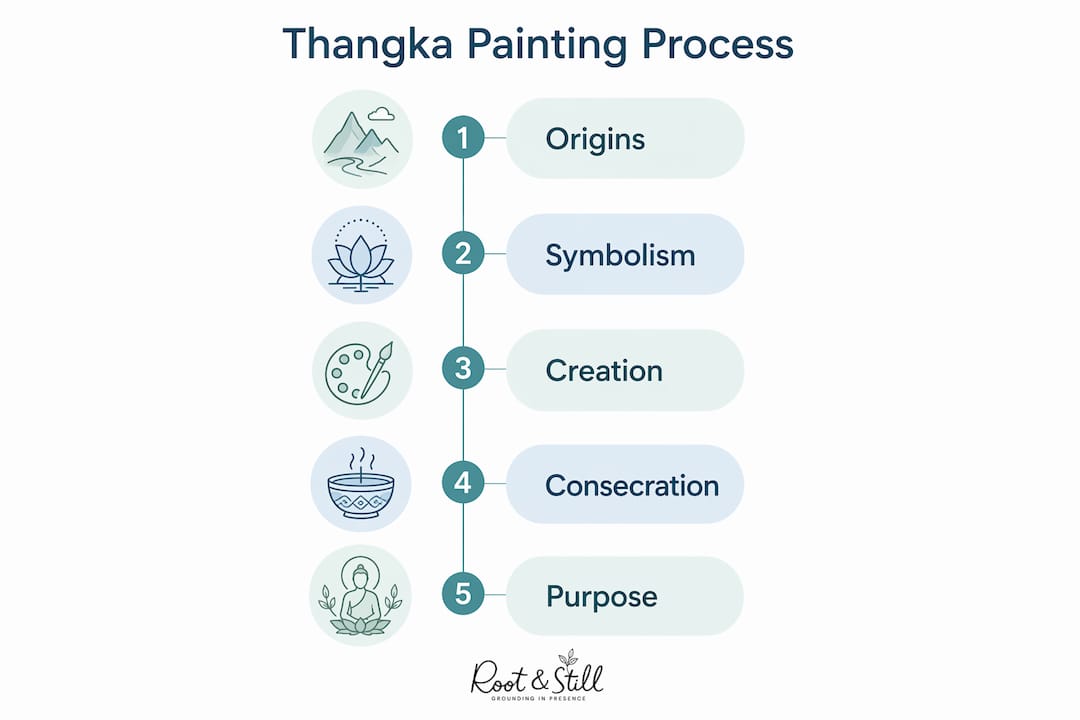
The tradition traces its roots to early Buddhist patronage in India. Anathapindika, the wealthy merchant and devoted supporter of the Buddha, is among the earliest patrons linked to the commissioning of sacred Buddhist imagery. As Buddhism spread northward through the Himalayas, the practice of creating portable painted scrolls took hold in Tibet and Nepal, where it merged with local artistic traditions and monastic culture.
By the time Tibetan Buddhism had established its great monasteries, thangkas had become central to both monastic education and popular devotion. Monks used them to teach the dharma visually, pointing to figures and scenes as a living curriculum. Lay practitioners commissioned them as acts of merit, requests for healing, or expressions of gratitude. The Nepalese paubha tradition developed alongside, sharing many iconographic roots but carrying its own distinct character shaped by Hindu sacred painting.
Across the Himalayan region, distinct regional styles emerged:
- The Tibetan central style, characterised by bold outlines and rich mineral pigments
- The Newar tradition of Nepal, with its refined gold work and intricate detail
- The eastern Tibetan (Kham) style, showing Chinese landscape influence in backgrounds
- The western Tibetan style, closer to early Indian Buddhist painting conventions
How symbolism and sacred geometry shape every thangka
Every element of a thangka composition is governed by iconometric rules, a system of precise proportional guidelines derived from sacred texts. A deity’s body parts are measured in fixed units relative to the face and hands, so that even a novice viewer, trained in the tradition, can read the figure’s identity and spiritual meaning at a glance.
Colour carries specific meaning throughout thangka art. White suggests purity and compassion; blue evokes the infinite and the wrathful; red signals power and life force; gold denotes enlightenment and the sacred. Mudras, the hand gestures of deities, communicate states of mind and spiritual action: the earth-touching gesture of the historical Buddha signals his moment of enlightenment, while the gesture of fearlessness reassures the practitioner.
| Symbol | Meaning |
|---|---|
| Lotus flower | Purity arising from the mundane world |
| Vajra (thunderbolt) | Indestructible wisdom |
| Wheel of Dharma | The Buddha’s teaching set in motion |
| Skull crown | Transcendence over ego and death |
| Halo of flames | Transformative spiritual energy |
Peaceful deities appear serene, adorned with jewels, seated in meditation postures. Wrathful deities, by contrast, are depicted with bared teeth, multiple arms, and fierce expressions. This is not aggression for its own sake. Different Tibetan Buddhist sects favour specific deities and iconographic styles, and the peaceful or wrathful depiction of figures is a deliberate symbolic technique to aid psychological and spiritual practice, cutting through obstacles that gentler imagery cannot reach.
How a traditional thangka is created
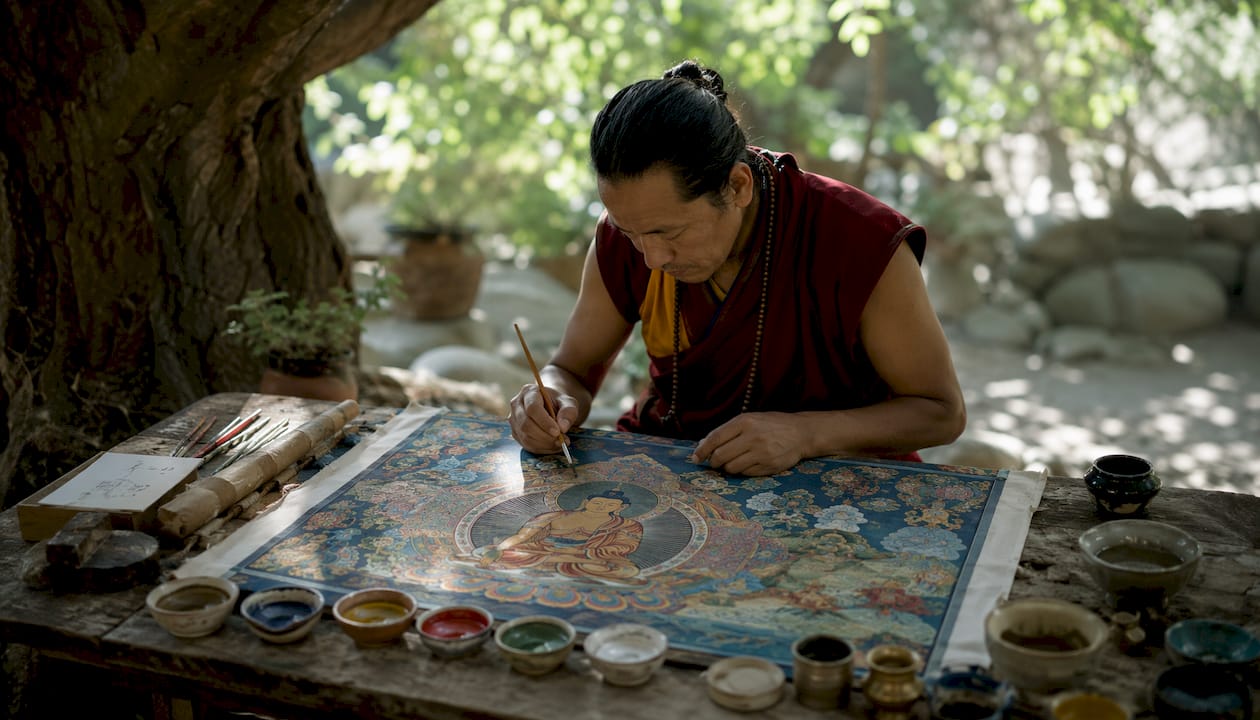
The creation of a thangka is as much a spiritual practice as an artistic one. Traditional artists prepare a cotton canvas by stretching it on a wooden frame, then applying multiple thin layers of chalk and animal glue sizing, burnishing each coat smooth with a stone or shell. The resulting surface is slightly flexible, velvety, and holds mineral pigment with extraordinary fidelity.
The six defined steps of thangka painting follow a strict sequence:
- Stretching and preparing the canvas on a wooden frame
- Applying the chalk and glue ground in thin, burnished layers
- Sketching the composition using iconometric grids and sacred measurements
- Applying base colours in flat, opaque mineral pigment layers
- Adding detail, shading, and gold leaf work with a single-hair brush
- Painting the eyes last, in a ritual known as “opening the eyes”
The pigments used are largely mineral in origin: lapis lazuli for deep blue, malachite for green, cinnabar for red, and ochre for warm earth tones. In Nepal, gold leaf is plated over halos, deity ornaments, and sacred details, giving finished works their characteristic luminosity. Organic pigments supplement the mineral palette for subtler tones.
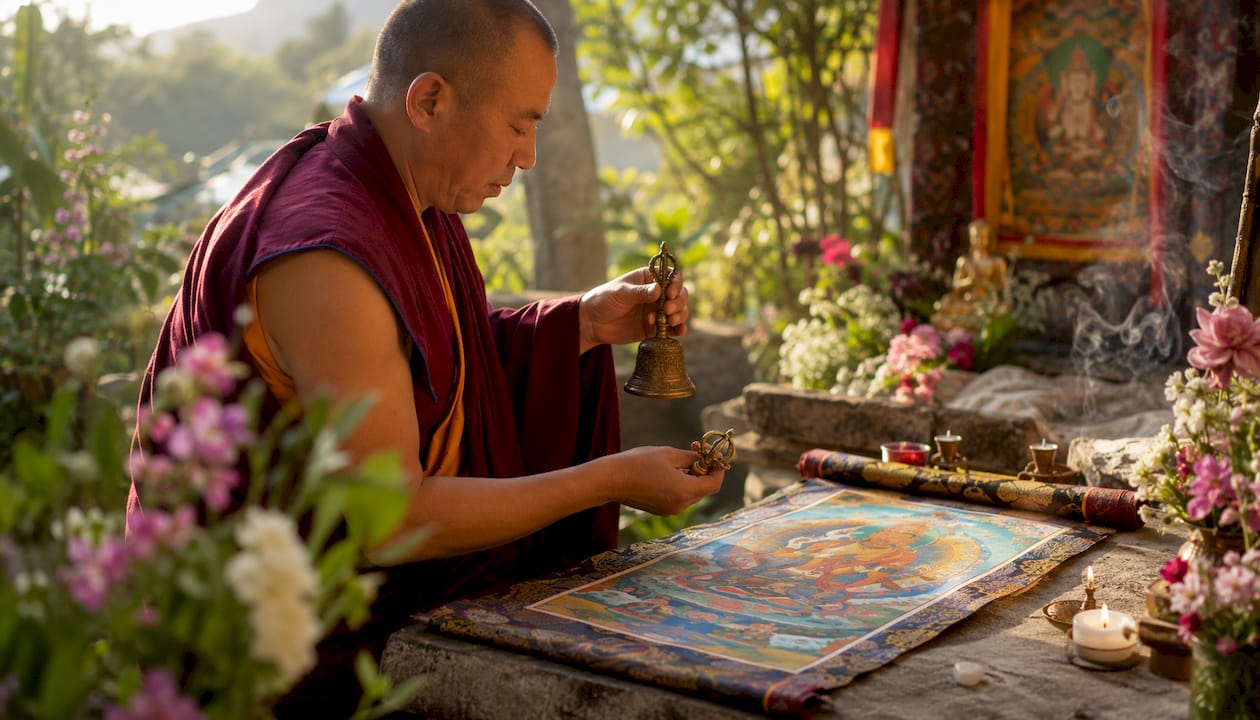
Once the painting is complete, a lama performs the consecration ritual known as rab-ne. Without this ceremony, the thangka remains a skilled artwork. With it, the painting becomes a spiritually active object, imbued with blessing and fit for meditation practice.
What types of thangka paintings exist?
Thangkas cover a wide range of subjects, each serving a distinct purpose within Buddhist practice.
Peaceful deity thangkas depict Buddhas and bodhisattvas in serene meditation postures, often surrounded by symmetrical arrangements of attendant figures. These are the most commonly encountered type and serve as primary meditation supports.
Wrathful protector thangkas show fierce dharma protectors, their multiple arms holding ritual implements, their faces contorted in expressions designed to subdue negative forces. Practitioners use these in specific protective rituals.
- Mandala thangkas map sacred realms as geometric diagrams, with a central deity surrounded by concentric rings of symbolic architecture. A mandala painted on fabric is considered a thangka, though its composition is fixed and its meaning often accessible only to trained practitioners.
- Lineage teacher thangkas portray historical figures such as Milarepa or Tsong Khapa, recording the transmission of teachings from master to student across generations.
- Narrative thangkas illustrate scenes from the Buddha’s life, the Wheel of Life (Bhavachakra), or stories from the Jataka tales, functioning as visual teaching aids.
- Yab-yum thangkas depict deities in union, a symbolic representation of the union of wisdom and compassion rather than a literal image.
Regional variation adds further richness. A thangka made for the Gelug order often includes a figure of Tsong Khapa; one made for the Nyingma order may feature the blue Buddha Samantabhadra at its centre. These distinctions help scholars and collectors identify a painting’s sectarian and geographic origins.
Preserving, authenticating, and collecting thangkas in the UK
Thangkas are fragile. The organic materials that give them their beauty, cotton, animal glue, mineral pigment, and silk mounting, are sensitive to light, humidity, and temperature fluctuation. The Asian Art Museum’s policy of displaying thangkas in low light and rotating the collection every six months reflects the standard that serious collectors and institutions follow.
Authenticating a thangka requires looking beyond surface appearance. Genuine works show mineral pigment granularity under magnification, confident and fluid brushwork, and a chalk-glue ground that feels slightly flexible rather than brittle. The back of an authentic canvas often bears artists’ or monastery seals, prayers, or mantras in traditional scripts, details that commercial reproductions rarely replicate convincingly. A thangka’s value is determined by the artist’s skill in following iconometric guidelines, the quality of materials including gold leaf, and the quality of the brocade mounting.
Pro Tip: When examining a thangka, turn it over before anything else. The back tells you more than the front: look for hand-stitched seams on the canvas, chalk-glue residue, and any inscribed prayers or seals. A blank, machine-stitched back is a strong indicator of a reproduction.
For UK collectors, provenance documentation matters considerably. A clear lineage from a recognised monastery, reputable dealer, or established collection adds credibility that no amount of surface patina can substitute. Approach pieces with vague origin stories carefully, and consult specialists at institutions such as the British Museum, which holds significant Tibetan collections, before making a significant purchase.
How thangkas differ from other Tibetan Buddhist art forms
Thangkas occupy a specific place within a broader family of Tibetan sacred art. Wall paintings, found in monastery chapels, share the same iconographic language but are fixed in place, monumental in scale, and created for communal veneration rather than personal practice. A thangka, by contrast, is portable, intimate, and designed to be rolled and carried.
Sculpture in bronze, copper, or clay depicts the same deities but engages the viewer three-dimensionally. A thangka’s two-dimensional format makes it particularly suited to visualisation practice, where the meditator internalises the image mentally. Sand mandalas, created from coloured sand over days or weeks and then ritually destroyed, share the mandala thangka’s sacred geometry but are impermanent by design, embodying the Buddhist teaching on non-attachment. A painted mandala thangka endures, its composition fixed and repeatable across generations. Embroidered and appliquéd thangkas exist too, created from silk rather than paint, and displayed at festivals on monastery walls at a scale that painted scrolls rarely reach.
If you are drawn to Buddhist art for your own space, a Buddha painting or wall hanging can carry a similar quality of calm presence without the preservation demands of an antique thangka.
Key takeaways
A thangka painting is a consecrated Tibetan Buddhist scroll, governed by sacred iconometric rules, created from mineral pigments on cotton or silk, and activated through ritual to serve as a living meditational object.
| Point | Details |
|---|---|
| Sacred function | Thangkas serve as meditational tools and ritual objects, not purely decorative art. |
| Iconometric precision | Every proportion follows sacred rules; deviations indicate lower quality or training. |
| Consecration is essential | A lama’s rab-ne ritual transforms the painting into a spiritually active object. |
| Authentication markers | Check the back for seals, chalk-glue sizing, and hand-stitched seams. |
| Preservation needs | Keep thangkas in low light and dry conditions to protect organic materials. |
FAQ
What is the purpose of thangka paintings?
Thangkas serve as meditational tools, teaching aids, and ritual objects within Tibetan Buddhist practice. They help practitioners visualise deities, accumulate spiritual merit, and support focused contemplation.
Which religion does thangka painting belong to?
Thangka painting belongs primarily to Tibetan Buddhism, though the Nepalese paubha tradition shares closely related roots and iconographic conventions shaped by both Buddhist and Hindu sacred art.
How do you identify an authentic thangka?
Authentic thangkas show mineral pigment granularity, fluid single-hair brushwork, a flexible chalk-glue ground, and hand-stitched canvas seams. The back often carries monastery seals, prayers, or mantras in traditional scripts.
What makes a thangka valuable?
A thangka’s value rests on the artist’s mastery of iconometric guidelines, the quality of materials such as gold leaf, the richness of the brocade mounting, and the presence of a consecration ritual performed by a lama.
Is a mandala the same as a thangka?
A mandala painted on fabric is considered a thangka, but the two are not identical. A mandala has a fixed, geometric composition understood mainly by trained practitioners, while thangkas cover a far wider range of subjects and narrative scenes.
Bringing sacred art into your home, whether a thangka-inspired piece or a beautifully crafted statue, creates a space that feels anchored and restful. Rootandstill’s antique Buddha figurines and brocade-detail Buddha painting offer a considered way to honour that same spirit of mindful presence in your own surroundings.