A singing bowl can fit on a side table and still feel awkward to play there. Its diameter tells you how much space the bowl takes up, but your hand, striker and support need room too.
Before choosing a bowl for a small room, measure the clear tabletop and try a paper outline in the place where you would actually sit. The aim is to find a comfortable setup, rather than squeeze the largest possible bowl into the space.
Measure the clear space you can actually use
Measure the width and depth of the clear area, after moving anything you would normally put aside to play. A lamp base, a raised table edge or a nearby wall can restrict movement even when the bowl itself fits. Check the table's stability and load guidance as well; dimensions alone do not establish that it can support the bowl.
Keep the bowl and its support fully on the surface, well back from edges and away from places where someone could knock them. Leave a separate place to put the striker down without it rolling off or resting against the bowl.
The bowl's widest diameter is the useful starting measurement. Its base may be narrower, and its cushion may have a different footprint. If the support projects beyond the bowl, include that larger footprint in your layout.
Compare three sizes on the same example tabletop
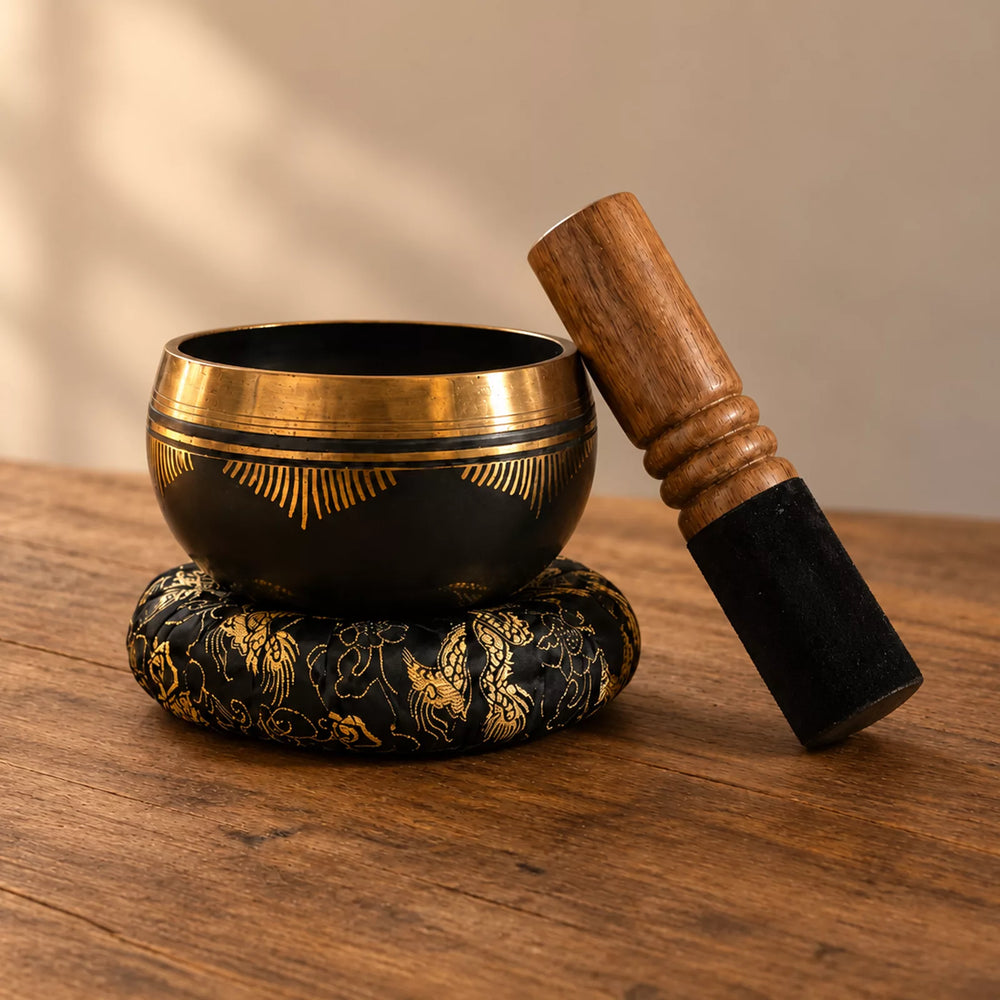
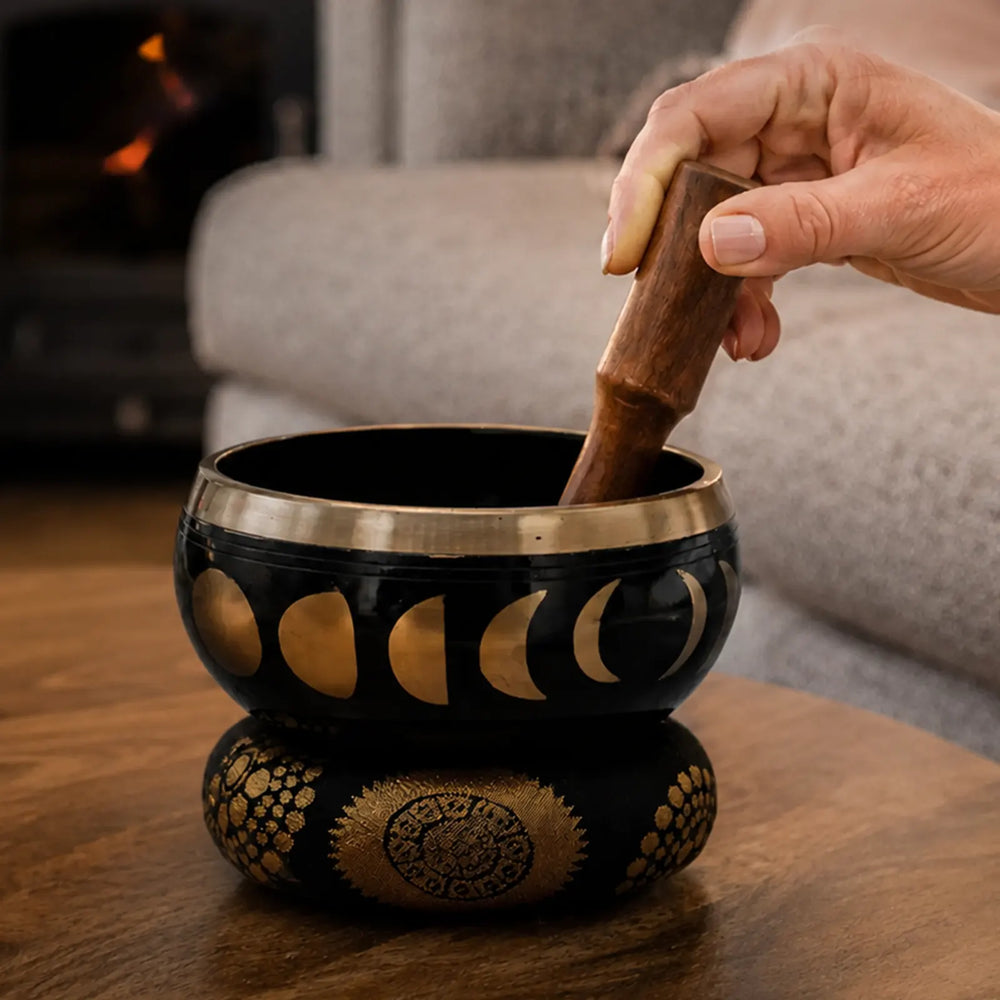
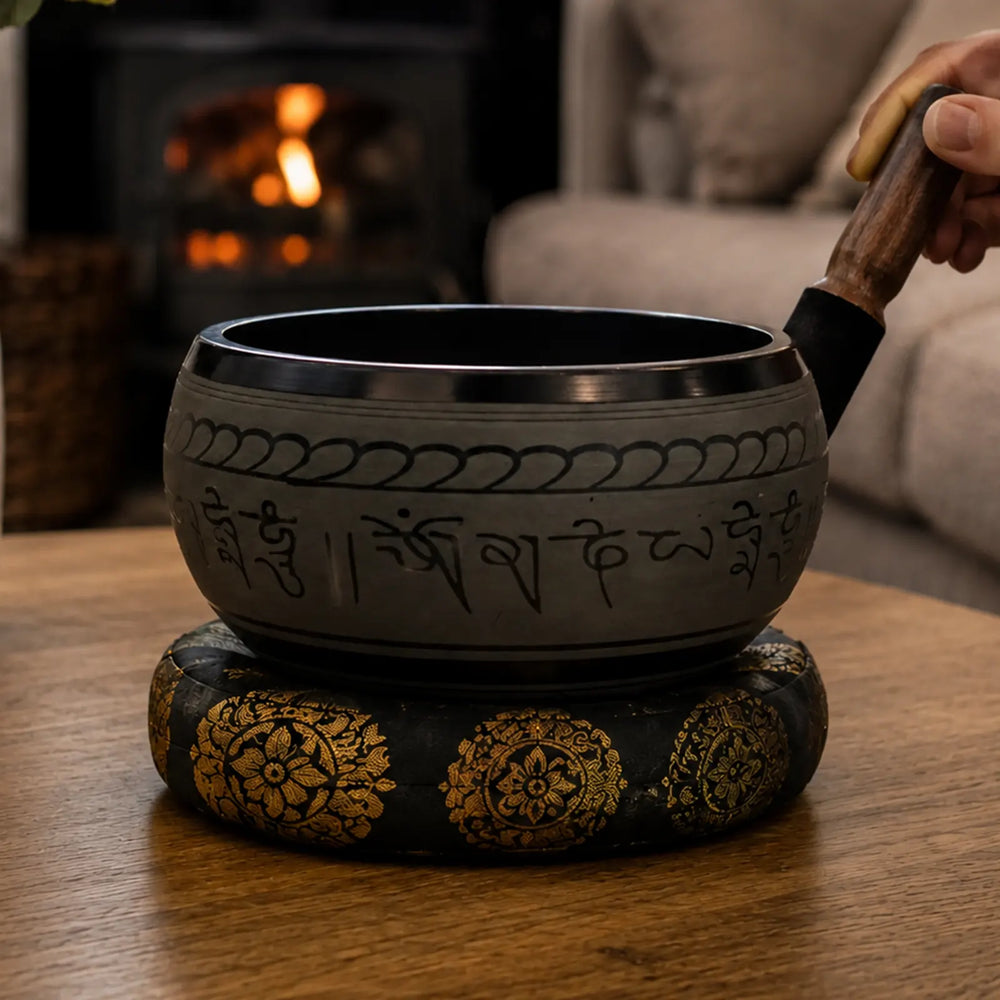
The table below uses three bowls from our singing bowl collection. Bowl dimensions are approximate. The final column is a calculation for an imaginary 30 cm-wide clear surface with the bowl centred on it. It is not a recommended clearance or a test of whether that table would be suitable.
| Bowl | Across | Height | Gap on each side when centred |
|---|---|---|---|
| Flower of Life Singing Bowl Gift Set | 9 cm | 5 cm | 10.5 cm |
| Large Moon Phase Singing Bowl Set | 14 cm | 6.5 cm | 8 cm |
| Five Buddha Singing Bowl | 21 cm | 12.5 cm | 4.5 cm |
For the 14 cm bowl, the calculation is (30 − 14) ÷ 2 = 8 cm on each side. For the 21 cm bowl, it is (30 − 21) ÷ 2 = 4.5 cm. Neither result includes the space your hand or striker will use, or any support wider than the bowl.
Repeat the calculation for the clear depth. On a hypothetical 30 × 25 cm surface, the centred 14 cm bowl would leave 8 cm at each side but only 5.5 cm at the front and back. The smaller gap is easy to overlook if you measure only the width. These figures describe the layout, not a safe distance from an edge.
Try a paper outline before you order
- Draw the bowl's outline. Mark a circle at the listed diameter on paper and cut it out. For a 14 cm bowl, a compass radius of 7 cm gives a 14 cm diameter. If the widest dimension is unclear, ask Root & Still before relying on it.
- Place it where the bowl would sit. Include the footprint of the intended support if it is larger. A flat paper circle shows width, but does not reproduce the bowl's height, weight or stability.
- Sit in your usual position. Check that you can reach the far side without leaning awkwardly. Think about the bowl's height plus the height of its support, not just the tabletop height.
- Rehearse the movement slowly. Move your hand around the outline as you would around the rim. If you already have the intended striker, include it in this check without striking the table. Look for contact with walls, lamps, shelves or your other hand.
- Check the whole routine. Leave somewhere to set the striker down and enough access to lift the bowl with both hands if needed. If the layout is cramped, clear a larger area or compare a smaller bowl.
This is a planning check, not proof that a bowl will play well on that surface. When the bowl arrives, check its actual dimensions, support and stability before playing gently in the intended position.
Allow for the way you want to play
A gentle tap and a continuous movement around the rim use different paths. If you want to explore both, check both movements. There is no single extra number of centimetres that can account for every hand, striker, bowl shape and playing position.
If you intend to hold the bowl, check that its weight and shape are manageable and that you have a secure place to set it down. Choosing handheld playing does not remove the need for a suitable surface nearby. Our guide to choosing a singing bowl support explains why the fit of a cushion needs more than a diameter comparison.
Choose for the room and routine
Dhriti, founder of Root & Still, favours choosing an object around the routine and room it will belong to. For a singing bowl, that means considering where you will sit and how easily you can prepare the space, as well as how the bowl looks.
A shelf that works for display may not be comfortable for playing. It can be more practical to keep the bowl in a suitable storage place and move it to a clear table when needed. See where to keep a singing bowl between uses for the separate storage checks.
Once you have a size shortlist, assess the sound separately. Physical fit does not establish a particular note, loudness or ease of playing. Our sound-sample checklist helps you ask what a recording represents before choosing.