A beautiful photograph can help you choose a singing bowl's finish. A recording can help you decide whether you like a sound. Neither tells you everything about the bowl that will arrive at your door.
If you are buying a singing bowl online in the UK and cannot try it first, start with one question: does the sound sample show the actual bowl you would receive, another example of the same model, or simply a bowl from the range? That distinction matters more than how polished the video looks.
This guide gives you a practical way to compare clips, note what is missing and ask useful questions before ordering. It is a buying checklist, not a listening test of the bowls in our collection.
First, find out what the recording represents
Look for a product code, size and a clear explanation of which item is being played. An exact-item recording is the closest match to your purchase, but you will still hear it through a microphone, your playback device and a different room.
| Sample | Useful for | Do not assume |
|---|---|---|
| The exact bowl for sale | Judging your preference for that item's recorded sound and playing response. | Identical loudness or tone in your own room. |
| Another bowl of the same model and size | Getting a general impression of the model. | The delivered bowl will have exactly the same note or sustain. |
| A range video or unidentified bowl | Understanding the demonstration or deciding what questions to ask. | It demonstrates the product you have selected. |
If the description does not identify the sample, write “sample identity unclear” in your notes. Do not fill in the gap from the colour or decoration alone.
Ask for a useful demonstration, where one is available
A short, straightforward clip can be more useful than a video with background music. Ask whether it can show a gentle strike followed by the sound fading naturally. If you intend to play around the rim, ask for that method as well: a struck demonstration does not show how the bowl responds to rim playing.
It helps to know which striker and support are being used, and whether those are included with the bowl. Our singing bowl mallet guide explains why the playing tool belongs in the comparison.
Ask whether the audio has added music, reverb or other processing. An edited clip is not automatically unhelpful, but a fade-out or loop cannot tell you how long the bowl itself continued to ring. A seller may not have individual recordings available; that is missing evidence, not proof of a poor instrument.
Compare in two passes
Pass one: decide whether you like the recorded sound
Use the same headphones or speakers for both clips, in the same quiet setting. Keep playback comfortable and avoid changing sound-enhancement settings between samples. Listen for the character you enjoy, such as a soft opening, a brighter edge or a gently pulsing sound. Write down your preference in ordinary words instead of giving the bowl a technical score.
If one clip is much louder, reduce it to a comfortable level before comparing. This can make preference easier to judge, but it is not a calibrated loudness comparison. The recording levels may be completely different.
Pass two: check what could be affecting that impression
Return to the clip and look at the setup. Was one bowl struck more firmly? Is one recording close to the microphone? Are the supports or strikers different? These are reasons to qualify your comparison, not reasons to guess which bowl is better.
Shure's recording guidance explains how microphone choice, placement and room sound influence a recording. Using the same playback equipment helps keep your end consistent; it cannot remove differences in how the clips were recorded.
A cluster of tones or a pulsing sound is not, by itself, a defect or a quality certificate. If those sounds are unfamiliar, read our explanation of singing bowl overtones before judging them.
A simple listening worksheet
Copy these six prompts into a note for each shortlisted bowl. Keep observations separate from promises in the listing.
- Item: product name, code and size; exact-item, representative or unidentified recording.
- Setup: striker, support and playing method shown; anything not stated.
- My preference: what I enjoy or dislike about this recording, in my own words.
- Limits: background music, cuts, different recording levels or another reason the clips are not directly comparable.
- Practical fit: listed dimensions, bowl weight, included accessories and where I would keep it.
- Decision: enough information to choose, one question to resolve, or sound too important to buy without further evidence.
For example, “I prefer clip A, but it uses a different striker and is only a range demonstration” is a useful conclusion. “Bowl A is louder and higher quality” is not supported by that comparison. This is an illustrative example, not a result from product testing.
Keep physical facts separate from sound promises
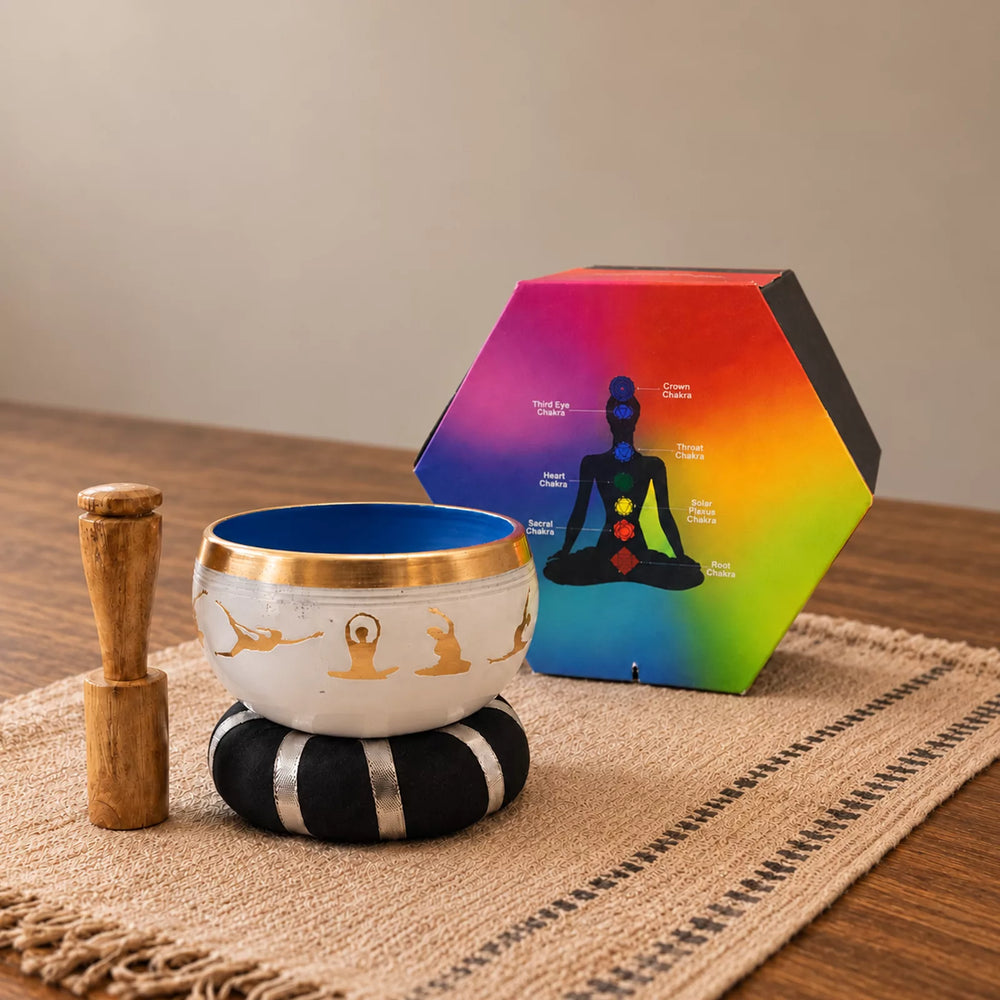
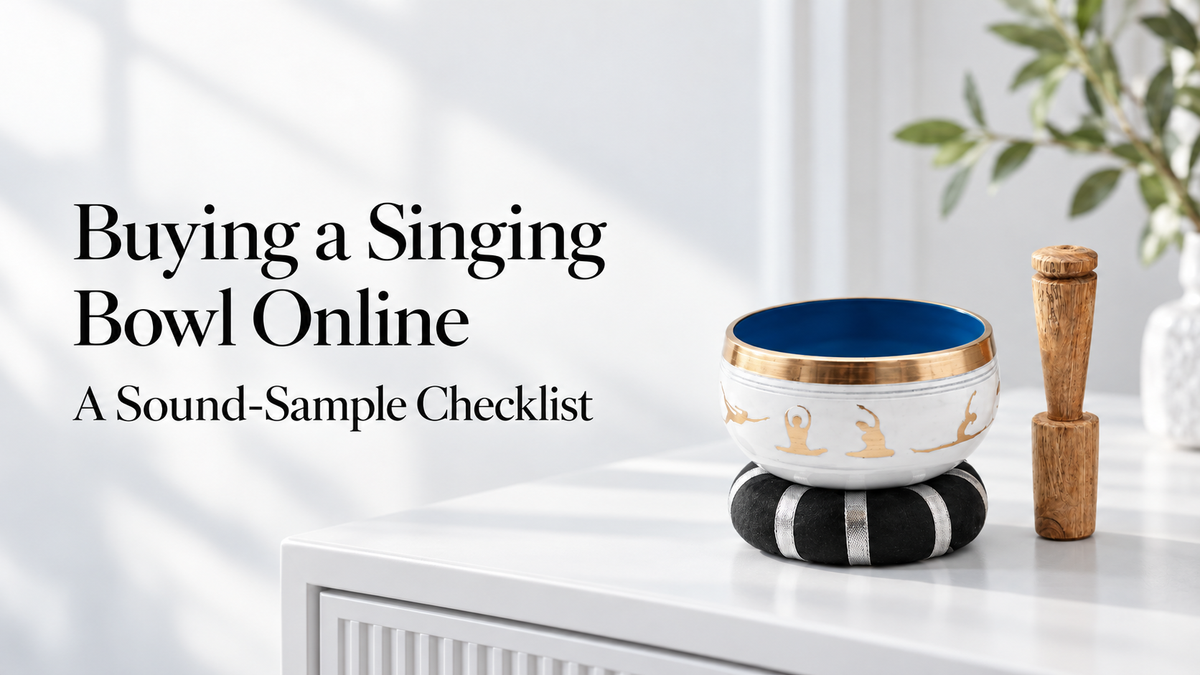
Consider the Yoga Moves white and blue singing bowl set. Its brass bowl is approximately 10.7 × 6 cm and weighs approximately 400 g. The set includes a wooden striker, ring cushion and drawstring pouch.
Those details help you judge scale, handling and what you would need to buy separately. They do not establish its exact pitch, loudness or ringing time. The photograph is a visual reference, not evidence of acoustic performance.
Before ordering any bowl for a particular musical note, ask whether the note has been checked on the actual item being supplied. If an exact match is essential and that evidence is unavailable, do not substitute a size, colour or product name for it.
Choose for the moment you want it to fit
Dhriti, founder of Root & Still, has previously described choosing an object around the moments and routine it will belong to. Applying that same perspective here, begin with how you want to use a bowl, rather than chasing the most impressive video.
If you want a simple sound to mark the start of a quiet pause, your questions may be quite different from those of someone matching another instrument. For broader help with size, handling and accessories, see how to choose your first singing bowl. The sound-sample checklist is one part of that decision.
A message you can adapt before ordering
I'm considering [product name and code]. Does the recording show the exact bowl I would receive, or an example of the model? Which striker and support are used, and are they included? Is an unedited demonstration available with a gentle strike and, if suitable, rim playing? My main requirement is [describe it]. Could you clarify this before I order?
You do not need every possible measurement. Ask about the one uncertainty that could change your decision. Check the retailer's current returns information too, particularly any conditions that matter if the sound is not what you expected.
Browse our Tibetan singing bowls to compare designs and listed specifications. Shortlist the bowls that suit your space and routine, then use this checklist to decide what you still need to hear or ask.
Prepared by Root & Still, 16 October 2026. This is editorial buying guidance, not an acoustic test or a promise that individual sound samples are available for every product.