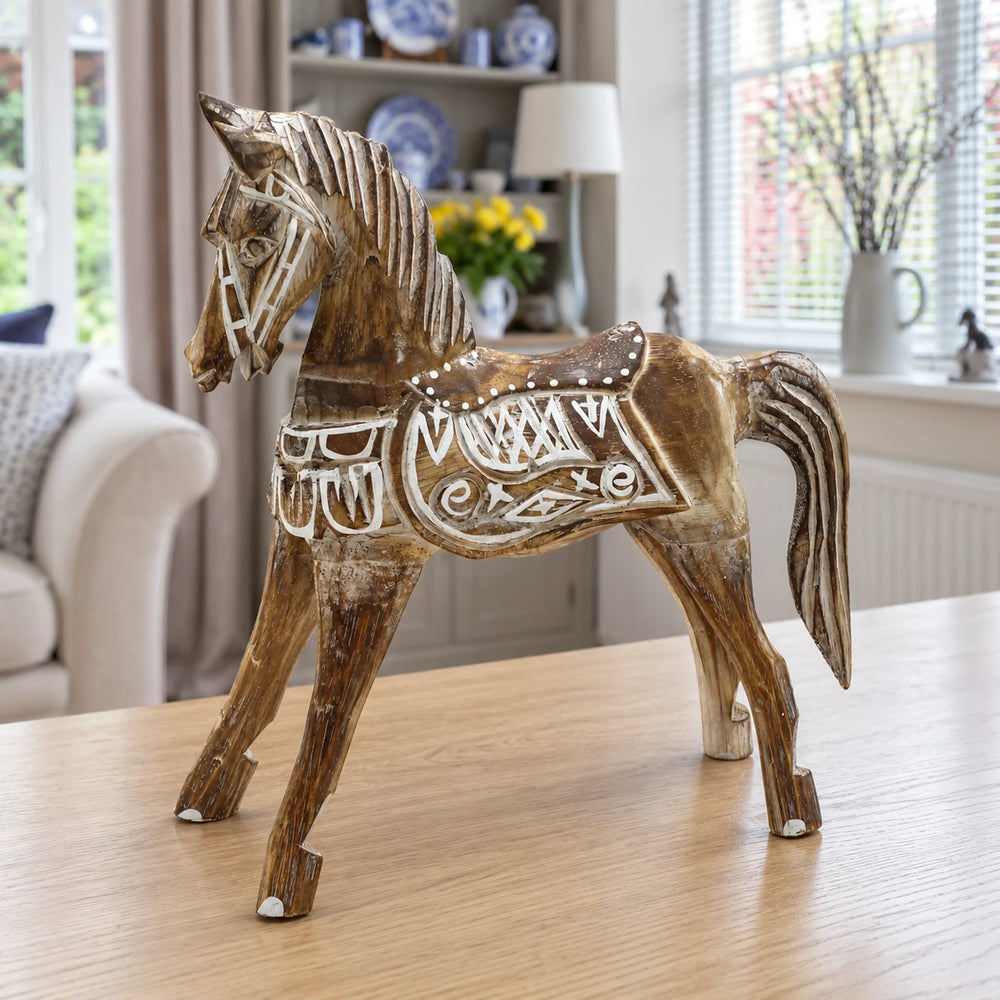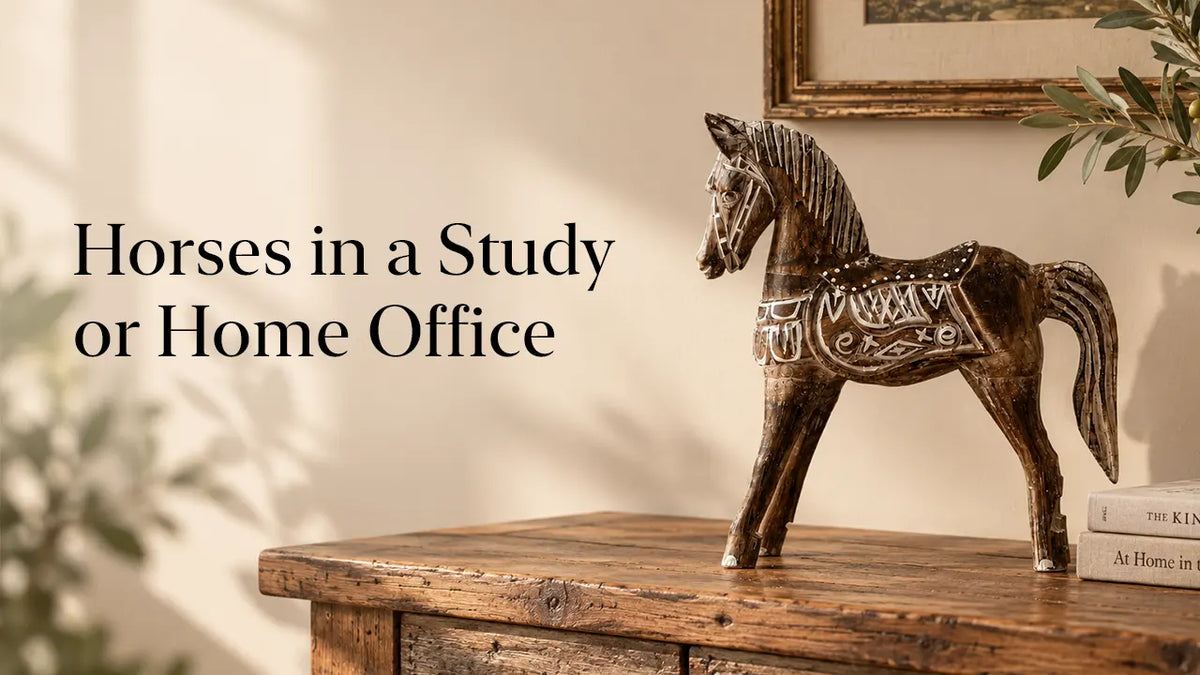
A carved horse can be a decorative choice for a study or home office if you enjoy the design and have a suitable place for it. It does not need to represent productivity, progress or a particular working style. Start with the space you use each day, then compare the pieces in our carved horse collection.
Key takeaways
| Check | Why it matters |
|---|---|
| Full dimensions and base | A size in the product name does not establish the whole footprint or guarantee desk fit. |
| Working space | Leave room for your keyboard, mouse, papers and normal movement before adding decoration. |
| Shelf support and access | The whole base needs stable support, with room to reach nearby items without catching the carving. |
| Your camera view | Check the actual frame before choosing an object for a video-call background. |
| Finish and meaning | Choose what you and any other users of the room welcome, rather than treating one style as compulsory. |
Choosing a horse for a working room
You might choose a horse because you like animals, its carved outline or a personal association with riding. A quieter-looking object may suit someone else. Neither choice establishes an effect on concentration or performance.
Horses have different associations in different settings. Avoid treating one meaning as universal or assuming that a decorative horse has no religious or cultural associations. Our guide to horse symbolism discusses that wider context; it is separate from the practical question of where an ornament fits.

On the desk or on the shelf behind
There is no reliable rule that a 25 cm ornament belongs on a desk and a 32 cm ornament belongs on a shelf. Desk depth, the object's complete shape, furniture support and the way you use the room matter more than that single measurement.
| Possible position | Check before buying | Try with what you already own |
|---|---|---|
| Beside the monitor | Usable width and depth after allowing for equipment, cables and hand movement | Mark the proposed footprint on paper and work normally around it. This checks space, not stability or load capacity. |
| On a shelf behind you | Shelf suitability, full-base support, access and what your camera actually shows | Use a lightweight placeholder to assess the outline from your normal seat. Do not balance it above someone to improve the picture. |
| On a windowsill | Depth, window opening, condensation and the product's care requirements | Open the window and check the surrounding space before choosing a display position. |
| Beside the desk at floor level | Whether the object would obstruct feet, chair movement, cleaning or a walking route | Leave the route clear if there is any doubt; a larger ornament is not automatically a floor piece. |
For a video-call background, check the preview with your usual seat and camera position. Cropping, background effects and lighting may change how much of the room is visible. An ornament can disappear outside the frame or look different from the way it appears across the room. A larger piece is not a guaranteed solution, and a clear background is an equally valid choice.
Compare the medium antique-style horse and large antique-style horse using their individual listings. If a required width, depth, base measurement or weight is not stated, ask Root & Still before relying on it. Do not assume that the number in the name describes every dimension.
Which finish for a working room
An antique-style finish and a gold-and-turquoise finish offer different appearances. Antique-style describes a decorative effect, not verified age. Either may suit a workroom, and a bright accent does not require an existing coloured wall or matching furniture.
The large gold-and-turquoise horse and medium gold-and-turquoise horse are alternatives to compare if you prefer that colour combination. Look at the whole design and decide whether you want it to stand out or sit quietly among other objects.
Our guide to gold and turquoise in a British room offers further ideas. Product photographs and screens are useful references, not exact colour standards for your room.

Try the orientation from your usual seat
Try a side view or a slight angle where the base remains fully supported. Choose the view you enjoy without assuming that one direction improves work or that an animal facing you must be distracting. There is no need to present a styling preference as a universal feng shui rule.
Keep projecting details clear of sleeves, chair movement and items you reach for regularly. Do not use the head or legs as handles when repositioning a carving.
What to pair it with
Books can provide a backdrop, but the arrangement should still let you remove them without knocking the ornament. An empty area is also a valid backdrop. A horse does not need books to establish that it is a decorative object.
If you want another piece nearby, choose it for its actual size, design and meaning. Our brass Buddha figures depict figures with their own features and religious context; they should not be described as objects with no face or as automatically suitable for every shared workplace.
Use lighting that suits the task as well as the display. A decorative lamp does not automatically provide sufficient reading or work light. A tall Amber Mosaic candle can be displayed unlit, but a paper-filled desk is not automatically a suitable place to burn it.
If using a real candle, follow its instructions and London Fire Brigade's candle guidance. Keep it attended in a suitable heat-resistant holder on a stable surface, away from papers and other combustible materials, and extinguish it before leaving the room.
Keep the working area usable
There is no fixed limit on animal ornaments or objects with faces. What matters is whether the arrangement leaves enough room to work and can be maintained without repeatedly moving fragile pieces. Start with one object if that makes the decision easier, then assess the result from your normal seat.
Keep the ornament clear of cables, chargers, drink spills and frequently moved paperwork. If it occupies space you need throughout the day, a suitable separate surface may work better, or you may prefer to leave the desk undecorated.
As a gift for someone's office
Ask whether the recipient wants an ornament and has somewhere suitable to put it. A promotion or new role does not make a particular symbol, finish or size universally appropriate. Shared workplaces may also have their own rules and preferences.
Choose between the medium and large designs using the recipient's space and taste. Check the linked product pages for current prices and availability rather than assuming a larger piece is a more meaningful gift.
Our guide to styling a desk object covers the wider question of display on a working surface.
Compare the pieces for your own room
Browse the wooden horse collection, check each product's complete information and keep the intended surface in mind. The Buddha glow lamp collection offers decorative lighting to consider separately by the exact model's specifications. Neither an ornament nor a decorative lamp is a requirement for a comfortable place to work.
Frequently asked questions
Why does a carved horse suit a study?
It may suit someone who enjoys the design and has a suitable display position. It is a personal decorative choice, not a proven aid to concentration or productivity.
What size horse should I choose for a desk?
Check the complete dimensions and base against the usable desk space. A 25 cm or 32 cm label alone does not guarantee fit or visibility on a video call.
Which finish works in a home office?
Choose the finish you enjoy in the room. Antique-style and gold-and-turquoise are appearance choices, not compulsory matches for particular furniture.
Which way should it face?
Try the view you prefer while keeping the whole base supported and the carving clear of everyday movement. There is no universal direction for every workroom.
Is a horse a good gift for a promotion?
It can be if the recipient wants one and has suitable space. Check their taste and any shared-workplace requirements rather than assuming the symbol is universally appropriate.