

Sensory grounding is defined as a mindfulness technique that uses your five senses to anchor attention in the present moment and reduce anxiety. Clinically known as grounding therapy, it is widely used in trauma recovery, panic management, and everyday mindfulness practice. The technique works by redirecting your mind away from distressing thoughts and back to what you can directly perceive right now. Sensory grounding requires no equipment and typically takes under two minutes to reduce physiological arousal. That accessibility makes it one of the most practical tools available for emotional regulation.
What is sensory grounding and why does it work in the brain?
Sensory grounding works because it interrupts the brain’s default mode network, the mental circuit responsible for worry, rumination, and self-referential thought. When you focus deliberately on what you see, hear, feel, smell, or taste, your sensory cortex becomes active. That activity competes directly with anxiety signals, giving your rational prefrontal cortex the chance to regain control.
Think of it this way: your brain cannot fully process a vivid sensory experience and a spiralling anxious thought at the same time. Grounding exploits that limitation. By flooding your attention with present-moment sensory data, you crowd out the mental noise that feeds distress.

Grounding also activates the parasympathetic nervous system, the part of your nervous system responsible for rest and recovery. This is why even a brief grounding exercise can leave you feeling noticeably more settled. The body begins to soften its threat response when the brain receives clear signals that the present environment is safe.
For moments of acute panic, physical interventions can help before cognitive grounding begins. Splashing cold water on your face triggers the mammalian dive reflex via the vagus nerve, rapidly lowering your heart rate. This physiological shortcut can create just enough calm to make a full sensory grounding exercise possible.
Pro Tip: If you feel too overwhelmed to start the 5-4-3-2-1 technique, hold an ice cube or splash cold water on your wrists first. The physical shock interrupts the panic response and gives you a clearer starting point.
The key mechanisms at work include:
- Redirection of attention from internal distress to external sensory reality
- Activation of the sensory cortex, which quiets the default mode network
- Engagement of the prefrontal cortex to restore rational thinking
- Stimulation of the parasympathetic nervous system for physical calm
- Provision of competing sensory input that displaces anxious thought patterns
How to practise sensory grounding: the 5-4-3-2-1 technique
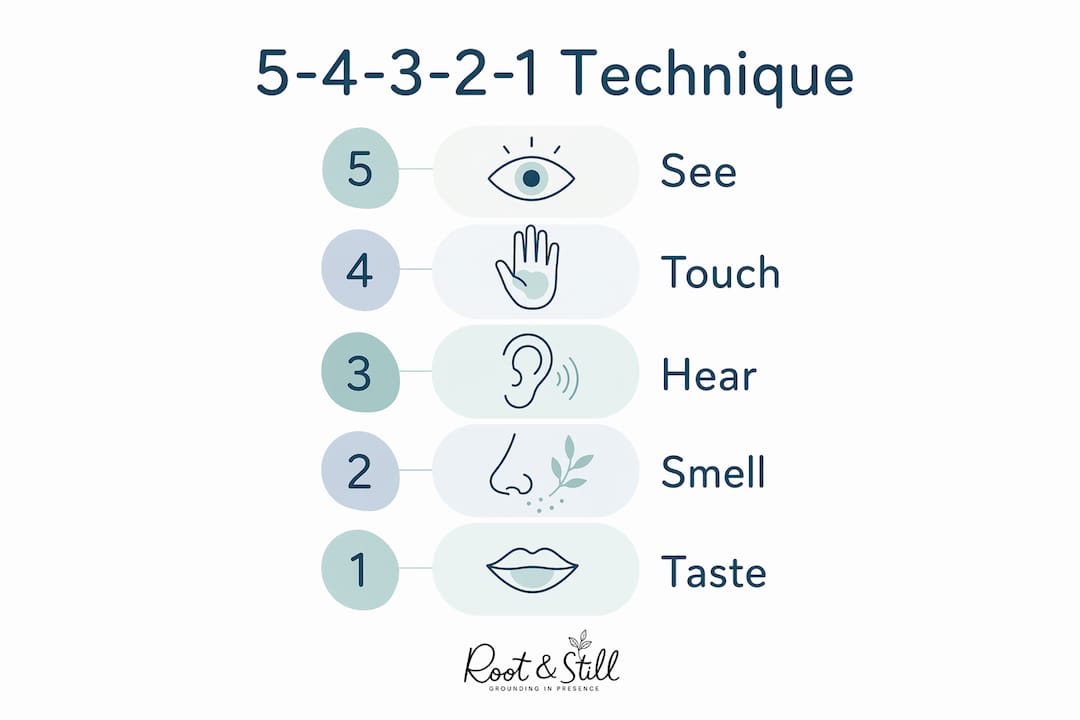
The 5-4-3-2-1 technique is the most widely used sensory grounding exercise, and it is straightforward to learn. The method involves naming five things you can see, four you can feel, three you can hear, two you can smell, and one you can taste, working through each sense slowly and deliberately. The sequence moves from the most accessible sense (sight) to the most subtle (taste), gradually deepening your focus.
Here is how to work through each step:
- See (5 things). Look around and name five objects in your environment. Do not rush. Notice the colour of the wall, the grain of a wooden surface, the way light falls across a fabric. The more specific your observation, the better.
- Feel (4 things). Bring your attention to four physical sensations. The weight of your feet on the floor, the texture of your clothing against your skin, the temperature of the air on your hands. Stay with each sensation for a breath before moving on.
- Hear (3 things). Identify three sounds. A distant car, the hum of a radiator, birdsong outside. Try to notice sounds you would normally filter out.
- Smell (2 things). Name two scents. If nothing is immediately obvious, notice the neutral smell of the air itself, or move closer to something with a gentle fragrance such as a candle or a plant.
- Taste (1 thing). Bring awareness to one taste. The lingering flavour of a drink, the neutral sensation of your own mouth. This final step draws your attention fully inward and completes the cycle.
Specificity is what makes this technique effective. Describing “a crack running diagonally across the lower left corner of the wall” taxes your cognitive resources far more than simply noting “a wall.” That deeper engagement is what displaces anxious thought most reliably.
If one of your senses is limited or unavailable, adapt freely. Substituting pressure or movement for a missing sense keeps the exercise effective without adding frustration. You might press your palms together firmly, or notice the rhythm of your own breathing, in place of a smell or taste you cannot access.
Pro Tip: Practise the 5-4-3-2-1 technique during calm moments, not just in crisis. Familiarity with the steps means you can access them more easily when distress is high. Pairing it with mindfulness activities for adults builds a broader toolkit for emotional regulation.
What are the benefits of sensory grounding for emotional regulation?
Regular sensory grounding practice offers benefits that extend well beyond managing acute anxiety. The short-term effects are immediate: a reduction in physiological arousal, a clearer sense of where you are, and a quieter mind. Over time, the practice reshapes how your nervous system responds to stress.
The most consistent benefits include:
- Reduced anxiety and panic. Grounding interrupts the body’s threat-scanning mode and helps the prefrontal cortex reassert calm. Repeated practice lowers the baseline intensity of anxious responses.
- Improved present-moment awareness. Deliberately engaging your senses trains your attention. You become more naturally attuned to your surroundings, which supports ongoing mindfulness rather than just crisis management.
- Greater emotional resilience. Each time you use a grounding exercise and feel distress ease, you build confidence in your ability to manage difficult moments. That confidence itself becomes a buffer against future anxiety.
- Easier integration into daily life. Unlike many therapeutic techniques, sensory grounding fits naturally into ordinary moments. A mindful cup of tea, a slow walk noticing textures underfoot, or a quiet minute with a calming visual focal point can all serve as informal grounding practice.
Sensory grounding also complements other anxiety relief approaches, including breathwork, body scan meditation, and progressive muscle relaxation. Used together, these practices reinforce one another and create a more settled baseline state.
Common challenges when starting sensory grounding
The most common difficulty with sensory grounding is not the technique itself. The hardest part is developing the awareness to notice when to begin. Anxiety often builds gradually, and many people only recognise they are in distress once they are already deep in it. Learning to spot the early signs, a tightening chest, a racing mind, shallow breathing, is as important as knowing the steps.
Other challenges people encounter include:
- Feeling impatient with slow results. Grounding does not always produce instant relief. Small reductions in distress after one cycle are meaningful progress, not failure. Repeating the cycle two or three times deepens the effect.
- Struggling to engage all five senses. Some environments make certain senses hard to access. Adapt without self-criticism. Swap a missing sense for a physical sensation such as pressing your feet firmly into the floor or holding a textured object.
- Losing focus mid-exercise. The mind will wander, especially when distress is high. When it does, return to the last sense you were working with rather than starting over. Consistency of attention matters more than perfection.
- Feeling self-conscious in public. Most grounding steps are invisible to others. You can run through the visual and tactile steps silently without drawing any attention to yourself.
Pairing grounding with slow, steady breathing strengthens the effect considerably. Breathe in for four counts and out for six as you move through each sense. The extended exhale activates the parasympathetic nervous system and works alongside the sensory focus to settle the body more quickly. Activities like adult colouring for relaxation can also serve as a gentle on-ramp to sensory awareness when full grounding feels like too much.
Key takeaways
Sensory grounding is one of the most accessible and evidence-supported techniques for emotional regulation, requiring no equipment, no training, and less than two minutes to begin working.
| Point | Details |
|---|---|
| Core definition | Sensory grounding uses the five senses to anchor attention in the present and reduce anxiety. |
| How it works | It redirects the brain from the default mode network to the sensory cortex, restoring rational control. |
| The 5-4-3-2-1 technique | Name five things seen, four felt, three heard, two smelled, and one tasted, slowly and specifically. |
| Specificity matters | Detailed observations engage more cognitive resources and displace anxious thoughts more effectively. |
| Consistency builds resilience | Practising in calm moments makes the technique easier to access during genuine distress. |
Sensory grounding is simpler than most people expect
I have spoken with many people who assume grounding is something reserved for therapy rooms or serious mental health crises. That assumption holds them back from one of the most practical tools available. The truth is that sensory grounding is for anyone who has ever felt their thoughts run ahead of them, anyone who has sat in a meeting with their mind elsewhere, or lain awake at night unable to settle.
What strikes me most about this practice is how it reframes the ordinary. The texture of a wooden surface, the sound of rain on a window, the warmth of a mug in your hands: these are not distractions from real life. They are real life. Grounding teaches you to notice that, and in noticing it, to feel more anchored.
The clinical evidence is clear, but the lived experience is what stays with you. The first time you genuinely feel a wave of anxiety ease because you chose to look closely at something in front of you, it changes how you understand your own mind. You realise that attention is something you can direct, not just something that happens to you.
My honest advice is to start small and stay patient. One cycle of the 5-4-3-2-1 technique in a calm moment is worth more than ten desperate attempts during a panic. Build the habit gently, and let the practice earn your trust over time.
— Dhriti
How Rootandstill supports your sensory grounding practice at home
The environment you create at home shapes how easily you can settle into a grounding practice. Rootandstill’s collection of handmade Buddha statues and mindful home accessories is designed with exactly that in mind. A hand-carved wooden Buddha statue offers both a tactile focal point and a visual anchor, two of the most accessible senses in the 5-4-3-2-1 technique. The natural grain of the wood and the stillness of the form give your attention somewhere restful to land.
For olfactory grounding, Rootandstill’s scented candles and incense burners introduce gentle fragrance that supports the smell step of your practice. An antique Buddha figurine placed on a shelf or desk becomes a quiet reminder to pause and return to the present. Explore the full collection at rootandstill.com to find pieces that feel right for your space and your practice.
FAQ
What is sensory grounding in simple terms?
Sensory grounding is a technique that uses your five senses to bring your attention back to the present moment and reduce anxiety. It works by redirecting the brain away from distressing thoughts and towards immediate physical reality.
What is grounding therapy and how does it differ?
Grounding therapy is the broader clinical term for techniques that reconnect a person with the present moment, often used in trauma and anxiety treatment. Sensory grounding is one specific form within grounding therapy, focused on engaging the senses rather than cognitive or movement-based methods.
How long does a sensory grounding exercise take?
A full cycle of the 5-4-3-2-1 technique takes under two minutes and requires no equipment. Repeating the cycle two or three times deepens the calming effect if distress remains high after the first round.
Can sensory grounding help with panic attacks?
Sensory grounding can reduce the intensity of a panic attack by interrupting the body’s threat response and activating the parasympathetic nervous system. For acute panic, starting with a physical intervention such as cold water on the face can make it easier to begin the sensory steps.
How often should I practise sensory grounding exercises?
Practising sensory grounding exercises daily in calm moments builds familiarity and makes the technique more effective under stress. Even brief, informal practice, such as noticing textures or sounds during a quiet moment, strengthens the habit over time.


