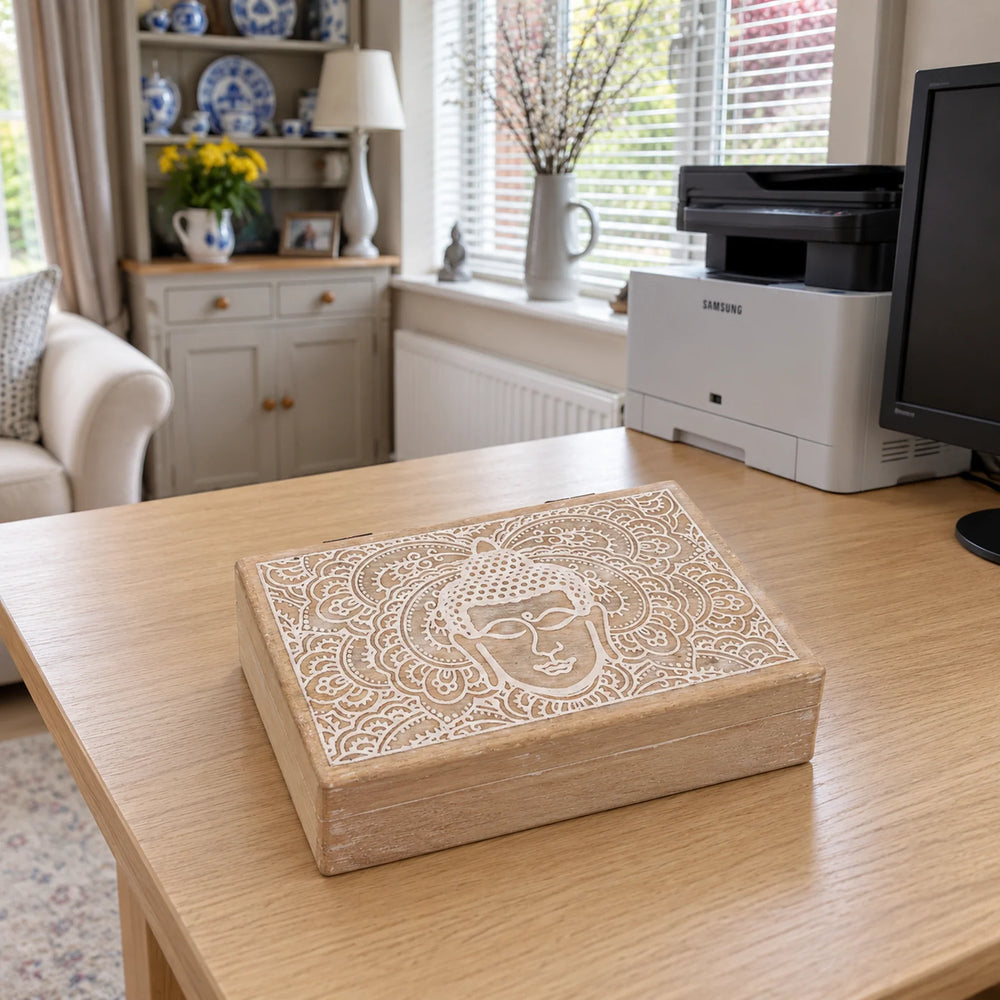
A decorative wooden box should not automatically be used to preserve old photographs. For an irreplaceable family print, choose storage materials intended for photographic conservation and keep the decorative box for other keepsakes unless its suitability has been established.
The important buying question is not simply whether a photograph fits. It is whether the box, enclosure and storage conditions suit the photograph you want to keep. A lid and a handsome finish do not answer that question.
Decide which job the box needs to do
| Your priority | A useful next step |
|---|---|
| Preserving the only original of a family photograph | Choose photograph-specific conservation storage. Ask for advice if the process or condition is uncertain. |
| Keeping replaceable copies to look through | Decide how much protection you want, then check the enclosure and usable box space. Keep the originals separately. |
| Giving a decorative keepsake box | Choose it for its design and documented everyday use. Do not describe it as an archival photograph box without evidence. |
Our founder Dhriti Howlader’s approach is to choose home accessories around how they will fit into your routine. Here, that means deciding whether you want a box to open regularly, an object to display, or storage that protects a family archive. You may need two different containers.
Look beyond an acid-free label
The Northeast Document Conservation Center’s guidance on photographic enclosures explains that labels such as acid-free or archival do not, on their own, establish suitability for photographs. It recommends looking for materials that have passed the Photographic Activity Test, usually shortened to PAT.
Ask which specific enclosure or material has been tested. A result for an inner sleeve is not a test of the complete decorative box. Equally, no published test result does not mean a product has failed a test. It means you should not assume that evidence exists.
Adding an ordinary fabric lining or a sheet of paper does not give us a basis to certify a wooden box for photographic preservation. For important originals, choose the purpose-made storage first rather than buying a decorative container and trying to turn it into conservation equipment afterwards.
Check the photograph’s condition before choosing a sleeve
The National Archives’ photograph-care leaflet recommends suitable individual folders or pockets and protective conservation boxes. It also explains that plastic enclosures are unsuitable for some fragile surfaces, including flaking image layers. A damaged photograph needs more specific advice than a general storage-shopping list.
Do not try to pull a photograph away from glass or an enclosure if it is stuck. Avoid home cleaning or adhesive-tape repairs. The leaflet advises specialist help for these situations. For everyday storage, it recommends a cool, dry, well-ventilated location away from places prone to extremes or condensation, such as attics and basements.
Making a copy for display or regular viewing can let you enjoy the image while keeping the original properly stored. Keep the original’s identity with its record so that a family name, date or place is not lost when you separate the items.
Measure the enclosure, not just the print
Once you have chosen appropriate storage materials, measure the outside of the filled sleeve or folder. Include mounts and any opening flap. Compare those measurements with the usable interior and opening of the intended container, not its overall dimensions.
A nominal 6 × 4 inch print measures 15.24 × 10.16 cm before any sleeve or mount. In a circular compartment, the corners matter: its diagonal is √(15.24² + 10.16²), approximately 18.3 cm. A flat, unbent print therefore needs a circular interior at least that wide even before allowing room for its enclosure and handling. This is a geometry calculation, not a fit test of our products.
What three decorative box sizes can tell you
These mango-wood designs are examples from our wooden Buddha boxes collection. Their listed measurements were checked on 31 October 2026. They are overall product dimensions, not verified internal capacities or evidence of photographic conservation suitability.
| Decorative box | Listed overall size | What that establishes |
|---|---|---|
| Whitewash rectangle | 21.5 × 14 × 6.3 cm | The outside is larger than a bare 6 × 4 inch print. That does not confirm the internal opening, enclosed-print fit or preservation suitability. |
| Whitewash round box | 17.5 × 7.5 cm | The stated overall width is less than the print’s 18.3 cm diagonal. It is not a suitable flat-fit choice for that unbent print. |
| Whitewash small square | 10 × 10 × 4.2 cm | Too small for that flat print. Choose it around smaller everyday keepsakes instead. |

Ask these questions before buying
- Am I storing an irreplaceable original or a replaceable viewing copy?
- What enclosure suits this photograph’s material and condition?
- What evidence supports the storage material’s photographic suitability?
- Will the filled enclosure fit through the opening and lie flat without pressure?
- Where will the container live, and can I retrieve the contents without bending them?
For dimensions or construction questions about one of our boxes, contact Root & Still with the product name and the measurements of what you want to store. We can clarify product details; a photograph conservator is the appropriate person to advise on vulnerable originals. For other uses, our guide to what to keep in a carved wooden box compares access, fit and everyday care.