A singing bowl may be able to travel in hand luggage, but a small diameter is not enough to establish that it can come into the cabin. Check two things before you pack: whether your complete bag or case fits the airline allowance you have booked, and whether airport security will accept the bowl and its playing stick.
This guide is for personal travel from the UK. It does not certify any bowl as airline-approved. Guidance checked on 28 October 2026 should be checked again for your route before departure.
Start with the bowl and the stick as separate items
GOV.UK’s musical-instrument guidance says instruments are screened separately and advises contacting the airline before booking with a large instrument. It does not give a specific clearance for singing bowls.
The playing tool deserves its own enquiry. Glasgow Airport’s musical-instrument FAQ warns that some percussion accessories, including mallets, may not be accepted in hand luggage. That is not a blanket ban on every singing-bowl stick. Send the airport a photograph and the actual tool’s material and measurements, rather than asking only whether “a musical instrument” is allowed.
Security staff can refuse something they consider dangerous even when it is normally permitted, as the UK hand-luggage overview explains. An airline’s answer about bag size does not override that decision.
Measure the outside of the complete packed bag
A bowl’s diameter and height describe the object. Cabin allowances apply to the bag or case you will carry. Padding, the playing stick, cushion and case can all change the space required. If the bowl goes inside your usual cabin bag, measure that whole bag once it is packed, including its protruding parts.
As one current example, easyJet’s instrument guidance gives 45 × 36 × 20 cm, including the case, for an instrument carried within or instead of the small cabin bag. It must fit under the seat. Its larger cabin-bag allowance uses 56 × 45 × 25 cm and depends on the allowance you hold. Check your booking and the current page; these are not limits for every airline.
A worked size check. Imagine your fully packed bag measures 40 × 30 × 22 cm. Against a 45 × 36 × 20 cm allowance, the first two dimensions fit but the 22 cm depth exceeds the limit by 2 cm. A bowl inside it might be only 9 cm wide, yet the packed bag still fails this size comparison. These are hypothetical bag measurements, not measurements of a Root & Still case.
Weigh the complete bag too. Add the case, accessories and everything else you intend to carry, then compare that total with any weight limit in your booking. Bowl weight, set weight and parcel weight are different figures.
What three singing-bowl sets tell you before packing
These examples from our singing-bowl collection show why an advertised size or included case leaves some travel questions unanswered. None of the measurements below is a complete packed cabin-bag measurement.
| Set | Known details | Still check |
|---|---|---|
| Yoga Om 9 cm set | Brass bowl approximately 9 × 5 cm; bowl weight approximately 550 g. Includes a mallet, ring cushion and carrying case. | The case’s outer measurements, complete packed weight and suitability for the way it will travel. A carrying case is not evidence of airport acceptance or impact protection. |
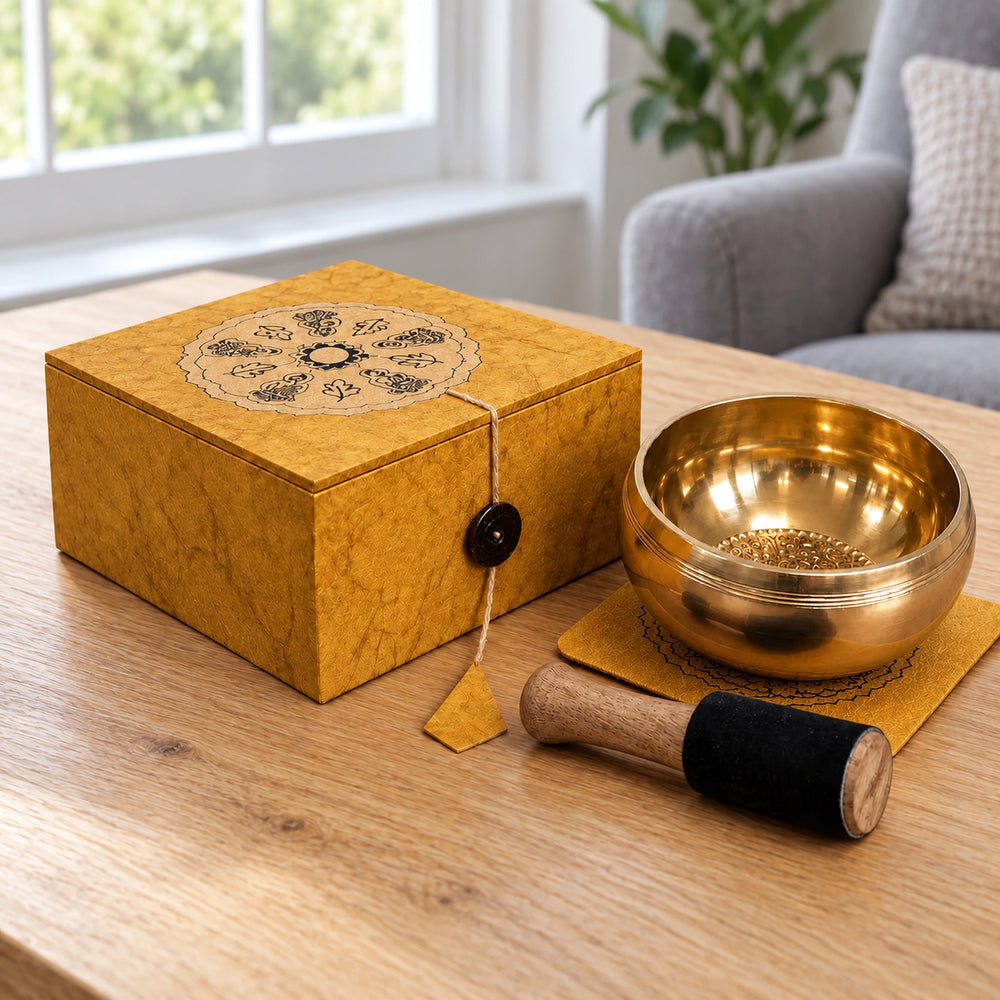
| Meditation 10.5 cm set | Brass bowl approximately 10.5 cm in diameter and 4.8 cm high. Includes a wooden playing stick, cushion and presentation box. | The dimensions and weight after adding travel protection. A presentation box should not be treated as a protective flight case. |
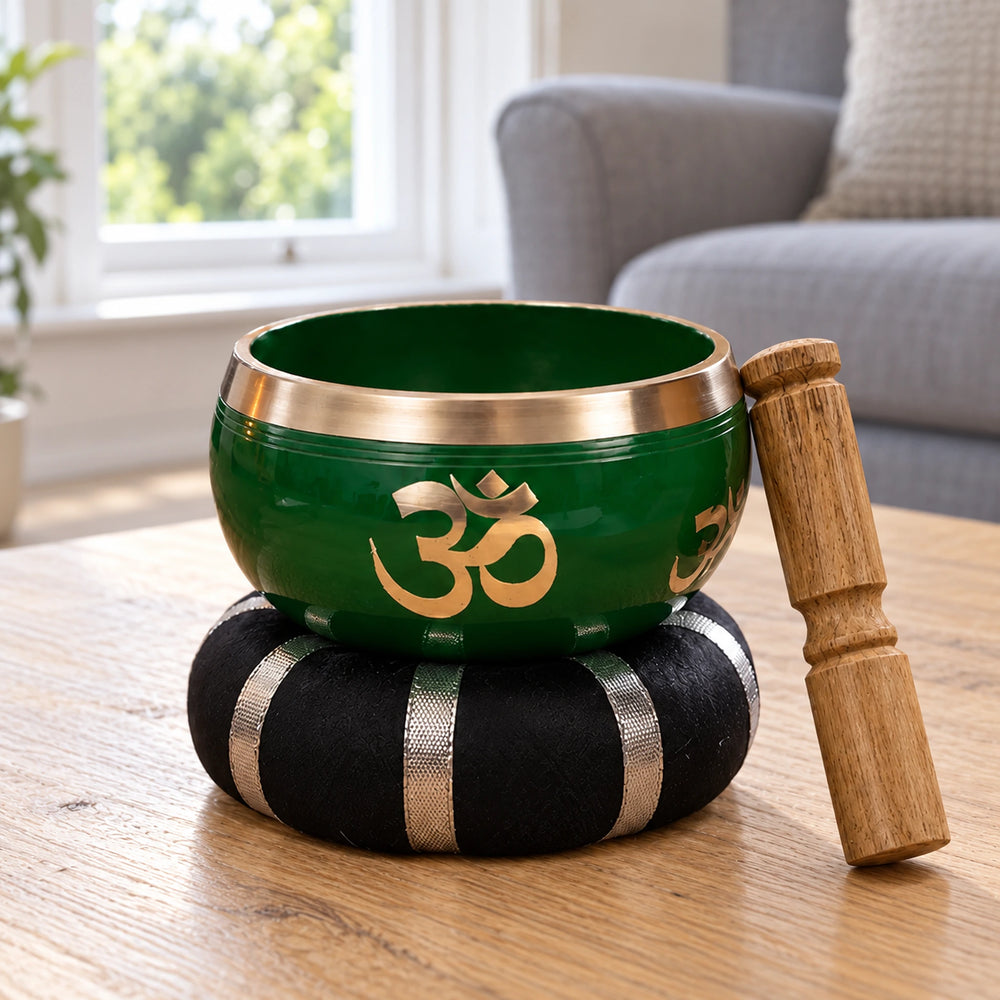
| Green Tree of Life 14 cm set | Bowl approximately 14 × 6.5 cm and approximately 900 g. | Accessories, protection and case add to the bowl’s weight and space. Measure and weigh the finished bag; 900 g is not its total travel weight. |
If a missing product detail affects your decision, ask Root & Still about the exact set before ordering. We can explain available product information; airport security and the operating airline decide travel acceptance.
A two-part checklist for your journey
Make one note for each flight, including the return. If you change airlines or pass through another airport’s security, repeat the relevant checks.
Ask the operating airline
- Give the route, flight date and booked cabin-bag allowance.
- Provide the outer dimensions and total weight of the bag or case as you will carry it.
- Say whether it replaces a cabin bag, sits inside one or would be an additional item.
- Ask how the instrument must be stowed and what happens if it cannot stay in the cabin.
Ask the departure and any transfer or return airport
- Describe the bowl’s material, diameter and height.
- List the playing stick or mallet separately, with a photograph, material, length and other relevant dimensions.
- Ask whether either item raises a hand-luggage restriction and what screening preparation is needed.
- Keep the response with your travel notes, while recognising that staff assess the items on the day.
Record the date of each answer and any conditions. If you cannot establish how an accessory can travel, resolve that before leaving home rather than relying on the bowl’s small size.
Choose around the journey you will actually make
Dhriti Howlader’s approach to choosing objects for the home starts with how they fit your routine. Applied to a travel decision, that means considering the whole journey alongside the bowl itself: the packed bag, transfers, accessories and how you will use it at your destination.
For everyday journeys to classes, our guide to choosing a singing bowl to carry covers practical carrying considerations. For a flight, complete the airline and airport checks first. An included case or a smaller bowl can be useful features, but neither answers both questions.
Travelling with equipment for a performance, business use or sale can involve additional requirements. Follow the business-travel links in the GOV.UK overview above for that situation.