A decorative figure can look perfectly at home on a wooden sideboard while its underside remains a mystery. Before placing it, check three things separately: the condition of the furniture finish, the points where the object will touch it, and how you will move the object for cleaning or everyday use. A familiar material or a soft-looking pad does not settle all three questions.
This guide is for dry decorative ornaments and keepsake boxes. It helps you decide what to check before buying or arranging a display, rather than promising that a particular object or accessory cannot leave a mark.
Start with the furniture finish
Look for the furniture maker's care instructions first. Solid wood and wood veneer describe construction, but they do not tell you which coating is on the top or which materials that coating can tolerate. If the finish is unknown, ask the maker or a suitable furniture specialist before choosing a protective layer.
The Institute of Conservation's furniture guidance identifies scratches from ornaments and damage from liquids as care concerns. That is a reason to consider the contact surface carefully, not evidence that every ornament will damage every wooden table.
If the surface is flaking, sticky or powdery, or the furniture is historically important, pause the new display. The Canadian Conservation Institute's advice on furniture finishes explains why finish type and condition matter. A covering is not a repair for a fragile coating.
Check the underside, not just the front photograph
A product photograph may show colour and carving clearly without showing the part that rests on the furniture. Before ordering, ask what actually makes contact: a continuous base, separate feet, an edge or a fitted covering. Also ask whether any covering is supplied and what it is made from.
Overall dimensions are not necessarily the supported footprint. A figure's widest point might be above its base, and a box might stand on feet. Where space is tight, request the contact dimensions instead of estimating them from the silhouette.
When the item arrives, inspect it somewhere suitable before moving it into its final position. Do not slide it across the furniture to find out whether the underside is smooth. Lift it using an appropriate secure hold, following its handling instructions, and keep fingers clear when lowering it.
A decision table for the display you have in mind
| What you find | What to do next | What this resolves |
|---|---|---|
| The underside or feet are not documented | Ask for details of the exact item before choosing a protective layer. | You know which surfaces will actually touch. |
| The finish is sound and its care instructions are available | Check which contact materials are permitted, then assess the stability of the complete arrangement. | Finish compatibility and steadiness are considered separately. |
| The finish is fragile or the furniture is historically valuable | Get suitable specialist advice before adding a new display. | A general decorating tip does not become an unsuitable treatment. |
| You will open, lift or move the object frequently | Leave room for hands, lids and access without dragging it. | The arrangement works during daily use as well as when still. |
| The proposed display involves water, heat or a flame | Use the specific product and furniture guidance to choose an appropriate location. | Dry-ornament advice is not mistaken for water, heat or fire protection. |
Felt pads and trays still need their own checks
There is no single pad recommendation that this guide can make for every finish. Check the furniture instructions and the protection product's intended use, including its material and any adhesive. Do not attach pads simply because they are sold for furniture: the particular surface and object still matter.
A tray adds another underside to the arrangement. Check that underside too, along with how the ornament sits inside it. A tray can make a group easier to organise, but it does not by itself establish scratch resistance, water protection or stability. If a covering makes an object wobble, the arrangement needs reconsidering.
Three examples and the question each leaves open
These Root & Still pieces illustrate different buying checks. Their listed materials and dimensions do not establish whether their bases suit your furniture, and we are not presenting them as tested scratch-safe options.
- The Large Classic Brass Buddha Head Figure is brass, with listed overall dimensions of 15 × 7 × 6 cm. The useful next question is what touches the furniture underneath, rather than assuming the material or front view tells you.
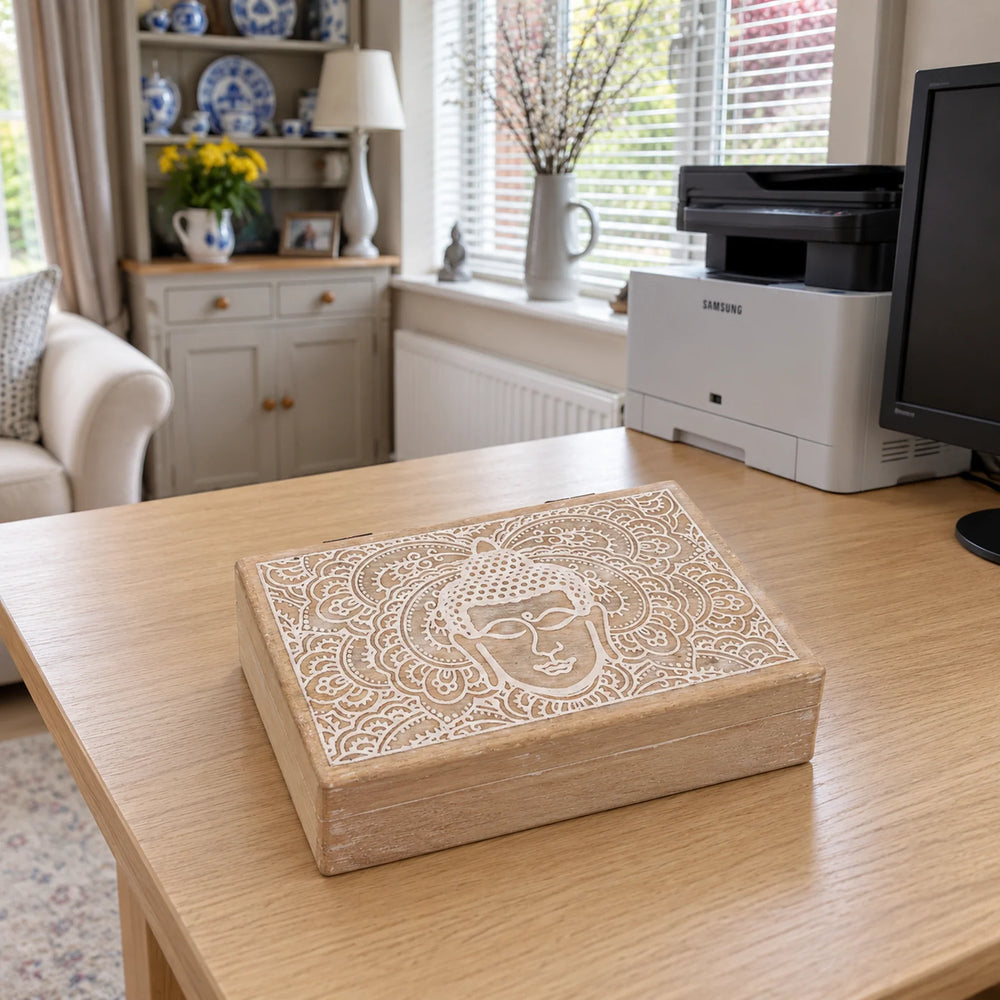
- The Buddha Face Whitewash wooden box is mango wood and measures 21.5 × 14 × 6.3 cm. Plan the space for opening and reaching into it as well as its resting position. A decorative finish on the visible faces does not establish the underside construction.
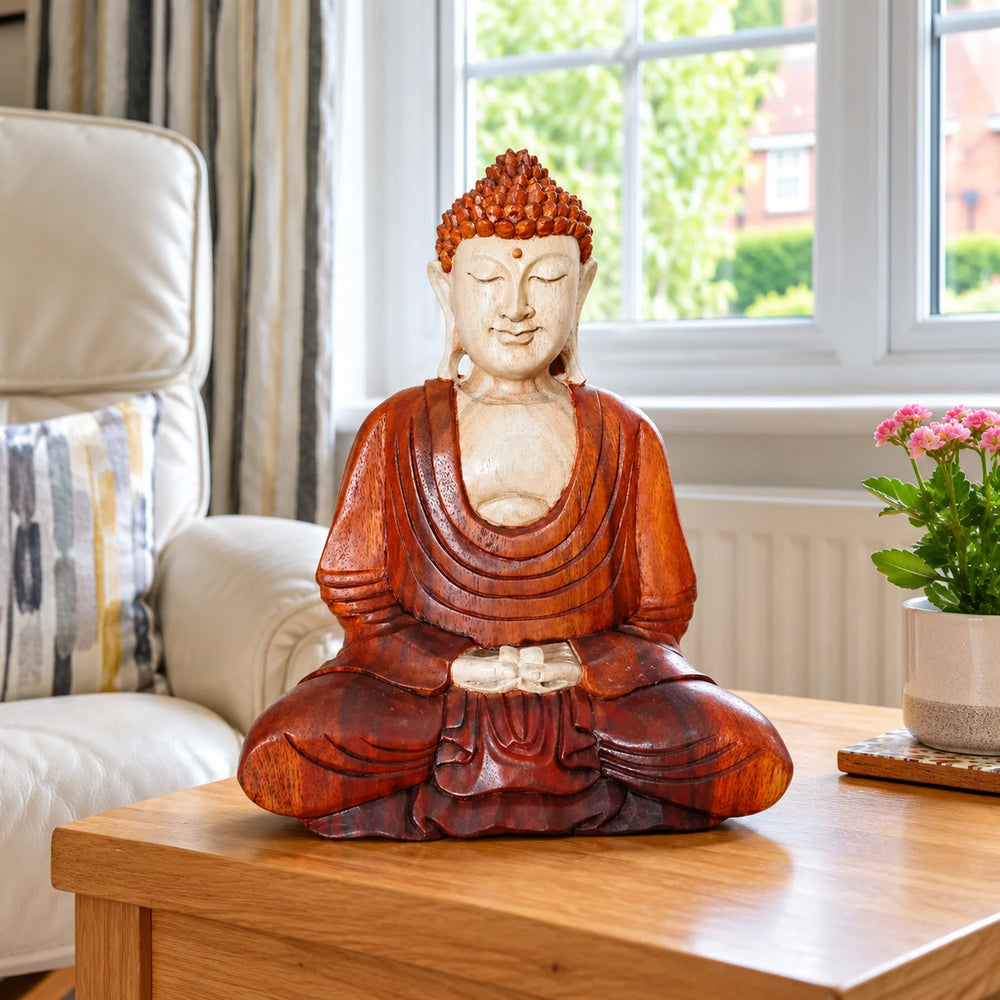
- The 30 cm hand-carved wooden Buddha statue is Suar wood, with a listed net weight of 3.35 kg. Decide how you will support and lift it comfortably; weight information does not establish base covering or the furniture's load capacity.
If these details are not clear on a product page, contact Root & Still with the exact item and your question before buying. You can compare the styles in our brass Buddha figures and hand-carved wooden Buddha statues collections once the practical requirements are clear.
Make the position work for everyday life
Dhriti Howlader's approach to choosing home pieces puts their fit with the room and everyday routine first. Applied here, that means choosing a display you can reach and care for comfortably, rather than squeezing an ornament into a spot that makes every dusting awkward.
Before settling on the position, check that you can lift the object clear, reach the surrounding surface and use nearby drawers or lids without knocking it. Follow the separate care instructions for the object and furniture. If you notice a new mark or a change in the finish, stop using that arrangement and seek appropriate advice before trying a treatment.