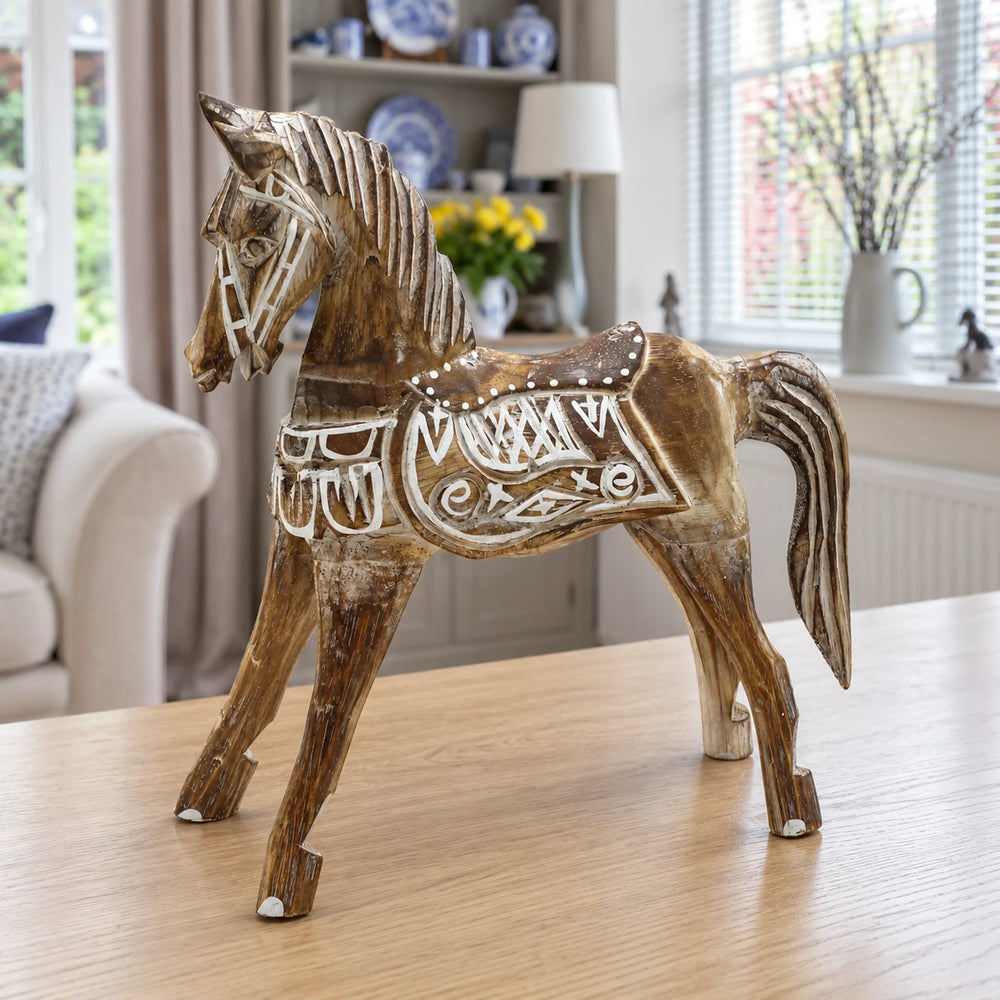
Almost all mantel advice assumes vertical objects. Candlesticks, vases, framed photographs, clocks. A carved horse is emphatically horizontal, and that turns out to be an advantage rather than a problem to work around. Understanding why explains something useful about chimney breasts generally, and it is the reason a horse frequently works on a mantel where a similarly sized upright object looks wrong. This article covers the geometry, the placement, what to put at the other end, and the specific problem a working fireplace presents for solid timber. The range is in our carved horse collection.
Key takeaways
| Point | Details |
|---|---|
| Horizontal cuts across the vertical | A chimney breast is the tallest element in a room. A horizontal object breaks it rather than reinforcing it. |
| Measure the shelf and the whole ornament | Check usable depth, the full base footprint and overhead space. A product’s size label is not a complete fit check. |
| Off centre, one third along | Dead centre reads as formal, which suits a matched pair and looks stiff otherwise. |
| Balance with something vertical | A tall candle or a slim vase at the other end, never another animal. |
| A working fire is a real problem | Keep wood away from working fires and follow the appliance manufacturer’s clearance requirements. |
Why horizontal works on a mantel
A chimney breast is a strong vertical element. It runs from floor to ceiling, it projects into the room, and it is usually the tallest single feature on the wall it sits on.
Fill the mantel with vertical objects and you are reinforcing something that is already dominant. The whole wall reads as one relentless column, which is why so many mantels look busy without anyone being able to say why.
A horizontal form cuts across that. It introduces a line at right angles to the dominant direction, which is what stops a fireplace wall reading as a single vertical mass.
This is the same principle behind hanging a wide picture above a fireplace rather than a tall narrow one, and it is why overmantel mirrors are traditionally landscape format.

Which size for a mantel
Start with the usable shelf space, not a standard mantel width. Measure its width and depth, allowing for a mirror, wall trim and anything else already on the surface. Check the fireplace guidance below before considering a display above an operating fire.
Compare the 32cm antique horse and the 25cm antique horse using their full dimensions and base footprints. Those product names do not, by themselves, confirm a width, depth or minimum shelf size. Ask Root & Still to confirm any measurement you need before ordering.
| What to check | Why it matters | Before you choose |
|---|---|---|
| Usable shelf depth | The entire base needs stable support without overhanging the edge. | Confirm the base depth and account for any trim behind it. |
| Full width and height | The carving can extend beyond its base or sit beneath a mirror or picture. | Check the outer dimensions and leave visual space around its outline. |
| Room for the arrangement | Other objects use some of the available surface. | Once the measurements are confirmed, try a paper footprint on the shelf before deciding on the layout. |
A paper footprint helps you judge space; it does not establish shelf load capacity, stability or clearance from a heat source. Confirm those separately. There is no single horse size that suits every mantel.
Where on the mantel
Off centre, at roughly one third along.
Dead centre reads as formal and symmetrical, which is correct in a period house with a matching pair at either end and looks stiff in almost every other context. Symmetry is a Georgian idea and most British rooms are not Georgian.
One third along, with something quieter at the other end and a clear gap between them, reads as arranged by a person rather than staged.
Which third depends on the room. If there is a clear seating position, place the horse on the side nearer it and angle the head toward the seating. If the room has a door on one side, place it away from the door so it is seen on entering rather than passed.
What to put at the other end
Something with vertical emphasis, to balance the horizontal.
A tall candle. A slim vase with a single stem. A tall Amber Mosaic candle in a tall jar. A trailing plant, which softens the hard edge of a mantel shelf and is one of the few things that improves a fireplace wall in summer when the fire is unused.
What not to put there is another animal, which creates a pair of competing subjects, or a matching horse, which reads as a shop display immediately. Our article on carved animals without a menagerie covers why.
Height matters. Whatever goes at the other end should be taller than the horse, because two objects of similar height at either end of a mantel reads as bookending, which is the formal arrangement again.

The gap in the middle
Leave it. A mantel does not need filling and the empty space between two arrangements is what makes each read as deliberate.
A mantel with objects along its whole length is a shelf, and a shelf on a chimney breast is a missed opportunity. The whole reason a mantel reads as special is that it is a surface which does not have to hold anything.
If the middle genuinely looks empty, the problem is usually that the two end arrangements are too small rather than that the middle needs something. Scale up rather than filling in.
Above the mantel
If there is a mirror or a picture above, leave clear space between the top of the horse and the bottom of the frame. Around 20cm.
Pushed together they read as one crowded mass, and both objects lose. Separated by a clear band, the horse is an object on a mantel and the picture is a picture on a wall, which is two things doing their jobs rather than one confused arrangement.
The other consideration is that a horse in front of a mirror is seen twice, from front and back. That is either interesting or awkward depending on the piece, and it is worth stepping back to check rather than assuming.
The working fireplace problem
Keep wooden ornaments away from working fires and other heat sources. Before using a mantel for display, follow the appliance manufacturer’s clearances to combustible materials. Moving a piece to one end or testing the surface with your hand does not establish a safe position.
An electric fire can also produce heat. Treat a purely decorative surround with no operating heat source separately, and keep any display clear of other heaters and lit candles. If the required clearance cannot be confirmed, choose a shelf or console away from the fireplace.
Our guide to why hand carved statues crack explains how heat and changing humidity can affect solid wood.
Orientation on a mantel specifically
Facing into the room, angled slightly rather than square on.
A horse facing along the mantel toward the wall looks like it is leaving the room, which is a small thing that reads oddly once noticed. Facing directly out reads as a specimen.
Three quarters toward the main seating position is the answer, and that single adjustment does more for how a carved animal reads than most people expect. It takes ten seconds and costs nothing.
The 32cm gold and turquoise horse in gold and turquoise benefits from this more than the antique, because the angle catches the metallic detail differently and the piece changes as you move through the room.
Bring that calm into your home with Rootandstill
Our carved horse collection includes antique-style and gold-and-turquoise designs. Confirm the dimensions and a suitable display position first, then choose the finish and arrangement you prefer.
The 32cm antique horse is one option for a room of wood, books and warm neutrals. The 32cm gold and turquoise horse adds a more colourful finish. Check the product pages for current prices and availability.
To balance at the other end, a tall Amber Mosaic candle in a tall jar provides vertical emphasis, and a long wooden tray handles the clutter that mantels accumulate.
FAQ
Does a carved horse work on a mantelpiece?
Well, because a horizontal form cuts across the vertical of a chimney breast rather than reinforcing it. Most mantel objects are vertical and add to a wall that is already dominated by height.
What size horse suits a mantel?
Measure the usable shelf width and depth, then confirm the ornament’s full dimensions and base footprint. A 25cm or 32cm product name alone does not establish how much shelf space it needs. Support the whole base and follow any fireplace clearance requirements before choosing by appearance.
Where on the mantel should it sit?
Off centre, roughly one third along, with something quieter at the other end and a clear gap between. Dead centre reads as formal.
What should go at the other end?
Something vertical to balance the horizontal. A tall candle, a slim vase or a trailing plant. Not another animal, which creates two competing subjects.
Is a working fireplace a problem for carved wood?
Yes. Keep carved wood away from working fires and follow the appliance manufacturer’s clearances to combustible materials. Mantel-end placement or a hand-temperature check is not a substitute. Electric fires can also produce heat; choose a different display surface if a suitable position cannot be confirmed.