A Buddha statue is one of the few garden ornaments that works in a British garden without looking like a garden centre afterthought, and it is also one of the easiest to buy badly. Too small and it vanishes into the border by July. Wrong material and it is grey and flaking by the second spring. Wrong spot and you never see it from the house, which in this climate means you barely see it at all.
This guide covers the whole decision, using the pieces in our own garden Buddha collection so the sizes and materials are real rather than theoretical.
Start with the material, because it decides everything else

Garden statues are sold in four materials in Britain and only two of them belong outdoors year round.
Fibre cement is what our outdoor statues are made from, and it is the right answer for a British garden. It is a composite of cement and cellulose fibre, dimensionally stable, unaffected by frost in the way porous stone can be, and it does not feed the decay fungi that destroy timber. It is heavy, which matters for wind stability, and it takes a metallic or gloss finish well.
Reconstituted stone is the traditional garden statuary material and it lasts indefinitely, though it is porous, which means it holds water, grows moss and lichen readily, and can suffer in a hard freeze if water gets into a fault.
Resin is light and inexpensive and varies enormously in quality. Good resin with a UV stable finish will last several seasons. Poor resin fades, chalks and goes brittle within two.
Carved wood does not belong outdoors in Britain. We sell a great deal of carved wood and none of it should live in a garden. British winters combine constant damp with dozens of shallow freeze thaw cycles, which opens splits along the grain and admits more water each time. Our article on what a British winter does to a wooden statue explains the mechanism properly.
Sizes, with real dimensions
Our garden range runs from 50cm to 3m, and the jumps between them matter more than the numbers suggest.
| Size | Suits | Reads as | Example |
|---|---|---|---|
| 50cm | Courtyards, balconies, small patios, viewing distance under 5m | A considered object at close range | Medium Classic Pose, antique gold |
| 96cm | Typical terraced or semi detached garden, viewing distance 8 to 12m | A proper focal point | Large Thai Buddha, antique gold |
| 1.5m | A garden with a corner or a path end to give it | Anchors the garden on its own | Meditation Buddha in Stupa |
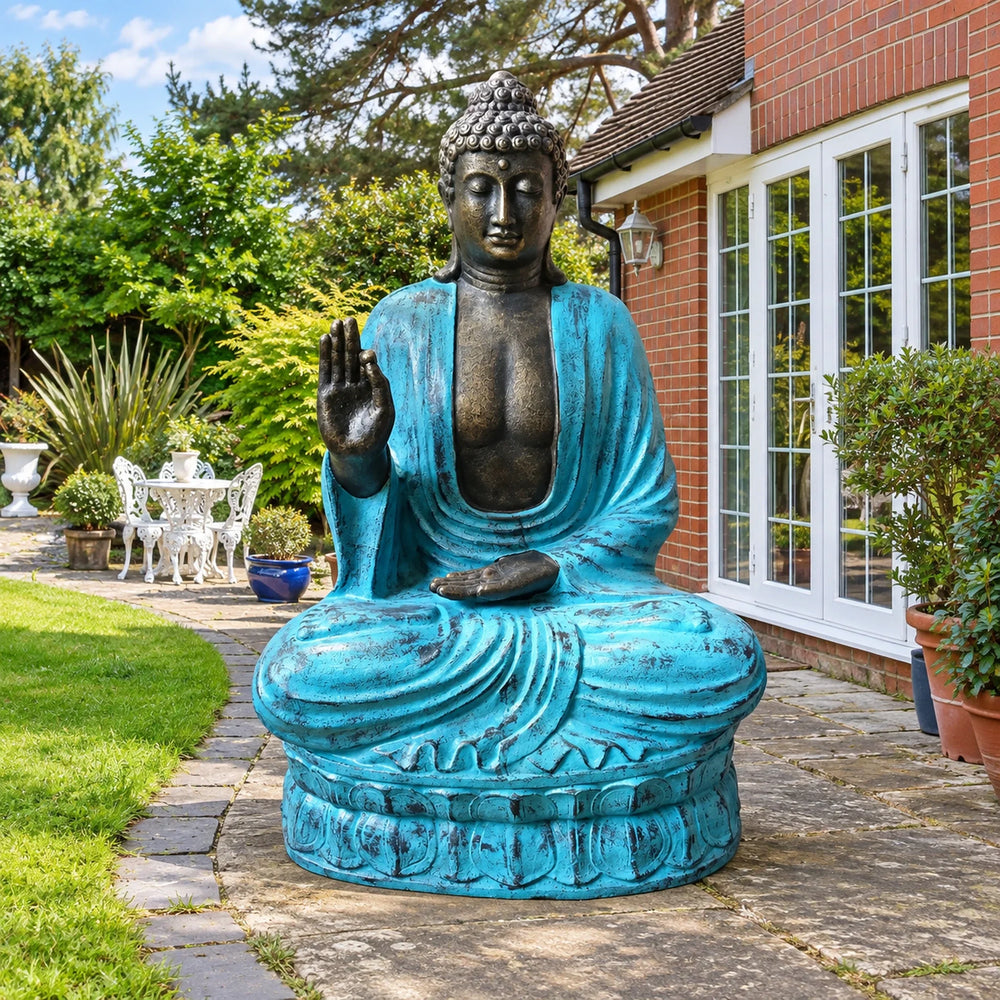
| 2m | Long sightlines, larger plots, strong entrances | Architecture rather than ornament | Teaching Buddha on Lotus |
| 3m | Substantial gardens, commercial and wellness spaces | The reason people visit the garden | Standing Buddha, 3m |
The commonest mistake by a distance is buying too small, and our guide to what each size actually looks like covers why outdoor scale defeats indoor instincts.
Antique gold or turquoise and stone

Our garden pieces come in two finishes and they behave differently in a British garden.
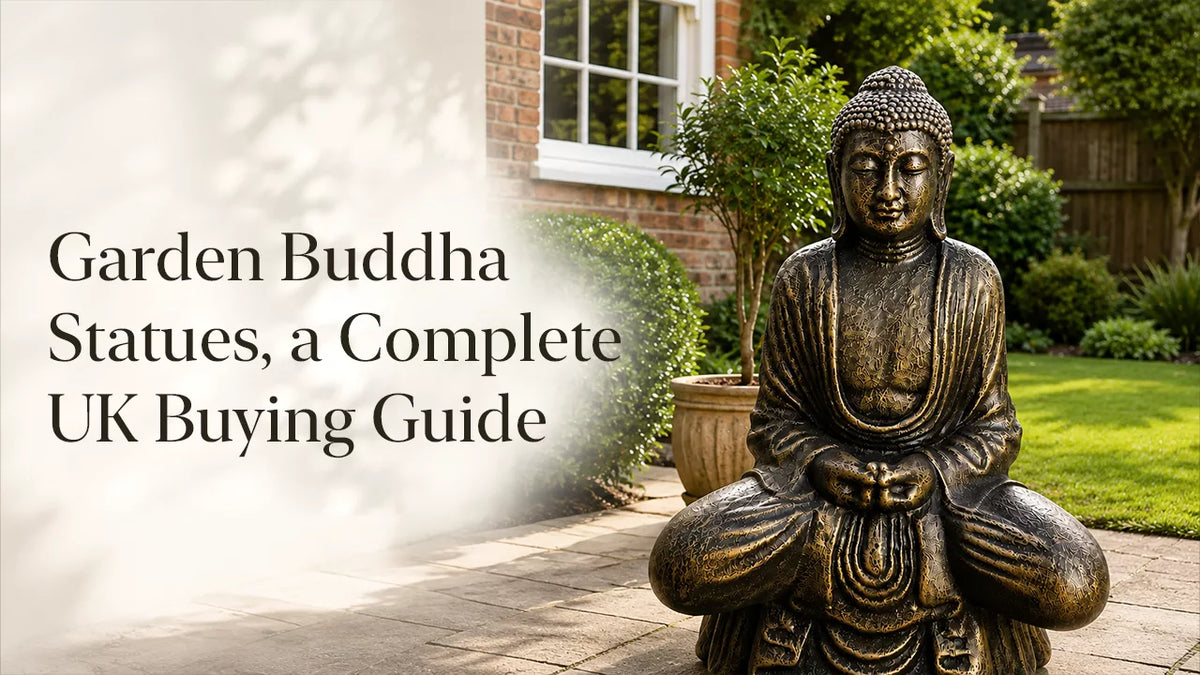
Antique gold is a metallic finish that catches low winter light and reads warm against green. It is the more traditional choice and it stands out strongly against dark evergreen backdrops, which is what most British gardens have.
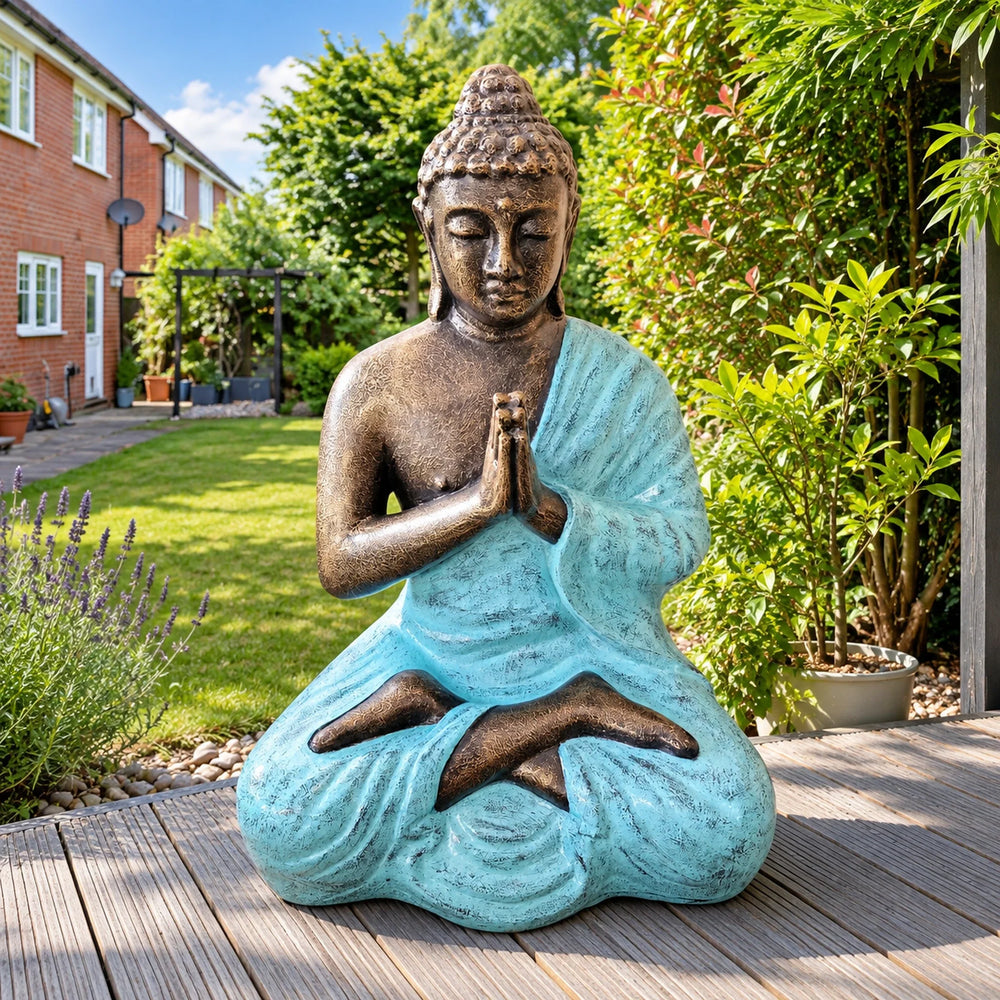
Turquoise and stone is quieter and cooler, and it sits into a planting scheme rather than commanding it. It suits gardens with a lot of grey stone, slate or pale paving, and it weathers into the background more readily.
If your garden is dark and green, gold. If it is pale and hard landscaped, turquoise and stone.
Siting, and the kitchen window rule
The single most useful piece of siting advice for a British garden: place the statue for the view from wherever you stand indoors most often, which is usually the kitchen window or the back door.
We get perhaps twenty genuinely pleasant garden evenings a year in this country. The rest of the time you are looking at the garden through glass, and a statue sited for a summer evening view that is invisible from the kitchen will be enjoyed for a fraction of its life.
Beyond that, three things matter. Give the piece a plain backdrop rather than a fence panel, since larch lap fencing is a strong pattern that swallows a figure. Raise it on a slab or low plinth, which satisfies the traditional preference for an elevated image and keeps the base out of standing water. And leave clear space around it rather than surrounding it with other ornaments.
Weather, honestly
Fibre cement is built to live outdoors and it will. What needs a little thought is the finish rather than the base material.
Metallic and gloss finishes look sharper for longer under cover, so a porch, veranda or pergola position extends their life. In open positions they will weather gradually, which many people prefer, since a statue that looks a little aged reads better in a garden than one that looks new.
Through prolonged frost or heavy rain, a breathable outdoor cover protects the finish. Moving the piece indoors is not necessary for the base material and is not practical at these weights anyway.
For cleaning, plain water and a soft brush. Never a pressure washer, which strips painted and gilded detail in seconds.
Weight, access and delivery
The practical consideration people leave until last and should consider first. These pieces are heavy by design, because weight is what keeps a tall object stable in a British gale.
Before ordering anything above a metre, walk the route. Side gate width, steps, a lawn that will be soft in February, and whether the final position can be reached without going through the house. Plan for two people minimum on anything above 96cm, and more for the 2m and 3m pieces.
Our guide to buying a garden statue in the UK covers delivery and what to check on arrival.
Foundations
British soil moves. Clay shrinks and swells through the year, frost heave lifts and drops the ground, and saturated winter soil compresses under weight. A statue set straight onto soil will lean within a season or two.
The fix is straightforward: excavate 100 to 150mm, fill with compacted hardcore, add a bedding layer, and set a level slab on top. For pieces of 2m and above, a concrete pad. Our guide to stopping a garden statue sinking covers the detail.
Planting around it
A statue needs something to sit against or it looks marooned on paving. Evergreen structure behind for a year round backdrop, fine textured planting to one side for contrast against the smooth cast surface, and low mounding at the base.
The trap is summer growth. Beds that are bare in March reach a metre and a half by July, and a 50cm statue disappears for four months of the year. Check the mature summer height of everything around the position before choosing a size.
Is it appropriate
Worth addressing, since a good many buyers wonder. Outdoor Buddha images are entirely traditional across the Buddhist world, from temple grounds in Thailand to cliff carvings in Sri Lanka. A figure in a garden is closer to normal practice than one on a hallway console.
What the traditions care about is treatment rather than location: raised rather than on the ground, kept clean and clear of overgrowth, and not used as a step or a support. Our article on whether Buddha statues belong in a British garden covers this honestly.
What each price band actually buys
Garden statuary pricing is opaque from the outside, so here is the plain version.
At the lower end you are buying a modest size in a good material, such as the 50cm Classic Pose in antique gold, which for a courtyard or a patio corner is exactly right. The cost at this level is dominated by the piece itself rather than by shipping and handling.
In the middle, around the 96cm mark, where our Large Thai Buddha sits, you are buying the size that most British gardens actually need, and the price starts to reflect the weight of material involved as much as the mould and the finishing.
Above a metre and a half, in the territory of the 2m Teaching Buddha and the 3m Standing Buddha, a growing share of the cost is logistics rather than product. These pieces ship on pallets, need specialist handling, and carry real freight cost per unit. That is why the price does not scale linearly with height: a 3m statue is not twice a 1.5m one, it is considerably more, because the weight, the crating and the handling all compound.
The useful consequence is that if you are choosing between a larger piece and a smaller one on a plinth, the smaller piece frequently wins on value. A plinth is cheap. Freight on an additional fifty kilos is not.
A month by month view of when to buy
Garden statuary in Britain follows a predictable annual rhythm, and knowing it saves both money and disappointment.
January and February. The quietest months, when availability is widest and delivery slots are easy. The drawback is ground conditions, since installing a heavy piece on saturated winter soil is unpleasant and can rut a lawn badly. Buy now, install in March.
March to May. The peak. Everyone is planning their garden at once, ranges sell through, and popular sizes disappear. If you want a specific piece for spring, order in February.
June and July. Still busy, and the best months for installation, since the ground is firm and the evenings are long enough to actually enjoy the result.
August to October. Demand tails off. Good availability returns and this is a sensible window for a considered purchase, with the whole autumn to get the position and the base right before winter.
November and December. Almost nobody buys garden statuary, which makes it an unexpectedly good time if you can handle the installation. It is also worth noting that a garden statue is a substantial and genuinely memorable Christmas present for the right person.
Buying for a rented property
A consideration for a good proportion of British households, and one nobody writes about.
Anything set on a proper foundation is, in practical terms, staying. If you rent, favour pieces you can lift: the 50cm sizes are movable by one person, and 96cm is movable by two. Set them on a slab laid on compacted hardcore rather than anything bedded in mortar, so the whole arrangement can be lifted and taken with you.
Avoid concrete pads and anything that could be construed as an alteration to the property. And if the garden is shared, a statue in a communal space is a conversation with the freeholder rather than a purchase decision.
Insurance, which almost nobody thinks about
Worth thirty seconds of your attention on anything substantial. Most home insurance policies cover contents in the garden, but frequently with a much lower limit than for items inside the house, and sometimes with conditions about whether an item is secured.
If you are buying a piece at the upper end of the range, check the garden contents limit on your policy and whether it is adequate. Theft of garden ornaments is not common but it is not unknown either, and larger statues are targeted precisely because they are valuable and unsecured.
Practically, the best deterrent is weight, which our pieces have, followed by siting away from a boundary that can be reached from a shared alley or a rear access.
Living with it through the year
A statue changes character with the seasons in a way that surprises new owners, and planning for it improves the result considerably.
In winter, with the borders cut back and the light low, the statue is doing all the work, which is the strongest argument for choosing from the fibre cement outdoor range rather than something that needs bringing in. This is the season it earns its keep, and it is the argument for a size that reads clearly against bare ground rather than one sized for midsummer.
In spring, emerging planting begins to frame it, and the piece looks its best around April and May when the growth is knee high rather than shoulder high.
By midsummer, the planting is at maximum and a piece sized for winter can be swallowed. This is the month to test any plan against.
In autumn, leaf fall marks surfaces and holds moisture, which is the annual reminder to give it a rinse and a soft brush before winter.
Questions people ask
What material is best for a garden Buddha statue in the UK?
Fibre cement, which is dimensionally stable, unaffected by frost in the way porous stone can be, and heavy enough to stay put in wind. Carved wood should never live outdoors in Britain.
What size garden Buddha should I buy?
Around 50cm for a courtyard, 96cm for a typical terraced garden, and 1.5m or above for a plot with real sightlines. Most people buy too small, since outdoor viewing distances make everything look smaller than it does indoors.
Do garden Buddha statues need bringing in for winter?
Fibre cement pieces do not. A breathable cover through prolonged frost or heavy rain protects the metallic finish, and a covered position such as a porch or pergola keeps gilded detail sharper for longer.
How do I clean a garden statue?
Plain water and a soft brush. Never a pressure washer, which strips painted and gilded detail immediately.
Does a garden statue need a base?
Yes. British soil moves with frost and moisture, so excavate 100 to 150mm, compact hardcore, and set a level slab. Anything from 2m upward wants a concrete pad.