

A Ganesh statue is defined as a sacred representation of Ganesha, the Hindu deity revered as Vighnaharta (remover of obstacles) and Prathama Pujya (the one worshipped first before any new venture or ceremony). Every curve, colour, and object in the statue carries deliberate meaning, making it far more than decorative art. Whether you are drawn to Ganesh through Hindu tradition, diaspora culture, or a desire for meaningful home décor, understanding the symbolism behind the form transforms how you see it. This guide unpacks the iconography, cultural history, placement rules, and spiritual significance of the Ganesh idol so you can appreciate it fully.
What is Ganesh statue meaning and core symbolism?
Ganesha is worshipped first before any new venture, ceremony, or festival in Hindu tradition. This position of primacy is not arbitrary. It reflects the belief that clearing obstacles before beginning any endeavour is the most intelligent act a person can take. Ganesha embodies wisdom, prosperity, and auspicious beginnings, making his statue one of the most widely recognised spiritual symbols across South Asian and diaspora communities worldwide.
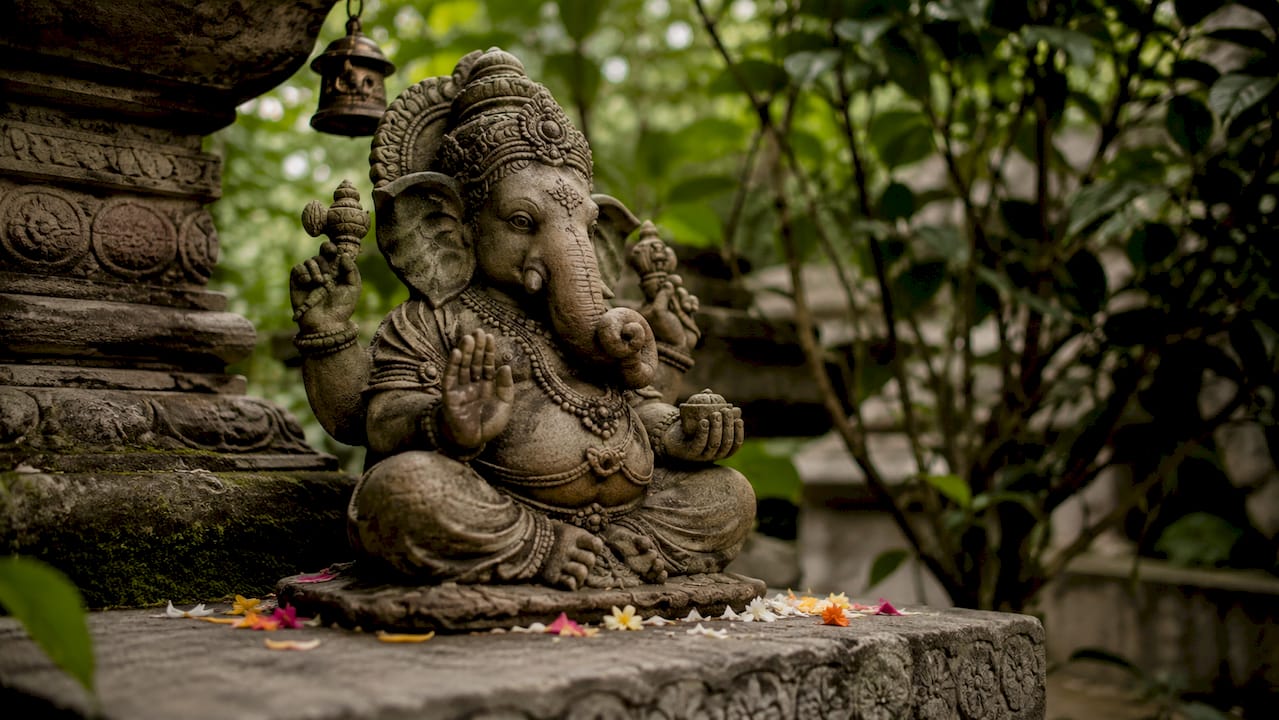
The Ganesh idol meaning extends beyond religion into philosophy. His form teaches that success requires both intellect and humility. Families place his statue at the entrance of homes, businesses, and temples not merely as decoration but as an active invitation for clarity and good fortune to enter. Festivals such as Ganesh Chaturthi, observed in september each year, draw millions of devotees who treat the idol as a living presence rather than an object.
What do the physical features of a Ganesh statue represent?
Each element of Ganesha’s form is a visual scripture. The elephant head symbolises supreme intelligence and discernment, known in Sanskrit as viveka. An elephant navigates dense forests without losing its path. Ganesha’s head carries that same quality: the ability to find a way through complexity with calm authority.
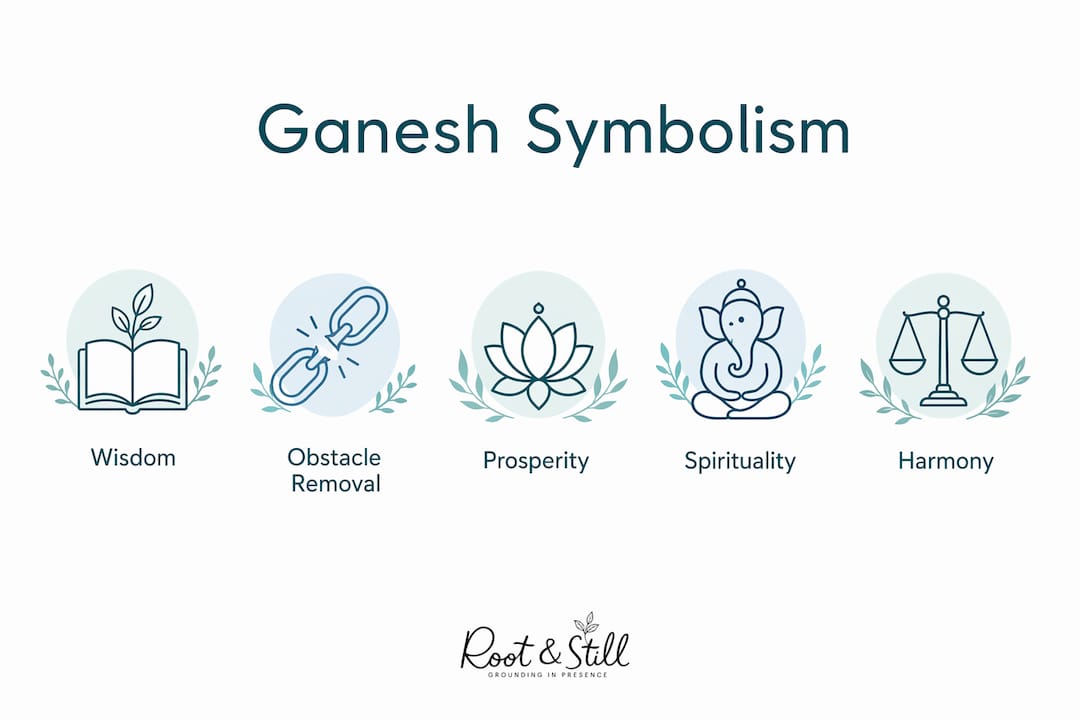
His large belly represents the capacity to hold the entire universe’s experiences without being overwhelmed. This is equanimity made visible. The mouse at his feet, his vehicle, symbolises mastery over desires and ego. A mouse is small and quick, driven by impulse. Ganesha riding it signals that the mind can govern even its most restless tendencies.
The four arms and what they carry
Ganesha’s four arms represent mind, intellect, ego, and conditioned consciousness. Each hand holds an object that teaches a specific spiritual lesson.
- The goad (ankusha) drives the mind forward, cutting through inertia.
- The noose (pasha) catches and restrains obstacles before they take hold.
- Sweets (modaka) represent the reward of spiritual effort and the sweetness of liberation.
- The broken tusk is perhaps the most layered symbol of all.
The broken tusk signifies sacrifice and the discernment to choose essential knowledge over intellectual vanity. Legend holds that Ganesha broke his own tusk to write the Mahabharata, choosing the task over his own completeness. That act teaches that true wisdom demands letting go of what no longer serves the deeper purpose.
The serpent belt represents controlled energy and the cycles of time. The crescent moon on his crown reflects the cooling, receptive quality of the mind in meditation. The third eye signals the capacity to see beyond surface appearances into deeper truth.
Trunk direction and what it means for your home
The direction of Ganesha’s trunk carries practical significance for placement. A left-turning trunk, known as Vamukha, channels calming lunar energy and is ideal for home use. Most domestic Ganesh statues carry this form precisely because it supports a nurturing, settled atmosphere. A right-turning trunk, Dakshinamukhi, channels solar energy and requires strict ritual observance. This form belongs in temples rather than living rooms.
Pro Tip: When choosing a Ganesh statue for your home, look for a left-turning trunk. It brings a gentler, more grounding energy that suits everyday domestic life without demanding the rigorous ritual care of the solar form.
How has the cultural significance of Ganesh statues evolved?
Ganesha’s origins in Vedic scripture are complex and layered. His birth stories vary across texts, but the most widely known tells of his elephant head replacing his original human one, a moment of transformation that itself symbolises the transcendence of ordinary human limitation. Over centuries, his role expanded from a deity who removes obstacles to one who embodies the full philosophy of contentment and sufficiency.
Scholar and mythologist Devdutt Pattanaik describes Ganesha as a deity who balances opposites: sky and earth, intellect and power, abundance and restraint. His image teaches not the pursuit of endless accumulation but the wisdom of consuming only what is necessary. That philosophy feels remarkably relevant today.
“Ganesh represents a balance of opposites — sky and earth, intellect and power — and his presence teaches contentment and a philosophy of consuming only what is necessary. His image embodies an ecosystem of stability and prosperity beyond material accumulation.” — Devdutt Pattanaik
Ganesh Chaturthi, celebrated in september and observed with particular warmth by diaspora communities across the UK, marks the annual homecoming of Ganesha. The festival lasts up to eleven days, during which the idol is treated as a living guest in the home. Eco-friendly Ganesh idols made from clay or seed materials have grown in popularity among urban devotees, reflecting a desire to honour both spiritual tradition and environmental responsibility. After the festival, these idols dissolve safely in water or are planted in gardens, completing a natural cycle.
What are the traditional rules for placing a Ganesh statue at home?
Placement is not incidental. The auspicious position for a Ganesh idol in the home is the northeast corner, elevated on a pedestal, facing north or east. The northeast direction is associated with divine energy and clarity of thought in Vedic tradition. Placing the idol there allows it to anchor the spiritual atmosphere of the entire space.
A few placement principles are worth knowing clearly:
- Never place a Ganesh statue directly on the floor. It must rest on a clean, elevated surface such as a shelf, altar, or pedestal.
- Face the statue north or east, never south. South-facing placement is considered inauspicious in Vedic tradition.
- Choose a left-turning trunk for domestic settings. Reserve right-turning trunk statues for spaces where you can maintain temple-level ritual care.
- Keep the area around the statue clean and free from clutter. The statue settles into its surroundings and reflects the energy of the space it occupies.
- During festivals, treat the idol as a living guest. This means maintaining a pure environment, avoiding alcohol and non-vegetarian food in the home, and never leaving the statue unattended during ritual periods.
Pro Tip: If you are placing a Ganesh statue as part of a broader spiritual décor arrangement, give it its own dedicated surface rather than grouping it with unrelated objects. A statue that has room to breathe feels more settled and commands the quiet presence it deserves.
How can a Ganesh statue enhance spiritual home décor?
A Ganesh statue functions as more than a symbol of faith. Placed thoughtfully, it anchors the mood of a room and invites a quality of attention that generic décor rarely achieves. The role of statues in interior design is well documented: they create focal points that slow the eye and settle the mind.
Ganesha’s symbolism maps naturally onto the principles of mindful living. His belly teaches equanimity. His broken tusk teaches discernment. His mouse teaches restraint. These are not abstract virtues. They are qualities that a well-placed statue quietly reinforces each time you pass it. Spiritual home décor works precisely because the objects you choose to live with shape how you feel in a space.
A few ways to integrate a Ganesh statue with care and intention:
- Place it on a natural stone or wooden surface to ground its energy visually.
- Pair it with a small oil burner or incense plate to engage the senses and mark the space as one of quiet intention.
- Avoid placing it in bathrooms or directly opposite the main entrance where it faces outward rather than inward.
- Approach the statue with cultural sensitivity, especially if you are not from a Hindu background. Appreciating the symbolism respectfully means understanding what it represents before treating it as purely aesthetic.
For those exploring spiritual home décor more broadly, Ganesha sits naturally alongside other contemplative figures and objects that bring a sense of grounded calm to living spaces. You can also find a wide range of spiritual sculptures that complement this kind of intentional décor approach.
Key takeaways
The Ganesh statue meaning is rooted in a complete philosophy of wisdom, obstacle removal, and contentment, encoded in every physical detail of the idol’s form.
| Point | Details |
|---|---|
| Ganesha as Vighnaharta | He is worshipped first before any new venture, symbolising the removal of obstacles. |
| Iconography as scripture | Each feature, from the elephant head to the broken tusk, encodes a specific spiritual teaching. |
| Trunk direction matters | A left-turning trunk suits home use; a right-turning trunk requires strict ritual observance. |
| Placement is purposeful | Position the idol in the northeast corner, elevated, facing north or east, never on the floor. |
| Cultural sensitivity in décor | Treat the statue as a living presence, not merely an object, whether during festivals or everyday life. |
Why Ganesh statues still speak to me after years of studying symbolism
— Dhriti
I have spent years looking at spiritual statues from many traditions, and Ganesha remains the one that rewards the most sustained attention. Most symbolic figures carry one or two layers of meaning. Ganesha carries dozens, and they are all internally consistent. The broken tusk alone contains an entire philosophy of sacrifice and discernment that most people walk past without noticing.
What strikes me most is how practical the symbolism is. This is not abstract theology. The mouse vehicle is a direct teaching on ego and impulse. The large belly is a direct teaching on equanimity. The goad and noose are tools for the mind. Every element has a function, and that function is to remind you, daily, of how to live with more clarity and less resistance.
I also think the placement rules deserve more respect than they typically receive. When people ask me whether it matters where they put a statue, my honest answer is yes, though perhaps not for mystical reasons alone. A statue placed with care, at eye level, in a clean and considered space, simply works better as a presence in the room. You notice it. It notices you back, in the way that good objects do.
If you are new to Ganesh and approaching him through an interest in décor or symbolism, I would encourage you to sit with the iconography before you decide where to place the statue. Read about the broken tusk. Think about what the mouse means. The statue will feel entirely different once you know what it is actually saying.
— Dhriti
Curated spiritual statues for a mindful home at Rootandstill
If the symbolism of Ganesha has deepened your appreciation for spiritually meaningful décor, Rootandstill offers a thoughtfully curated range of handcrafted statues designed to bring the same quality of presence to your home. From antique Buddha figurines to brass meditation figures, each piece is chosen for its ability to anchor a space with calm and intention. The collections at Rootandstill reflect the same philosophy that makes a Ganesh statue so enduring: that the objects you choose to live with shape the atmosphere you inhabit. Explore the full range at rootandstill.com and find the piece that feels right for your space.
FAQ
What does a Ganesh statue represent?
A Ganesh statue represents Ganesha as the remover of obstacles (Vighnaharta) and the deity of wisdom, prosperity, and auspicious beginnings. He is worshipped first before any new venture in Hindu tradition.
Which way should a Ganesh statue face at home?
A Ganesh statue should face north or east and be placed in the northeast corner of the home, elevated on a pedestal. It should never be placed directly on the floor.
What does the trunk direction mean on a Ganesh idol?
A left-turning trunk channels calming lunar energy and is ideal for home use. A right-turning trunk carries solar energy and requires strict ritual observance, making it more suited to temple settings.
What does the broken tusk of Ganesha symbolise?
The broken tusk symbolises sacrifice and the discernment to choose essential knowledge over intellectual vanity. It teaches that true wisdom requires letting go of what no longer serves a deeper purpose.
Is it culturally appropriate to use a Ganesh statue as home décor?
A Ganesh statue can be used respectfully in the home by anyone who takes time to understand its symbolism and treats it with care. Placing it thoughtfully, keeping the area clean, and appreciating its meaning honours the tradition it comes from.


