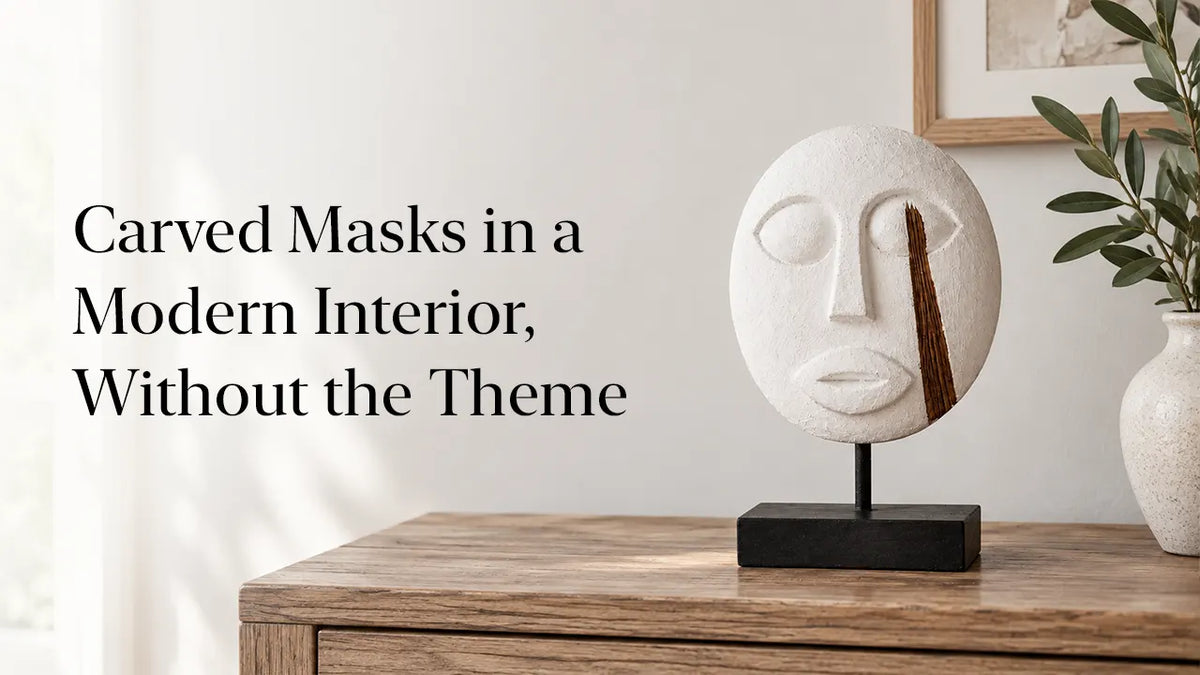
The worry people have about carved masks is that one will make a room look themed, which is a reasonable worry and an entirely avoidable outcome. It is also worth taking seriously rather than dismissing, because a room that reads as themed is genuinely harder to live with. Themes date, they narrow what else can go in the room, and they tend to feel like a decision made once rather than a space that developed. This article covers what actually creates the themed look, why a single carved object in a contemporary room does the opposite, and what to pair one with. The pieces are in our carved mask collection.
Key takeaways
| Point | Details |
|---|---|
| The mask is not what creates a theme | Quantity, matching origin and supporting props do. One carved object in a plain room is a focal point. |
| Contrast is the mechanism | A hand carved object among smooth modern surfaces reads as deliberate precisely because it differs. |
| Three props to avoid | Rattan in quantity, multiple objects from one region, and framed prints of the same place. |
| Black on pale is the most contemporary | It reads as graphic rather than ethnographic and sits comfortably beside modern furniture. |
| Photograph the wall to check | A phone photo strips away the experience of being in the room and shows what the arrangement reads as. |
What actually creates a theme
Three things, and none of them is the mask itself.
- Quantity. One carved object in a plain room is a focal point. Four is a collection, and a collection announces a subject. The moment a room has a subject other than being a room, it reads as themed.
- Matching origin. A mask, a carved elephant, a wooden bowl and a batik cushion all from one region reads as a display about that region rather than as a home containing objects.
- Supporting props. The moment you add rattan, a palm print and a bamboo frame around it, the mask stops being an object in a room and becomes scenery.
Notice that all three are about what surrounds the object rather than about the object. This is why the same mask can look considered in one room and themed in another with nothing about the piece having changed.
Why a single carved object works in a contemporary room
Contrast does the work.
A modern British interior is mostly smooth surfaces. Painted plaster, engineered flooring, plain upholstery, glass, powder coated metal. All of it is manufactured to be uniform, and uniformity is what makes it read as contemporary.
Put a hand carved object into that and the difference is the point. Tool marks, irregular edges and visible grain read as deliberate precisely because everything around them is not like that. The eye registers it as chosen rather than matched.
Add three more carved objects and the contrast disappears, because now the room contains a category rather than an exception. This is the mechanism behind the rule, and it is why quantity matters so much more than the individual piece.

What to pair it with
Four things that support a carved object in a modern room, and all of them work by staying out of the way.
| What | Why it works |
|---|---|
| Plain modern surfaces | Painted wall, simple console, plaster, concrete, glass. Nothing competing texturally |
| One ordinary houseplant | Green sits with carved wood and reads contemporary, provided it is not a palm |
| Books | Nothing says lived in rather than styled quite as reliably |
| Modern lighting | A contemporary lamp beside a carved mask is better than a traditional one, because the contrast is the point |
The plant point deserves expanding. A monstera, a rubber plant or a fig reads as a normal houseplant in a British room. A palm, a bird of paradise or anything with an obviously tropical silhouette pushes the whole arrangement toward a look, which is the opposite of what you want.
On the lighting, resist the instinct to match. People frequently pair a carved object with a traditional or ethnic looking lamp, which doubles down on the theme. A plain modern lamp is the better choice and it will also light the piece properly. Our guide to lighting a carved mask covers the angle.
What to avoid
The list is short and specific.
Rattan and wicker in quantity, which pushes everything toward a look faster than anything else in a British room. One rattan item is fine. Three is a theme.
Multiple carved objects from the same tradition on the same wall or surface. Our article on grouping covers why faces in particular compete.
Framed prints of the region the mask came from, which is set dressing rather than decoration and reads as such immediately.
Anything else with a face nearby, for the perceptual reasons covered elsewhere in this series.

Which finish reads most contemporary
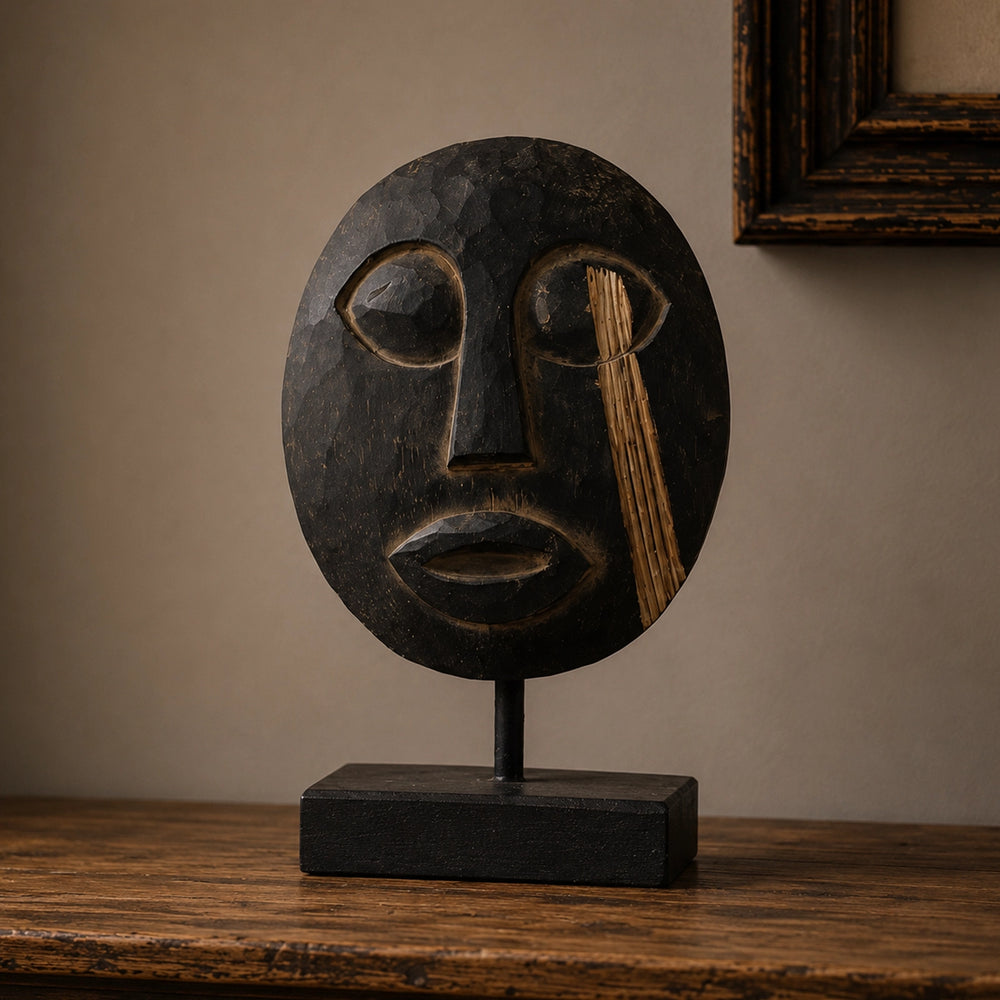
The black finish mask against a white or pale grey wall is the most contemporary combination available in this range. It reads as graphic rather than ethnographic, which is exactly the shift you want in a modern room, and it sits comfortably beside modern furniture in a way a warmer finish does not.
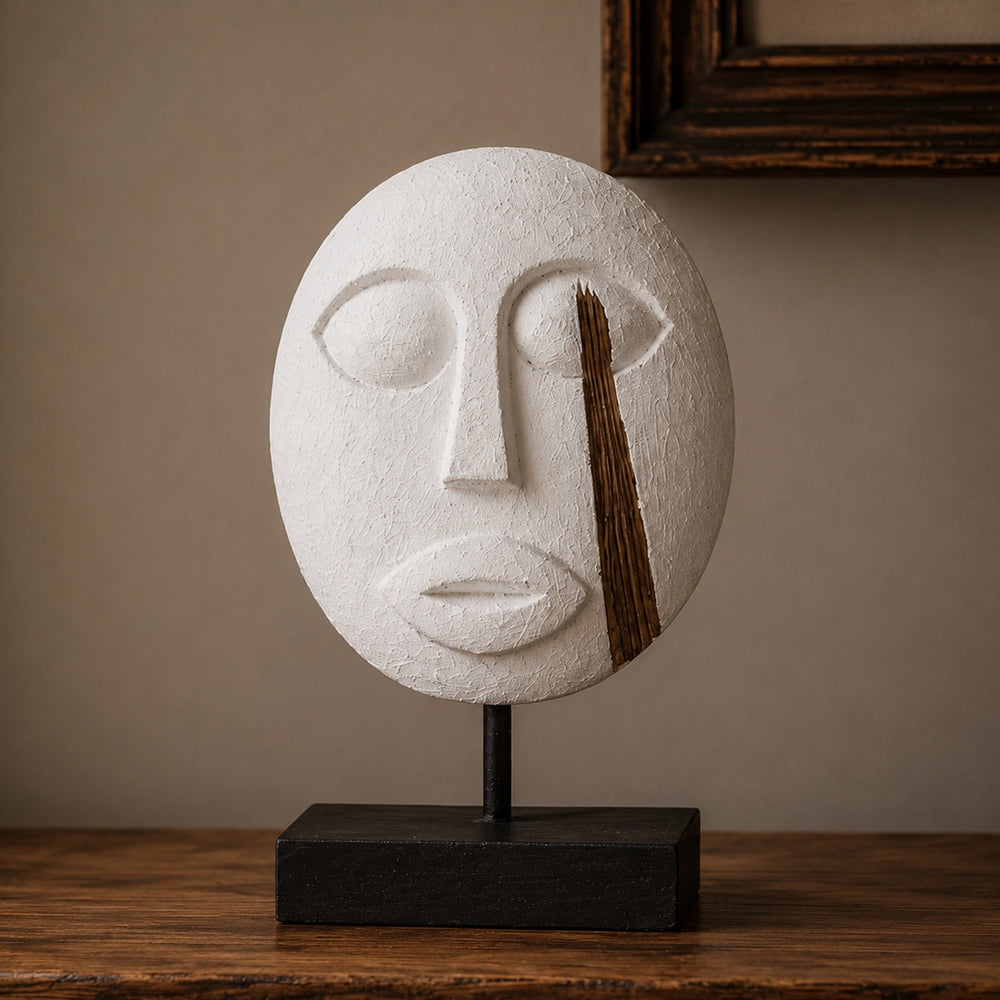
The white finish mask against a deep colour does something similar in reverse, and it suits a room with a dark feature wall. It also shows the carving most clearly, which is worth having if the piece is good.
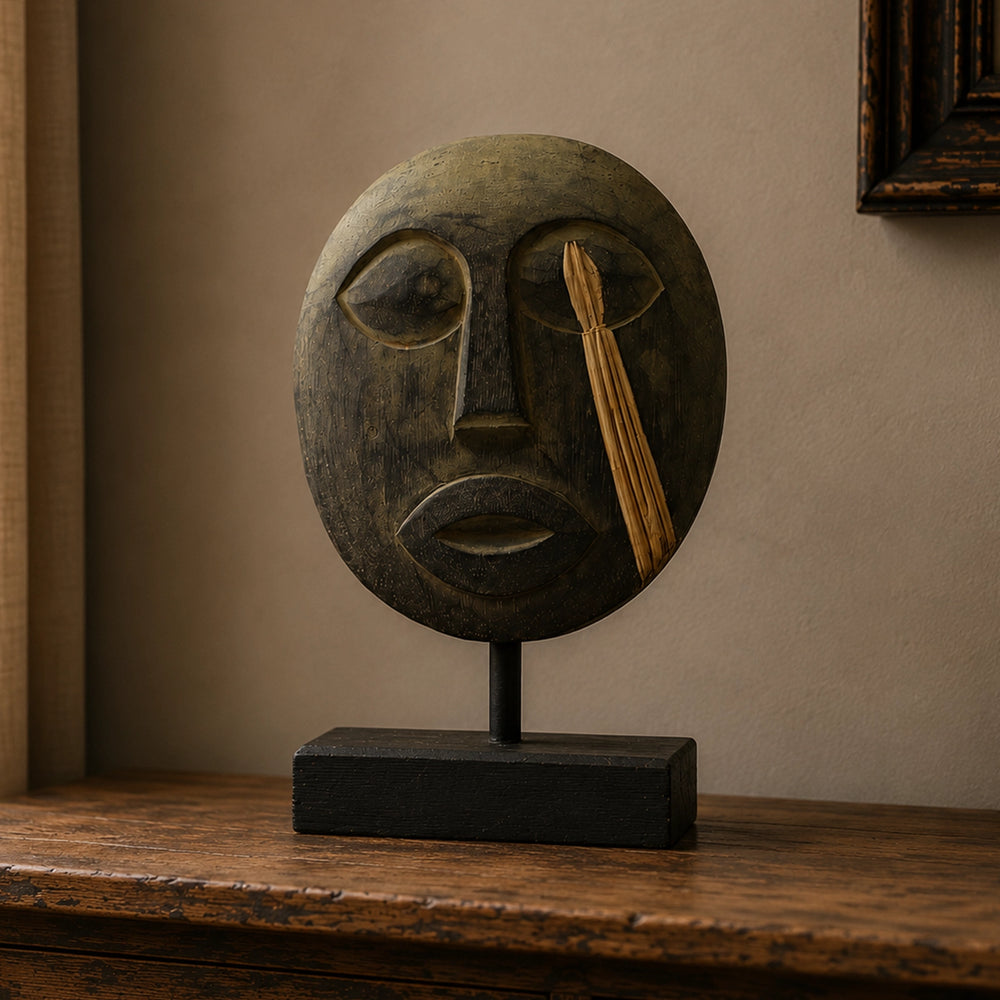
The antique finish mask is the most traditional reading of the three. That makes it the safest choice in a period house with original features and the least contemporary in a new build or a converted flat.
The photograph test
Take a photograph of the wall with the mask in place and look at it on a phone.
This works because a photograph strips away the experience of being in the room. You lose the sound, the light changing through the day and your familiarity with the space, and what you are left with is the composition on its own.
If the picture looks like a room that happens to contain a carved mask, the arrangement is working. If it looks like a display, remove something. In almost every case what needs removing is a supporting prop rather than the mask.
Do the same test again after a fortnight, because the eye adjusts to a new arrangement quickly and a photograph is more honest than memory.
Bring that calm into your home with Rootandstill
Our carved mask collection carries three finishes at 27 by 20cm and £32.99, carved in solid timber with the detail cut into the surface rather than applied.
For a contemporary room, the black finish mask against a pale wall is the most graphic combination and the one that reads least as ethnographic. The white finish mask suits a dark feature wall. The antique finish mask works best in a period property with original features.
If you want carved presence without a face in the room, our hand carved statue collection covers pieces that sit on surfaces and floors, and a large antique brass Buddha head gives you weight and craft in a smaller object that will not compete for attention.
FAQ
Will a carved mask make my room look themed?
Only if you add supporting props. One carved object on a plain wall in a contemporary room reads as a focal point, because the contrast with smooth modern surfaces is what makes it look chosen.
What creates the themed look?
Quantity, several objects sharing one origin, and props such as rattan, palm prints and bamboo frames. None of it is the mask itself.
What should I put with a mask in a modern room?
Plain surfaces, one ordinary houseplant rather than a palm, books, and contemporary lighting. The contrast between carved and smooth is what makes it work.
Which mask finish is most contemporary?
Black against a white or pale grey wall, which reads as graphic rather than ethnographic and sits comfortably beside modern furniture.
How do I check the arrangement is working?
Photograph the wall and look at it on a phone. If it reads as a room it works. If it reads as a display, remove a supporting prop rather than the mask.